Google paid $32B for a company doing roughly $1B in ARR. That's a 30x revenue multiple — a number that makes any traditional financial analyst flinch.
But Google didn't buy Wiz on a revenue multiple. They bought it to protect $200B+ in annual cloud revenue from being blocked by a security gap that enterprises used as a reason to stay on AWS and Azure. The $32B was the cost of not losing a much larger prize — not the discounted present value of Wiz's future cash flows.
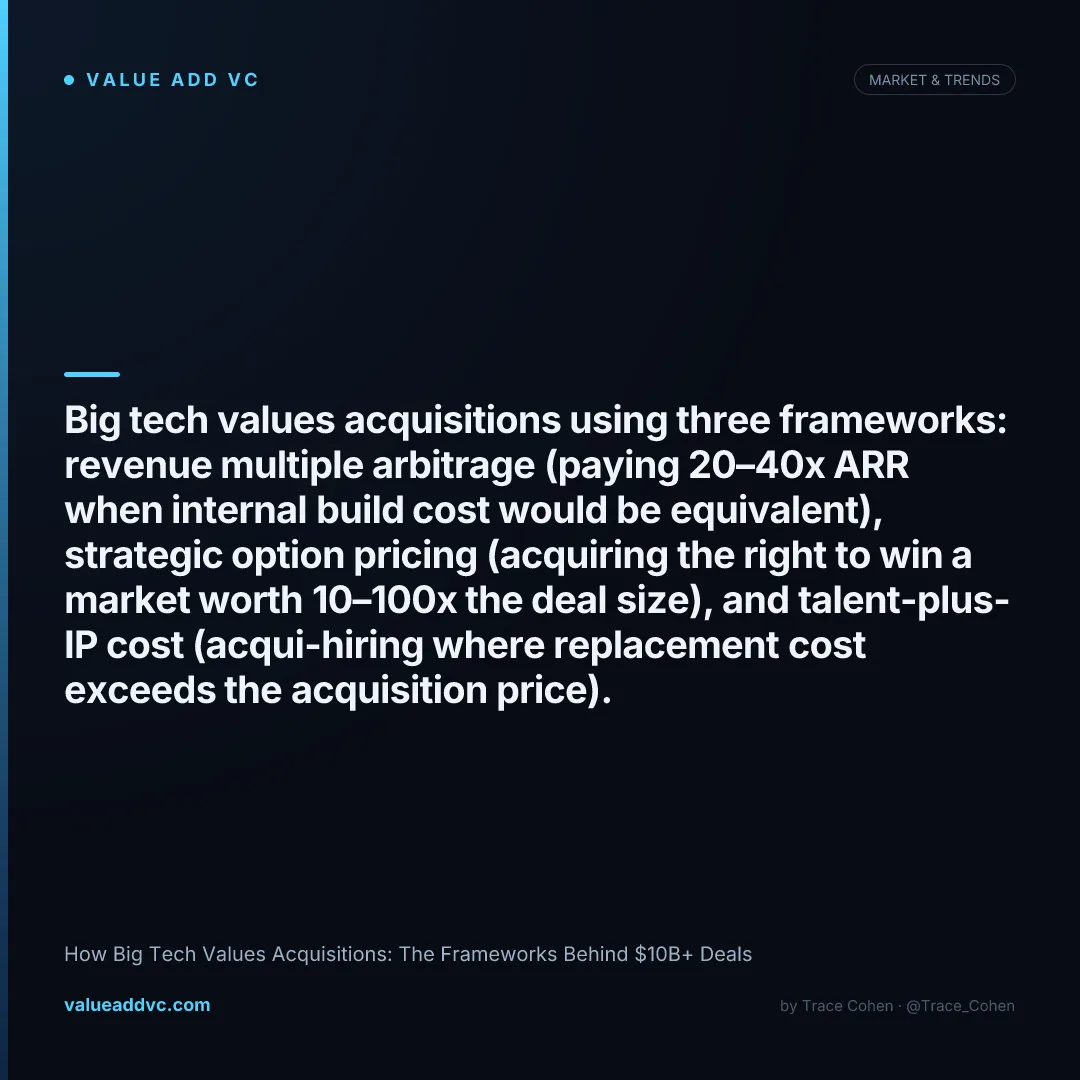
This is how big tech values acquisitions. Not DCF. Not EBITDA multiples. Three frameworks, each applied depending on what the deal actually is — and the strategic-option framework scales down too, as in OpenAI's much smaller buy of media property TBPN.
The Three Frameworks Big Tech Uses to Price Deals
Revenue Multiple Arbitrage
Used when the target is already generating meaningful ARR and the acquirer believes they can 10x distribution. The math: if it would take 3–5 years to build an equivalent product internally — spending $500M in R&D and $300M in sales — paying $800M for a company with $50M ARR at 16x is breakeven economics, not a premium.
Real Example
Microsoft's $7.5B GitHub acquisition (2018): GitHub had ~$200M ARR. Microsoft paid ~37x. But GitHub accelerated Azure developer adoption by hundreds of millions in annual cloud spend within two years. The distribution arbitrage made the multiple irrelevant.
Strategic Option Pricing
Used when the target gives the acquirer a call option on a market that doesn't exist yet at scale. The acquirer isn't buying current revenue — they're buying the right to participate in (or block competition from) a market worth 10–100x the deal price. This is the framework behind most of the biggest checks.
Real Example
Meta's $19B WhatsApp acquisition (2014): WhatsApp had ~$20M in revenue and 450M users. Meta was pricing the option on owning messaging globally before Google, Apple, or Tencent could. That option was worth $19B — messaging was going to be a $100B+ advertising and payments platform.
Talent + IP Cost
Used for acqui-hires and technology consolidation. The math is simple: recruiting 50 senior ML engineers at $500K total comp each takes 18 months and $25M in recruiting fees — plus equity dilution, relocation, and the time-to-productivity lag. Paying $75M to acquire a 20-person AI lab with a coherent team and proprietary model weights is cheaper and faster.
Real Example
Apple's acquisition of PrimeSense (2013, ~$350M): They bought 3D sensing expertise they couldn't hire fast enough. That team became the foundation of Face ID — a $15B+ feature in terms of iPhone differentiation and the premium pricing it enables.
How Big Tech Values Acquisitions: The Multiple Ladder
Not every deal is a Wiz. The multiple paid correlates tightly with strategic tier — and most of the largest deals in history sit in the top tier.
| Deal Type | Typical Multiple | Primary Driver | Example |
|---|---|---|---|
| Acqui-hire | $1–5M / engineer | Team cost replacement | Dozens annually |
| Feature acquisition | 3–8x ARR | Product gap fill | Slack → LinkedIn ($26B at 26x was an exception) |
| Platform expansion | 8–20x ARR | Distribution leverage | GitHub ($7.5B, ~37x) |
| Category ownership | 20–35x ARR | Market foreclosure | Wiz ($32B, ~30–35x) |
| Pre-revenue strategic | No revenue cap | Option pricing on future market | WhatsApp ($19B), Instagram ($1B) |
Media M&A runs on a different logic than software roll-ups: Skydance Corporation's roughly $110 billion acquisition of Warner Bros. Discovery, which closed October 6, 2026, was priced as an enterprise value against content-library scale and distribution leverage, not an ARR multiple — the same strategic-option logic behind WhatsApp and Instagram, applied to IP instead of users.
Stripe's reported $8 billion-plus deal for OpenRouter in August 2026 is a fresh example of the pre-revenue-strategic tier in action — OpenRouter had raised just $150 million total, but its position as the neutral routing layer across 400-plus AI models made it worth roughly 6x its $1.3 billion valuation from three months earlier.
The Defensive Premium: Why Blocking a Competitor Is Worth 2–3x
The single biggest multiplier on any acquisition is whether a competitor acquiring the same asset would be materially damaging. When the answer is yes, the effective price cap becomes "what would it cost us if our competitor owned this?" — not "what's this company worth on a standalone basis?"
Google → Wiz ($32B)
If Microsoft bought Wiz, it would have the dominant cloud security platform wired into Azure AD and Defender — making GCP a security liability vs. asset.
Standalone
~$10–12B at fair SaaS multiples
Defensive
$25–35B
Microsoft → Activision ($69B)
If Sony acquired Activision (rumored), Call of Duty goes PlayStation-exclusive — potentially ending Xbox's competitive relevance in console gaming.
Standalone
~$40–45B on gaming revenue
Defensive
$65–75B
Meta → Instagram ($1B, 2012)
Instagram was growing faster than Facebook in photo sharing. Google was circling. At $1B, it was the cheapest option foreclosure in history.
Standalone
$300–500M at the time
Defensive
$1–3B
Apple → PA Semi ($278M, 2008)
Apple was entirely dependent on Intel and ARM licensees for chips. Building in-house capability meant competitors couldn't replicate the iPhone's power/performance ratio.
Standalone
~$100–150M standalone
Defensive
$250–300M
The Internal Build Cost Benchmark
Every serious acquirer runs a "build vs. buy" model before submitting a bid. The model inputs are almost never just engineering cost — they include time-to-market drag, the opportunity cost of diverting internal teams, and the probabilistic risk of the build failing or being too late.
Modern cloud security platform (Wiz equivalent)
Build Cost
$2–3B over 4–5 years
Build Success Probability
40% of reaching parity
Acquisition Price
$32B
Consumer messaging at global scale (WhatsApp)
Build Cost
$500M over 3 years
Build Success Probability
10% of reaching network effect
Acquisition Price
$19B
Developer platform with OSS community (GitHub)
Build Cost
$300–400M over 2–3 years
Build Success Probability
20% of reaching adoption
Acquisition Price
$7.5B
Enterprise CRM with vertical depth (LinkedIn)
Build Cost
$1–2B over 3–5 years
Build Success Probability
5% of reaching professional network
Acquisition Price
$26B
When you probability-weight the internal build — a 40% chance of spending $2.5B over 5 years means an expected build cost of ~$1B — and add the 3–5 years of competitive disadvantage during the build, the acquisition price often looks rational even at seemingly extreme multiples.
What This Means If You're Building to Be Acquired
Founders building with M&A as a potential outcome should understand which acquisition framework they're most likely to be valued under — because it determines both your ideal buyer and your positioning strategy.
Revenue Multiple Arbitrage
Build ARR the acquirer can 10x
Land in an acquirer's ecosystem as a complementary product with clear distribution leverage — not a competitor
Valuation ceiling: 5–20x ARR
Strategic Option Value
Own a market position the acquirer needs
Build genuine network effects or data moats that make you the only viable entry point into a market the acquirer cares about
Valuation ceiling: No ceiling — limited by the market you represent
Talent + IP Cost
Build an irreplaceable team
Concentrate technical expertise — 15 world-class researchers in a narrow domain are worth more than 100 generalists. The moat is the team, not the product.
Valuation ceiling: $1–10M per engineer depending on domain
The Regulatory Discount in 2026
Post-FTC vs. Meta (Instagram/WhatsApp) and the blocked Adobe-Figma deal ($20B in 2022), big tech acquirers are now pricing regulatory risk into every bid. A $15B acquisition with a 30% regulatory block probability has an expected value of ~$10.5B — which either means the offer price rises to compensate, or a deal doesn't happen. That live tension between active antitrust litigation and a record pace of megadeals is exactly what's shaping this year's tech M&A boom.
High Regulatory Risk (2026)
- • Any deal that gives Big 5 >50% market share in a defined category
- • Acquisitions of companies that have filed to compete with the acquirer
- • Cross-platform data consolidation (messaging + social + payments)
- • Defense tech acquisitions requiring CFIUS review
Lower Regulatory Risk (2026)
- • Vertical acquisitions outside acquirer's existing market
- • Talent-only acqui-hires under $500M
- • International acquisitions in non-US-dominant markets
- • Enterprise B2B deals without consumer data overlap
Big tech acquisition pricing is not irrational.
It's priced on what it costs not to own the asset — which has no ceiling when the market at stake is large enough.
Track active M&A trends and AI company valuations on the AI Valuations Dashboard and the Corp Dev Dashboard at Value Add VC. For the full picture of how 2026's tech M&A boom compares deal-by-deal to prior years, see our complete breakdown.
Latest from the Pulse
Get VC data most people never see
— free to subscribe
Trace's notes on venture, AI and startups, a few times a week. Join 5,000+ subscribers. No spam.
No spam, unsubscribe anytime. Sent via Substack · Privacy · or subscribe on Substack ↗