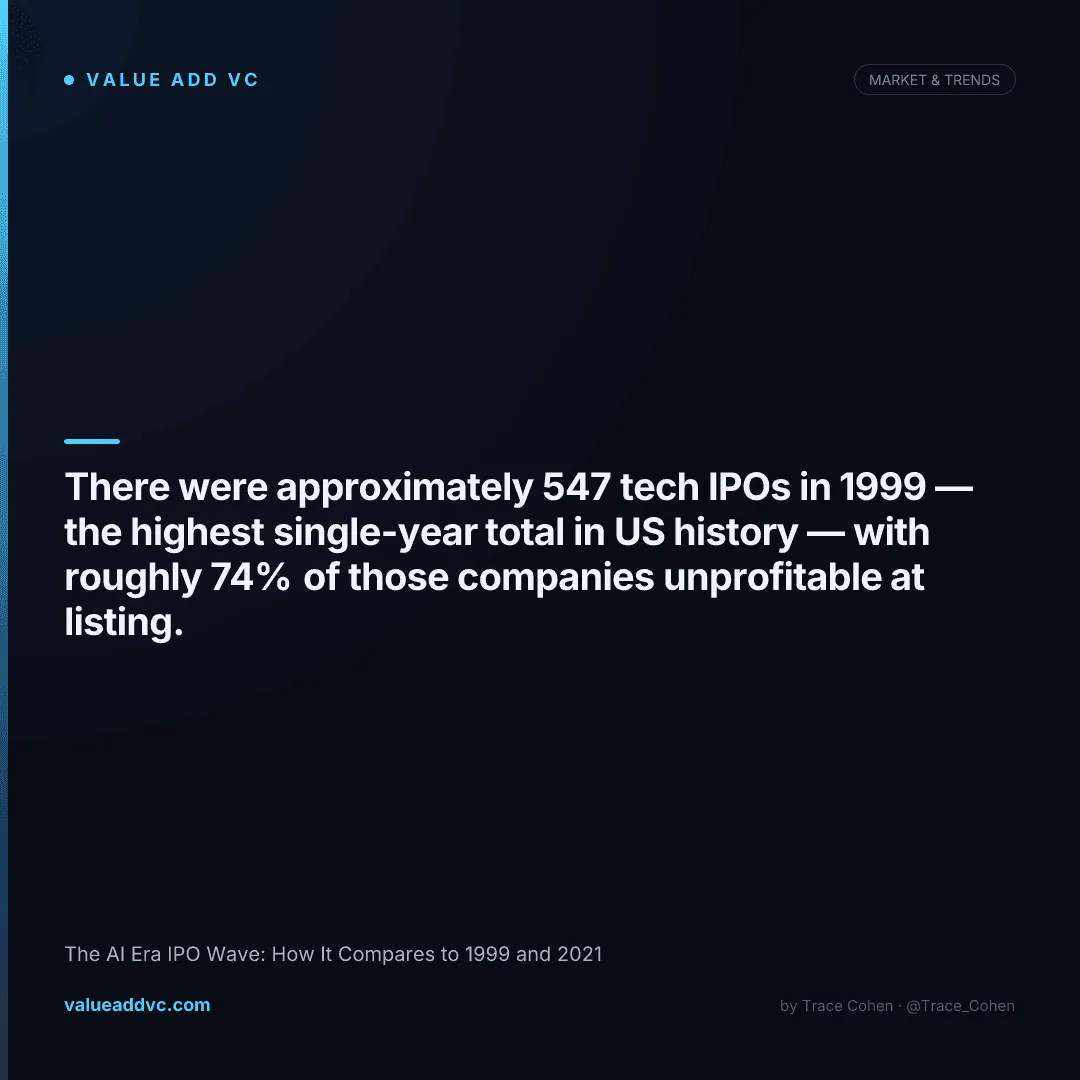
The number of tech IPOs in 1999 — 370, by Jay Ritter's count — remains the most of any year since 1980. No year since has matched it, and the AI era is not on pace to challenge it.
That figure comes from the University of Florida's IPO statistics maintained by Jay Ritter (Table 4b), the standard academic dataset for US IPOs. The runner-up year, 1996, had 276. Everyone comparing AI to the dot-com bubble is measuring the wrong variable. The 1999 IPO machine was defined by quantity: companies with thin revenue and no profits going public because capital was cheap and belief was unlimited. We break down the full pipeline in our biggest IPOs of 2026 guide. The 2026 AI IPO window is defined by selectivity: fewer deals, higher revenue at listing, and institutional buyers who lived through what happened next.
The honest comparison requires looking at all three eras: 1999, 2021, and now. Each had a different mechanism. Each produced a different kind of bubble or correction. The AI era has elements of both — and a few things neither had.
The 1999 Dot-Com IPO Machine: Volume Without Discipline
In 1999, 370 technology companies went public in the US, out of 476 operating-company IPOs, according to Ritter's data. That number is almost incomprehensible by today's standards. For context, Ritter counts 54, 73 and 90 operating-company IPOs across all sectors in 2023, 2024 and 2025 — an average of about 72 a year ((54 + 73 + 90) ÷ 3).
The 1999 tech cohort was defined by a few brutal facts: only 14% were profitable at listing, so 86% were not. Tech IPOs averaged an 86.7% first-day return, and VA Linux Systems surged 698% on day one in December 1999, a record at the time. Then the bill came due: the average 1999 IPO returned −47.6% over the three years after its first close, and the Nasdaq lost 78.4% from its March 2000 peak to its 2002 low.
| Metric | 1999 | 2021 | 2024 / 2025 |
|---|---|---|---|
| US tech IPOs | 370 | 121 (plus 613 SPAC IPOs) | 14 / 31 |
| Tech IPOs unprofitable at listing | 86% | 79% | 79% / 74% |
| Median tech IPO sales (2022 $) | $20.7M | $202.4M | $198.7M / $120.5M |
| Avg tech first-day return | 86.7% | 33.0% (SPACs: 1.9%) | 41.1% / 33.4% |
| Avg 3-yr return, all IPOs (from first close) | −47.6% | −49.1% | Too early |
| Dominant narrative | Internet changes everything | Zero rates, blank checks | AI infrastructure + revenue |
Source: Jay Ritter, University of Florida IPO statistics — Tables 4b (counts, profitability, median sales), 4h (first-day returns), 15b (SPACs) and 19 (three-year returns). Unprofitable share = 100% minus Ritter's profitable share. Ritter excludes SPACs, penny stocks, ADRs, units, REITs and closed-end funds from operating-company counts.
The 2021 SPAC Bubble: Quantity by Different Means
The 2021 SPAC wave was the dot-com boom's spiritual successor, executed with a different financial instrument. In 2021, 613 SPACs went public and raised $144.5B excluding overallotments, per Ritter's Table 15b — more than the 466 SPAC IPOs of the previous ten years (2011–2020) combined. The mechanism was clever: raise cash in a trust, find a merger target, avoid the traditional IPO process. The result was approximately the same: companies that should not have been public became public.
By early 2023, investors were pulling their cash before deals closed: 95% of trust capital was redeemed on deals completed in March 2023. SPAC IPOs fell from 613 in 2021 to 31 in 2023, a 95% drop (1 − 31 ÷ 613). Lucid Motors' SPAC merger was announced at a pro forma equity value of about $24B. WeWork, which listed via SPAC in 2021, had lost about 98% of its value by the time it filed for Chapter 11 in November 2023.
The 2021 era added a new failure mode the dot-com era didn't have: the projection problem. SPAC mergers leaned on multi-year revenue forecasts that traditional IPO prospectuses avoid. Many targets looked like they were on their way to $1B in revenue. Most were not. In January 2024 the SEC adopted rules that made the PSLRA safe harbor for forward-looking statements unavailable to SPACs and required more disclosure behind projections. The vehicle did not die, though: Ritter counts 144 SPAC IPOs in 2025, up from 31 in 2023.
What Makes the AI Era IPO Wave Different
The number of tech IPOs in 1999 was driven by near-zero friction: underwriters would take almost anything, retail investors would buy almost anything, and institutional buyers were afraid of missing out. Those conditions do not describe today's market.
The 2024–2026 IPO class clears a higher revenue bar, though not a higher profit bar. Reddit, which went public in March 2024, had $804M in 2023 revenue and a $90.8M net loss. CoreWeave, the AI cloud company, had $1.92B in 2024 revenue and an $863M net loss before its March 2025 IPO, priced at a valuation closer to $19B. Klarna, long billed as a 2026 candidate, priced at $40 in September 2025 at about a $15B valuation, after a $53M net loss on $823M of revenue in Q2 2025. Cerebras was the exception: it reported $88M of net income on $510M of 2025 revenue before its May 2026 listing.
Revenue threshold rising
Median pre-IPO sales for tech IPOs were $198.7M in 2024 and $120.5M in 2025, versus $20.7M in 1999 (2022 dollars) — about 10x and 6x higher ($198.7M ÷ $20.7M; $120.5M ÷ $20.7M).
Profitability is still rare
Only 21% of 2024 tech IPOs and 26% of 2025 tech IPOs were profitable at listing, versus 14% in 1999. Revenue scale has improved far more than earnings.
Smaller pipeline, longer wait
Ritter counts 90 operating-company IPOs in 2025 across all sectors, versus 476 in 1999. Large private companies can raise huge private rounds, so many are waiting for the right window rather than needing one — track them on the Tech IPO Dashboard.
AI infrastructure is real
Nvidia near $5.7T in market cap (mid-May 2026), CoreWeave priced near $19B in March 2025, Cerebras valued near $95B after its May 2026 debut — and Alphabet, Microsoft, Meta and Amazon were expected to spend nearly $700B combined on 2026 capex.
Sources: Ritter Tables 4 and 4b; Nvidia market cap per CNBC, May 15, 2026; Cerebras per CNBC, May 14, 2026; 2026 capex per CNBC, Feb. 6, 2026.
The AI IPO Pipeline: Who's Listed and Who's Coming
Several of the companies once billed as 2026 IPO candidates are already public, and the AI-era listings span a range of sectors — not just pure AI. What they share is real revenue at meaningful scale. Check the Tech IPO Dashboard for live tracking.
Listed on Nasdaq March 28, 2025 at $40 and closed flat; $1.92B 2024 revenue, $863M net loss
Listed on Nasdaq June 12, 2025 at $27; closed at $37.11 (+37%, ~$13.5B market cap), below its $25B 2021 private valuation
Listed on NYSE September 10, 2025 at $40; closed at $45.82 (+15%, ~$17.3B); Q2 2025 net loss of $53M on $823M revenue
Listed on Nasdaq May 14, 2026 at $185, raising $5.55B; closed at $311.07 (+68%); $510M 2025 revenue, $88M net income
Public IPO prospectus filed May 20, 2026; plans to list on Nasdaq as SPCX
$122B round closed March 31, 2026; preparing a confidential IPO filing per CNBC
$65B Series H at $965B (May 28, 2026); IPO preparation underway, timing fluid per CNBC
Sources: CNBC on CoreWeave, Chime, Klarna, Cerebras, SpaceX, OpenAI and Anthropic. Valuations at pricing are as reported by CNBC and are not current market caps.
The One Risk the Data Can't Capture
The argument that the AI era is different from 1999 is compelling — and true, structurally. But that's exactly what people said in 2000 after the NASDAQ peaked, and in 2022 after the rate environment reversed. The companies going public today are real businesses. The question is whether the valuations attached to the pipeline companies — OpenAI at $852B (CNBC, March 31, 2026), Anthropic at $965B (CNBC, May 28, 2026), and SpaceX, which filed to list on Nasdaq on May 20, 2026 after a $1.25T merger valuation — are sustainable if the AI capex supercycle slows.
The companies in the AI IPO queue are not 1999-era shells. For a closer look at what VC-backed IPO returns actually look like historically, see our data breakdown. But the private-market multiples baked into the pipeline are steep: Anthropic's $965B valuation is about 20x its reported $47B revenue run rate ($965B ÷ $47B), and OpenAI's $852B is about 35x the $24B annualized pace implied by the $2B of monthly revenue it reported in March 2026 ($852B ÷ ($2B × 12)). Those prices assume AI becomes infrastructure at cloud scale. If it does, these valuations may look reasonable in 10 years. If it doesn't, the correction could be faster and steeper than either 2000 or 2022.
The number of tech IPOs in 1999 was 370. In 2025, it was 31.
Fewer listings. Higher revenue. Same question: are the valuations real?
Track the full AI-era IPO pipeline on the Tech IPO Dashboard and IPO Pipeline at Value Add VC. Originally published in the Trace Cohen newsletter.
Latest from the Pulse
Get VC data most people never see
— free to subscribe
Trace's notes on venture, AI and startups, a few times a week. Join 5,000+ subscribers. No spam.
No spam, unsubscribe anytime. Sent via Substack · Privacy · or subscribe on Substack ↗