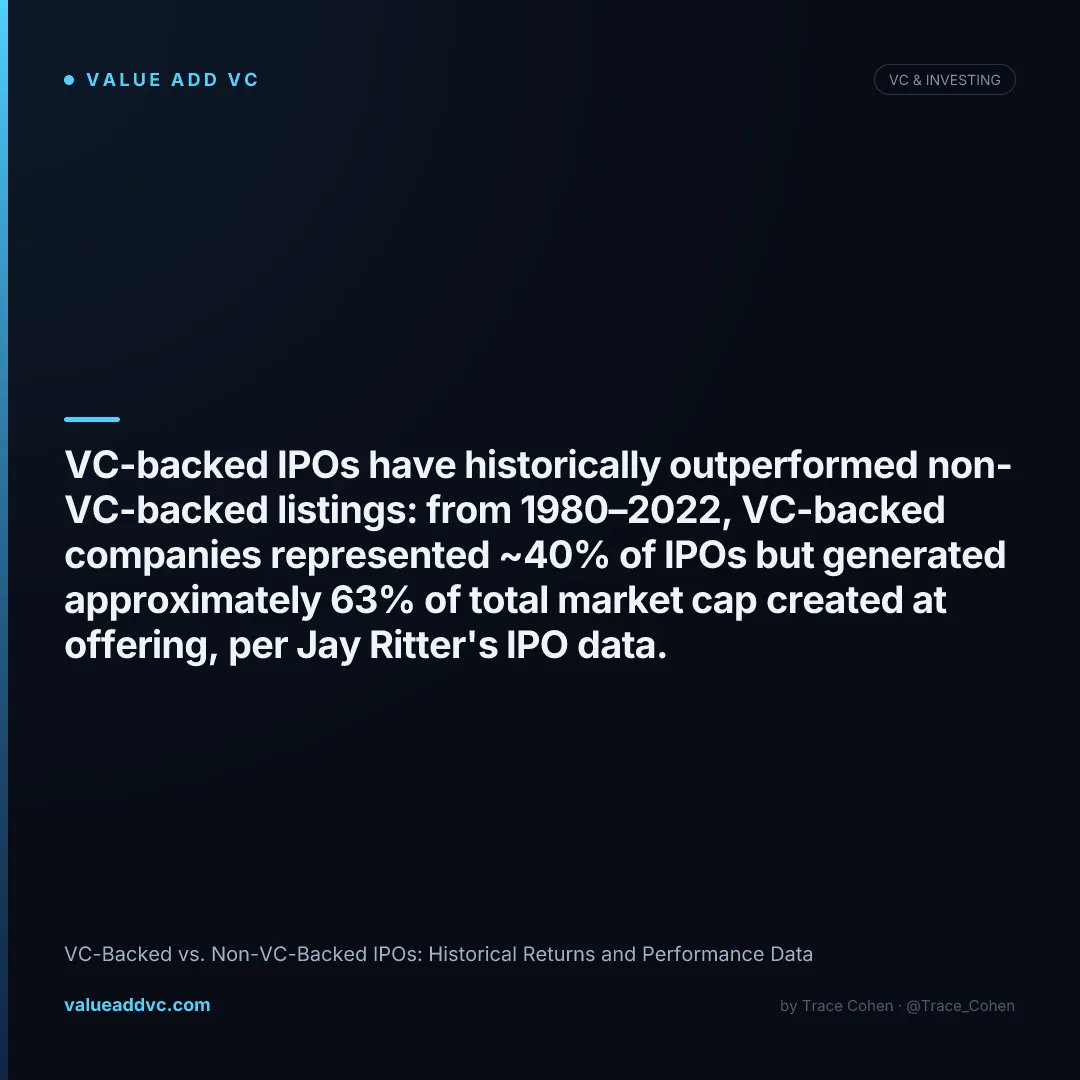
VC-backed IPOs are not just more common in tech — they dominate the total value created at the public market gate. The data is clearer than most people realize.
From 1980 through 2022, venture-backed companies represented roughly 40% of all US IPOs by count but accounted for approximately 63% of total market capitalization created at the offering price — a disproportionate share driven by a small number of transformative outliers, per Jay Ritter's IPO data. The challenge, for both LP investors and public market buyers, is that the distribution is wildly skewed.
VC-Backed IPOs vs. Non-VC-Backed: The Headline Numbers
The comparison between VC-backed and non-VC-backed IPOs covers three distinct windows: at offering, first-day pop, and multi-year post-IPO performance. Each tells a different story.
| Metric | VC-Backed IPOs | Non-VC-Backed IPOs |
|---|---|---|
| Share of all US IPOs (1980–2022) | ~40% | ~60% |
| Share of total market cap at offering | ~63% | ~37% |
| Avg. first-day return | 20–25% | 10–15% |
| Median 3-year post-IPO vs. S&P 500 | -5% to +8% | -10% to +3% |
| % trading below offer price at 5 years | ~45% | ~55% |
| Top decile 5-year return | 800%+ | 250%+ |
Sources: Jay Ritter IPO data (University of Florida), NVCA Yearbook, PitchBook. Ranges reflect equally-weighted medians.
Why VC-Backed IPOs Generate More Market Cap at Offering
The math on why VC-backed companies represent a disproportionate share of IPO market cap is not complicated. VC backing selects for high-growth sectors (software, biotech, semiconductors, fintech) where valuations are multiples-based rather than earnings-based. A SaaS company growing 50% YoY will list at 15–20x revenue; a mature manufacturing business growing 5% YoY will list at 1–2x revenue.
Sector concentration in tech/biotech
VC systematically deploys into sectors with the highest revenue multiples at IPO — software, AI, and biopharma dominate VC-backed listings.
Longer private gestation period
VC-backed companies typically go public after 10–12 years of private growth, arriving with more developed revenue profiles than non-VC-backed peers.
Blue-chip underwriter access
Goldman, Morgan Stanley, JPMorgan, and BofA handle a disproportionate share of VC-backed IPOs — their bookbuilding process supports higher pricing.
Institutional investor pre-marketing
VC networks give companies warm introductions to Fidelity, T. Rowe, and other cornerstone accounts before the S-1 drops, improving price discovery.
The Post-IPO Performance Problem With VC-Backed Companies
Here is where the narrative gets complicated. The same factors that drive large first-day pops — high growth multiples, investor enthusiasm, blue-chip syndication — also create the conditions for post-IPO underperformance.
When a company goes public at 25x forward revenue and then grows into a 15x company (the typical multiple compression for maturing SaaS), the stock falls 40% even if revenue is up 80% in that same window. This is the lockup expiry trap: VC-backed companies often price at peak enthusiasm, VCs and insiders sell at lockup expiry (90–180 days), and public investors absorb the supply.
1999–2001 Dot-Com IPO Class
~74% of VC-backed tech IPOs lost 80%+ of value within 3 years. A handful (Amazon, Priceline) recovered to generate 1000x+ returns.
2019–2021 VC-Backed IPO Cohort
Median VC-backed IPO from 2021 is down ~45% from IPO price as of early 2026, per Ritter data. Best performers: Snowflake (recovered), Duolingo, Monday.com.
2004–2007 Pre-GFC Vintage
Relatively benign environment — median VC-backed IPO outperformed S&P 500 by ~3% annually over 5 years. Google (2004) and Salesforce (2004) drive most of the alpha.
2010–2015 Vintage (SaaS era)
Best cohort for public investors: Workday, ServiceNow, HubSpot, and Veeva listed at reasonable multiples and have compounded at 25%+ annually through 2025.
What the VC-Backed IPO Data Means for the 2026 IPO Pipeline
The 2026 IPO pipeline is heavily VC-backed: Klarna (Sequoia, SoftBank), Chime (Sequoia, SoftBank), ServiceTitan (Battery Ventures, ICONIQ), and Cerebras (Benchmark, Foundation Capital) are among the most anticipated listings. The question every institutional buyer is asking is the same one that burned buyers in 2021: are we pricing in peak-cycle enthusiasm or sustainable unit economics?
The VC performance data tells a more nuanced story than most fund pitches suggest. Top-quartile VC funds from 2010–2015 vintage are showing 3.5–5x TVPI on IPO exits, but those exits are highly concentrated in 2–3 names per fund. The median VC-backed IPO still underperforms the S&P 500 on a 5-year equally-weighted basis.
How to Think About VC-Backed IPOs as a Public Investor
The most important variable is not whether a company is VC-backed — it's whether the IPO price reflects the same growth expectations already baked in by the private market. VC-backed companies often arrive at the public gate with valuations that leave limited upside unless growth dramatically accelerates.
Signals That Favor Buying at IPO
- ✓ IPO price at or below last private round valuation
- ✓ NRR above 120% with positive FCF trends
- ✓ Insiders retaining significant ownership post-lock
- ✓ Reasonable multiple vs. public comparables (not a 50%+ premium)
- ✓ TAM with room to grow beyond current revenue
Signals That Should Give Pause
- ✕ IPO at 30–50% premium to last private round
- ✕ Revenue growth decelerating YoY into the IPO
- ✕ VCs and insiders selling heavy blocks at offering
- ✕ Multiple expansion required for the stock to work
- ✕ Large secondary market selling pressure pre-IPO
VC-backed IPOs create more value at the public gate — but the public investor captures only a fraction of it.
The real VC IPO return accrues to the fund. Public investors get the multiple compression.
Track the full 2026 IPO pipeline and VC fund performance benchmarks on the Value Add VC dashboards. IPO data sources: Jay Ritter (University of Florida IPO Data), NVCA Yearbook 2024, PitchBook.
Latest from the Pulse
Get VC data most people never see
— free to subscribe
Trace's notes on venture, AI and startups, a few times a week. Join 5,000+ subscribers. No spam.
No spam, unsubscribe anytime. Sent via Substack · Privacy · or subscribe on Substack ↗