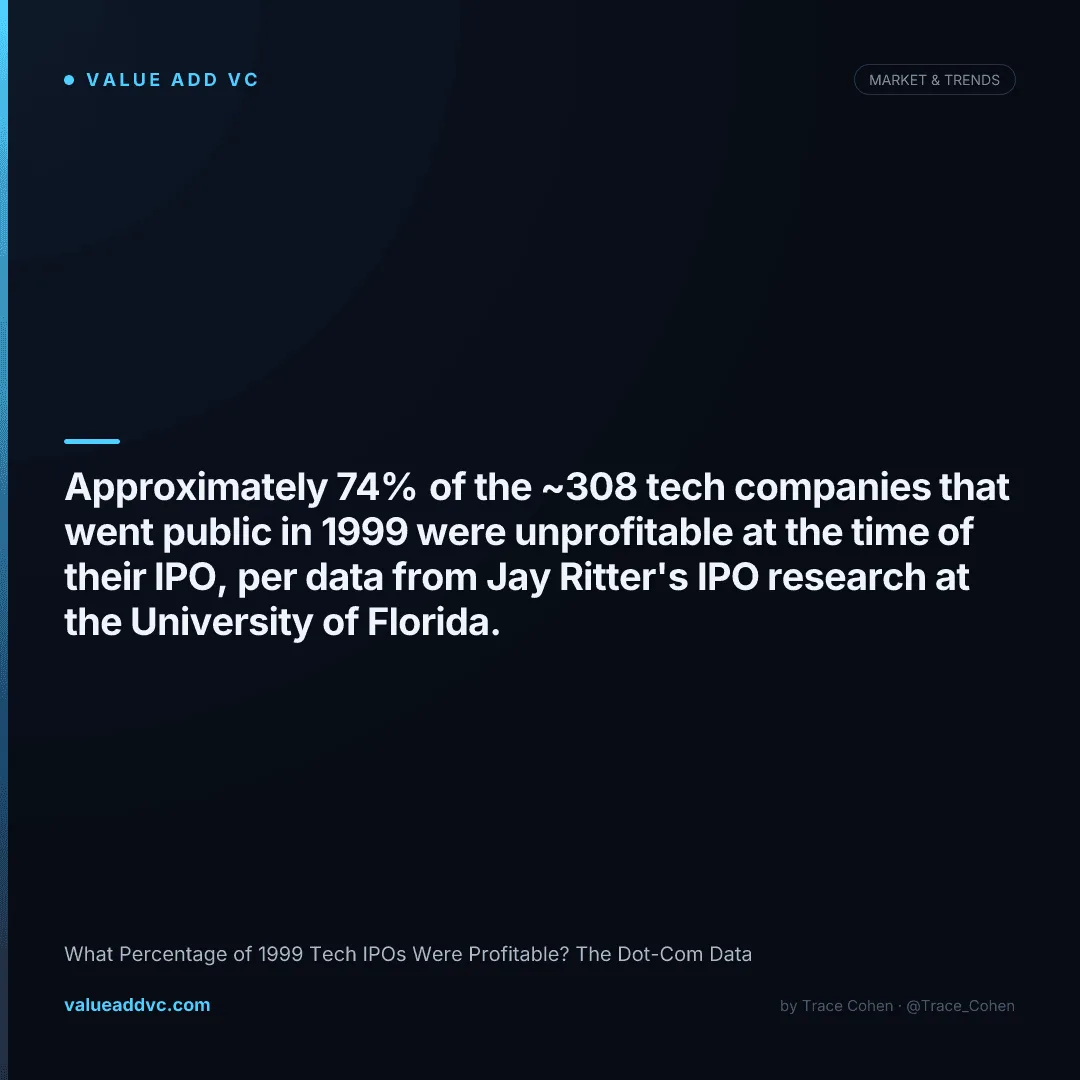
Only 14% of the 370 tech companies that went public in 1999 were profitable at the time of their IPO. The other 86% were losing money, a share exceeded only by the 2000 tech cohort in Jay Ritter's data going back to 1980.
That number sounds shocking until you understand the context: the 1999 market was explicitly rewarding growth and market share over profits. Analysts were building valuation models based on eyeballs, page views, and total addressable markets. Profitability was not just irrelevant. It was sometimes seen as evidence that management was not investing aggressively enough.
The Percentage of Profitable Tech IPOs in 1999: The Raw Numbers
Jay Ritter, professor of finance at the University of Florida and the leading academic authority on IPO data, tracks trailing twelve-month profitability for every US operating-company IPO cohort since 1980. His IPO statistics (Table 4b) count 370 tech IPOs in 1999, of which just 14% were profitable. Across all 476 IPOs that year, 76% had negative earnings (Table 9). Tech made up 78% of the 1999 IPO count, so it drove that figure. In 2000, the all-IPO loss rate rose to 81%.
| Year | Tech IPOs | % Unprofitable at IPO | Mean First-Day Return |
|---|---|---|---|
| 1995 | 205 | 30% | +30.8% |
| 1996 | 276 | 53% | +20.2% |
| 1997 | 174 | 50% | +16.9% |
| 1998 | 113 | 64% | +39.1% |
| 1999 | 370 | 86% | +86.7% |
| 2000 | 261 | 87% | +69.2% |
| 2021 | 121 | 79% | +33.0% |
| 2024 | 14 | 79% | +41.1% |
| 2025 | 31 | 74% | +33.4% |
Source: Jay R. Ritter, Initial Public Offerings: Updated Statistics (University of Florida). Tech IPO counts and % profitable from Table 4b; % unprofitable is 100% minus Ritter's % profitable (trailing twelve-month earnings). Equal-weighted mean first-day returns (offer price to first close) from Table 4h. Excludes IPOs priced below $5, unit offers, ADRs, SPACs, REITs, closed-end funds and banks.
Why Were So Many 1999 Tech IPOs Unprofitable?
The business logic of the dot-com era ran like this: the internet was going to be a winner-take-all market, so any company that could capture a dominant market position early would be worth an enormous amount. Spending aggressively on growth now, even at negative margins, looked like the rational strategy. The problem was that almost every participant was running the same playbook simultaneously. Academic work on the period describes this "Get Big Fast" belief as widespread among venture investors (Goldfarb, Kirsch and Miller).
Land Grab Mentality
Management teams were pushed by bankers and VCs to spend on customer acquisition above all else. Gross margin mattered less than winning market share.
Valuations on Eyeballs, Not Earnings
Analysts valued internet companies on page views, registered users, and total addressable market, which let deeply unprofitable companies command multi-billion-dollar market values.
Cheap, Abundant Capital
The Fed cut its funds-rate target three times in late 1998, to 4.75%, after the LTCM/Russia crisis. Venture capital was abundant and the public markets were wide open for growth companies.
VC Pressure to IPO Fast
The median company going public in 1999 was just 5 years old, versus 8 to 10 years in every year from 1990 to 1998, and 68% of 1999 tech IPOs were VC-backed (Ritter Table 4).
Sources: Federal Reserve open market operations archive (target-rate changes); Ritter IPO statistics, Table 4 (median age of all IPOs; % of tech IPOs VC-backed).
Notable 1999 Tech IPOs: What Happened to Each
Some of the most famous 1999 tech IPOs illustrate the full spectrum of outcomes, from lasting survivors to spectacular failures. First-day returns are computed from offer and first-day closing prices in Ritter's list of IPOs that doubled on the first day, except Webvan's, which did not double.
Survived. Priced at $26 and closed its first day at $145.19. 2004 was its first full fiscal year with net income. Akamai 2004 10-K
Priced at $30 and closed day one at $239.25, a 697.5% gain. Renamed VA Software (2001), SourceForge (2007) and Geeknet (2009); acquired by GameStop in 2015 for about $140 million. GameStop release
Raised $375 million selling 25 million shares at $15. Filed for Chapter 11 on July 13, 2001. The textbook dot-com failure. Webvan 8-K
Priced at $20 and closed its first day at $76.56. Filed for Chapter 11 in March 2001 and closed its website. Deseret News
Traded above $200 a share by December 1999, then below $1 by October 2001. Renamed Actua in 2014 and liquidated in 2018. Actua history
Priced at $23 and closed day one at $90. Survived the bust as a procurement software and commerce network business; acquired by SAP in 2012 for about $4.3 billion. SAP release
Webvan first-day return and IPO size: The Seattle Times, Nov. 5, 1999.
The Aftermath: What Happened After the IPO
The Nasdaq Composite hit a record close of 5,048.62 on March 10, 2000. By the end of the bear market on October 9, 2002 it had fallen to 1,114.11, a 78% decline, according to CNBC. Ritter's long-run return data (Table 19) shows what that meant for the 476 IPOs of 1999, measured from their first closing price over the following three years:
These are equal-weighted averages across all 1999 IPOs, not only tech, and they run to the earlier of the three-year anniversary or delisting. Ritter does not publish a count of how many 1999 IPOs went bankrupt or were delisted, and we have not found an authoritative source that does, so we do not put a number on it. The closest academic benchmark covers startups rather than IPOs: Goldfarb, Kirsch and Miller found that 48% of the dot-com businesses in their sample (788 internet startups that had pitched a single venture capital fund) survived through 2004.
The companies that survived did so through a few paths: building durable enterprise software franchises (like Ariba), finding a sustainable niche in internet infrastructure (like Akamai), or cutting costs hard enough to outlast competitors until the market recovered. The ones that failed were almost universally those that never found a model where revenue could cover costs at any realistic scale.
How 1999 Compares to Today's Tech IPOs
The comparison to today's AI-era listings gets made constantly, usually by people who haven't looked at the actual data. Ritter's numbers show the difference is less about profitability than about scale and maturity:
1999 Tech IPO Cohort
- • 370 tech IPOs
- • 86% unprofitable at listing
- • Median trailing sales: $20.7M (2022 $)
- • Median age of all 1999 IPOs: 5 years
- • Mean first-day return: +86.7%
- • Valued on eyeballs and TAM
2024–2025 Tech IPO Cohorts
- • 14 tech IPOs in 2024, 31 in 2025
- • 79% (2024) and 74% (2025) unprofitable at listing
- • Median trailing sales: $198.7M (2024), $120.5M (2025), in 2022 $
- • Median age of all IPOs: 13 years (2024), 12 years (2025)
- • Mean first-day return: +41.1% (2024), +33.4% (2025)
Source: Ritter IPO statistics, Tables 4 (median age), 4b (counts, profitability, median sales) and 4h (first-day returns).
Recent tech IPOs are still mostly unprofitable: 21% of 2024 tech IPOs and 26% of 2025 tech IPOs were profitable, compared with 14% in 1999. What has changed is that companies wait much longer to list and arrive far bigger. Median trailing sales for 2024 tech IPOs were roughly 10 times the 1999 level in inflation-adjusted terms, and far fewer companies are going public. Private valuations for leaders like OpenAI and Anthropic look elevated by historical standards, but the companies going through the IPO window today, such as Reddit, Astera Labs, and Rubrik, had real revenue and real gross margins. That is structurally different from Pets.com. Track current IPO filings on the Tech IPO Dashboard.
The Investor Lessons From the 1999 Cohort
If you had only bought profitable tech IPOs in 1999, you would have bought roughly 1 in 7 of the 370 deals. The profitability screen at IPO is crude, but Ritter's data across 9,253 IPOs from 1980 to 2024 (Table 16b) shows it matters: IPOs with positive trailing earnings averaged a 33.6% three-year buy-and-hold return, versus −0.5% for unprofitable issuers. After adjusting for the market, profitable IPOs trailed by 13.0% and unprofitable IPOs by 30.7%. In 1999 itself, loss-making IPOs had a mean first-day return of 81.0%, double the 40.2% for profitable ones (Table 9). The market paid most for the companies least able to support it.
The deeper lesson is about the relationship between valuations and rates. The 1999 boom followed three Fed rate cuts in late 1998. When the Fed then raised its target six times between June 1999 and May 2000, taking the federal funds rate from 4.75% to 6.5% (Federal Reserve), the speculative excess unwound fast. Loss-making companies with no path to profitability were suddenly very expensive to fund.
That dynamic played out again after the Fed began hiking aggressively in 2022. Ritter's Table 19 shows the 311 IPOs of 2021 returned −49.1% on average over three years, about the same as the 1999 cohort's −47.6%, and −68.6% after adjusting for the market, worse than 1999's −32.5%. Rates matter more to loss-making companies than to anyone.
86% of 1999 tech IPOs were unprofitable at listing. Three years out, the average 1999 IPO was down 47.6% from its first close.
The question for every IPO is not whether the business is exciting. It is whether it can survive a rate cycle without new capital.
Track current and historical tech IPO data on the Tech IPO Dashboard at Value Add VC. See all upcoming 2026 listings on the IPO Pipeline tracker.
Latest from the Pulse
Get VC data most people never see
— free to subscribe
Trace's notes on venture, AI and startups, a few times a week. Join 5,000+ subscribers. No spam.
No spam, unsubscribe anytime. Sent via Substack · Privacy · or subscribe on Substack ↗