An acqui-hire priced at $10M sounds like a win. After a $4M seed round with a 1x liquidation preference, founders with 55% ownership walk away with about $3.3M — pre-tax, before legal fees, and years after they expected a much better outcome.
Acqui-hires are the most misunderstood outcome in startup M&A. The press release says "acquisition." The economics say "graceful exit for investors, team hire for the acquirer, and a modest payday for founders who built something for 3–5 years." Understanding the exact deal structure changes how you negotiate one — and whether you should take it at all.
What an Acqui-Hire Structure Actually Looks Like
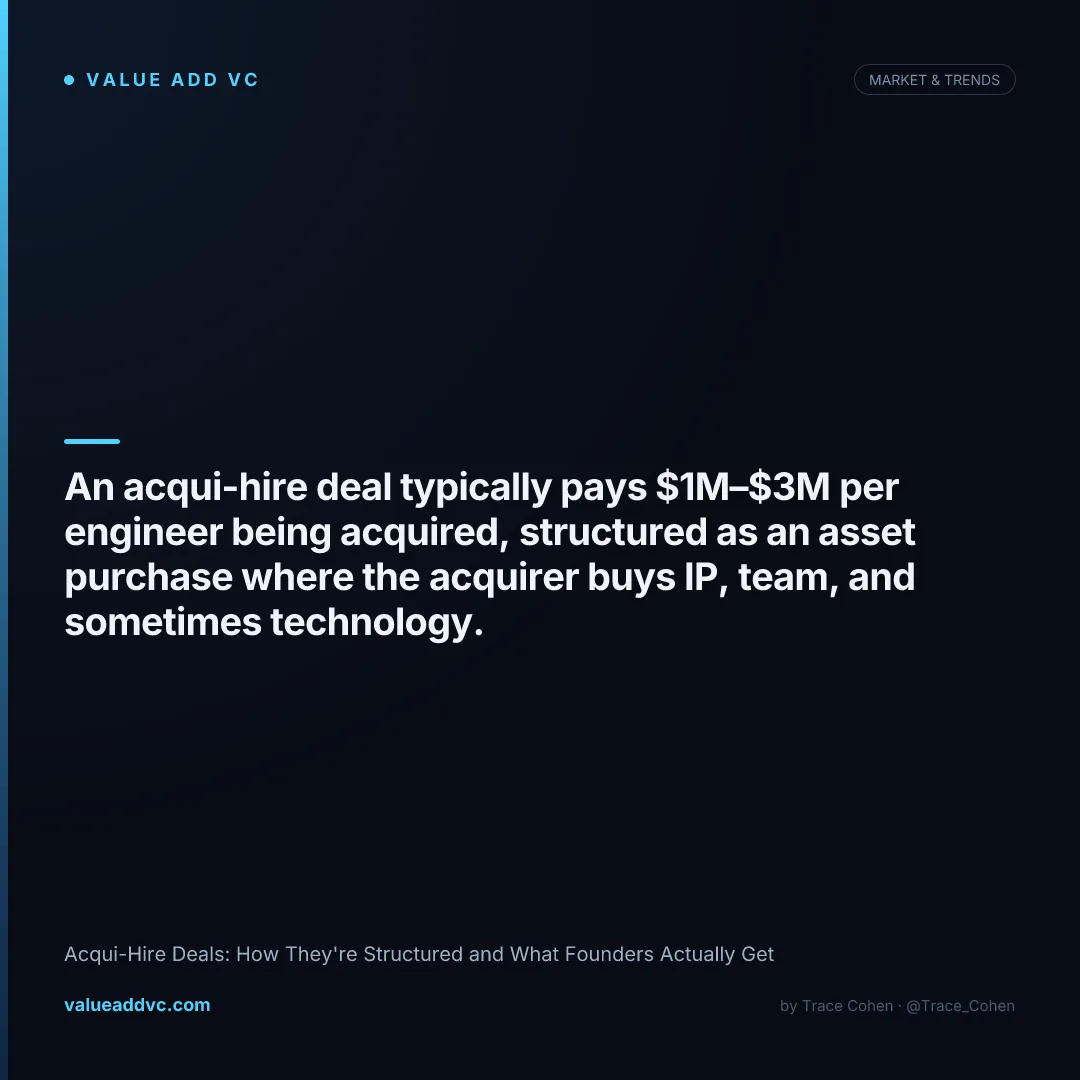
Almost every acqui-hire is structured as an asset purchase, not a stock purchase. The acquirer buys specific assets — IP, patents, technology, and crucially, offers employment to key team members. The acquired company then distributes the proceeds to its shareholders through its existing liquidation waterfall.
Asset Purchase Agreement
Acquirer buys IP, code, domain, and specified assets from the company entity
Employment Offers Extended
Acquirer issues new-hire offers to target engineers; acceptance is usually a closing condition
Closing & Fund Flow
Purchase price flows to the company's bank account, then distributes per the cap table waterfall
Liquidation Preference Paid First
Preferred investors receive their preference amount (typically 1x their investment, sometimes participating)
Remainder Splits by Ownership
What's left after preferences distributes pro-rata to all shareholders including common stockholders (founders, employees)
Unvested Equity Canceled
Employees' unvested startup equity is typically canceled; value comes from the new employer's RSU grant instead
How Acqui-Hire Pricing Works: The Talent Math
Acqui-hire pricing is simple but rarely discussed openly: the acquirer is essentially paying a one-time recruiting fee plus a retention premium to secure a team they couldn't easily hire individually. The benchmark in 2025–2026:
| Engineer Profile | Typical Range Per Person | Driver |
|---|---|---|
| Senior SWE (5-8 yrs, general) | $800K–$1.5M | Replacement cost |
| ML/AI Engineer (general) | $1.5M–$3M | Market scarcity |
| LLM / RLHF specialist | $3M–$5M+ | Near-impossible to recruit |
| Domain AI (healthcare, legal, finance) | $2M–$4M | Vertical expertise premium |
| Founding engineer / tech lead | $2M–$6M | Team cohesion + IP |
A 6-person AI team where 4 members are acqui-hire targets can realistically price at $8M–$16M in total deal consideration — before the acquirer factors in the value of any IP or technology being acquired. That range is the starting point for term sheet negotiations, not a ceiling.
The Liquidation Waterfall Problem
Here's the math founders often don't model until a term sheet lands. Run the numbers on a realistic acqui-hire scenario:
That's ~$1.9M for 3–5 years of work after raising $3.5M from investors. Not nothing — but not the "$8M exit" the headline implies. If the round had participating preferred at 2x, the math gets worse. This is why experienced founders push hard for founder carveouts: a negotiated pool (often $500K–$2M) set aside for founders before the standard waterfall runs.
What Employees Actually Receive
Individual engineers don't participate in the company sale proceeds unless they hold common stock (and even then, the amounts are usually small after preferences). Their value comes entirely from the acquirer's new-hire package:
New base salary
Typically at or above acquirer's internal band for the equivalent role — often 15–30% above what the startup was paying
RSU grant
4-year vesting with 1-year cliff, sized to the talent premium the acquirer is willing to pay. A senior ML engineer might receive $1.5M–$3M in RSUs at a big tech company.
Signing / retention bonus
Cash paid at signing or over 12–24 months, designed to bridge the employee through the unvested equity they're leaving behind
Accelerated vesting (sometimes)
If the employee held startup options, the acquirer may allow a partial acceleration before cancellation — rare but possible as a negotiating concession
When You're the Target: What to Negotiate
Founder Negotiating Levers
- ✓ Founder carveout pool ($500K–$2M off the top, before waterfall)
- ✓ Direct employment offer with above-band RSU grant
- ✓ Accelerated vesting on existing startup options
- ✓ Escrow holdback reduction (12 months is standard; push for 6)
- ✓ Reps & warranties insurance to limit personal liability post-close
Common Founder Mistakes
- ✕ Accepting the first term sheet without running a competitive process
- ✕ Not modeling the liquidation waterfall before negotiations
- ✕ Conflating the headline deal price with personal proceeds
- ✕ Letting investors control the process without founder counsel
- ✕ Signing before all key employees have accepted employment offers
The AI-Era Acqui-Hire Premium
In 2025–2026, acqui-hires in AI have accelerated faster than any other segment of tech M&A. The talent scarcity is real: teams with production RLHF experience, LLM fine-tuning capabilities, or domain-specific AI trained on proprietary edge cases are being actively bid on by the major labs and hyperscalers. This has meaningfully changed the pricing dynamic.
Where a 2019-era acqui-hire of a standard SaaS team might price at $5M–$8M for 6 people, an equivalent AI team with specialized expertise in 2026 can command $15M–$25M — and some teams with deep technical leads are seeing $30M+. The acquirer calculates it as a recruiting cost: if they can't hire these people individually, and their competitors might, the acqui-hire price is simply what it costs to secure a strategic asset.
For founders in the AI space, this means acqui-hire outcomes have improved substantially relative to historical norms. But the waterfall math still applies. Track the current corporate development landscape and AI company valuations at Value Add VC to stay current on what acquirers are paying.
An acqui-hire is not an acquisition disguised as a team hire.
It's a team hire disguised as an acquisition — and the founders who understand that distinction negotiate far better deals.
Track M&A trends and AI company valuations on the Corp Dev Dashboard and AI Valuations Dashboard at Value Add VC. Originally published in the Trace Cohen newsletter.
Latest from the Pulse
Get VC data most people never see
— free to subscribe
Trace's notes on venture, AI and startups, a few times a week. Join 5,000+ subscribers. No spam.
No spam, unsubscribe anytime. Sent via Substack · Privacy · or subscribe on Substack ↗