Cognition, the company behind the Devin AI coding agent, is generating more than $900 million in annualized revenue as of September 2026 — up from $492 million just four months earlier. That's the short answer. The longer answer involves a new funding round, reported by Bloomberg on September 2, 2026, that would value the company at roughly $47 billion, nearly double the $26 billion it was worth in May.
A year ago, Cognition was a Devin-only company burning through a modest raise with roughly $73 million in ARR. Today it's a company closing in on a $47 billion price tag, running two products — Devin and Windsurf — with Goldman Sachs, Citi, and the U.S. Army and Navy among its customers. Here's exactly how the money moves.
Figures from Sacra, Bloomberg, TechCrunch, and PitchBook as of September 4, 2026. Cognition is privately held and does not publish official financials; the new round was still being finalized as of this writing.
How Does Cognition Make Money?
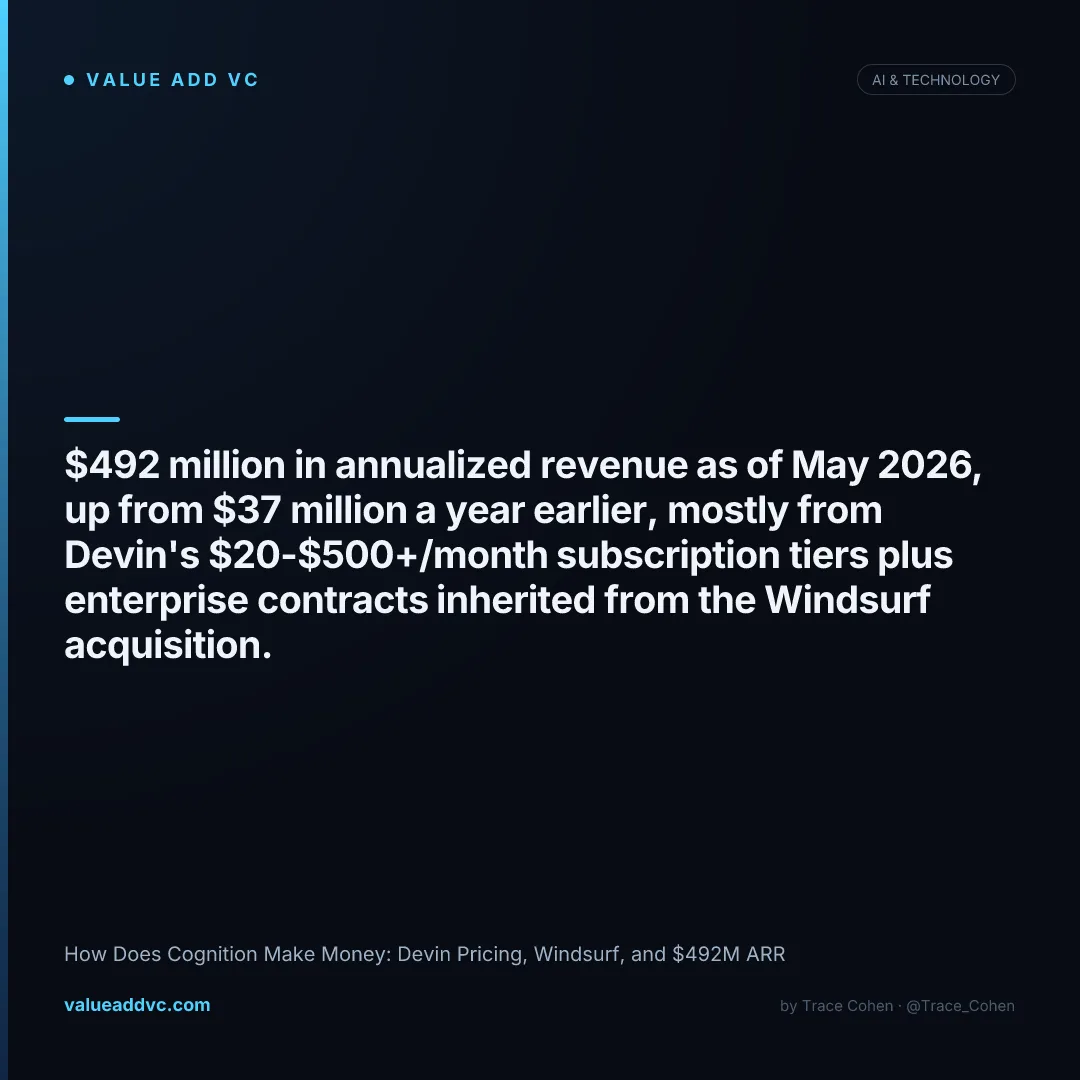
Cognition makes money from two subscription-based products sold to overlapping developer and enterprise customers: Devin, an autonomous AI software engineer billed on monthly tiers plus usage credits, and Windsurf, an AI-native coding IDE acquired in 2025 that sells multi-seat enterprise licenses. Combined, those two lines generated an estimated $492 million in 2026 annualized revenue.
Before mid-2025, Cognition was a single-product company selling only Devin, mostly to individual developers and small teams on a self-serve basis. The Windsurf acquisition changed that mix overnight, adding a second sales motion aimed at large organizations already paying for seat-based IDE licenses, which is why Cognition's revenue composition looks meaningfully different in 2026 than it did even twelve months earlier.
How Much Revenue Does Cognition Actually Generate?
Cognition's annualized revenue grew from roughly $1 million in September 2024 to $37 million by May 2025, to $492 million by May 2026, and to more than $900 million by September 2026 — a near-1,000x increase in two years, according to Tech Funding News' reporting on the new round. The company had publicly targeted $1 billion in annualized revenue before the end of 2026 and, on this trajectory, looks likely to clear that months early.
Cognition's New Round: A $47 Billion Valuation
Less than three months after closing its $26 billion Series D, Cognition was already back in the market. Bloomberg reported on August 12, 2026 that Cognition was in early talks for a new round that would value it at $40 billion or more. Those talks moved fast: Bloomberg reported on September 2, 2026 that Cognition is set to close roughly $1 billion in new funding at a $47 billion valuation, nearly double May's $26 billion price in about three months, with the company reportedly fielding almost $10 billion in investor interest for the round — meaning the final raise could land above the initial $1 billion target.
PYMNTS' coverage of the earlier talks framed the raise as a bet on Cognition's enterprise traction rather than Devin alone: the client roster now includes Goldman Sachs, Citi, Mercedes-Benz, Elevance, Dell, Santander, and the U.S. Army, Navy, and Treasury Department running Devin in production. Lux Capital, General Catalyst, and 8VC — which co-led the May Series D — are again expected to anchor the round. As of this writing the round has not been publicly confirmed as closed, so treat $47 billion as the reported price Bloomberg's sources described, not an audited final term.
Cognition Turned Down a SpaceX Acquisition Offer First
The new round follows a notable data point most coverage of the $47 billion figure buries: less than a month before opening this financing, Cognition reportedly rejected an acquisition offer from SpaceX, which had just closed its own $60 billion move on Cursor-rival Anysphere. Rather than sell, Cognition's board chose to raise independently at a price that implies a far larger standalone valuation than an acquirer was reportedly willing to pay — a bet that Devin's enterprise contracts are worth more as a going concern than as a bolt-on to another company's AI stack.
This likely means Cognition's board views the current AI-coding fundraising environment — where investors are reportedly offering nearly 10x the round's target size — as unlikely to repeat if the company waits. It's a read on timing, not a confirmed statement from the company, since Cognition has not disclosed its reasoning for declining the offer.
What the Headline Misses
A valuation that nearly doubles in three months is also a warning sign, not just a growth story. Cognition's implied revenue multiple sits above 50x a still-unaudited ARR estimate that the company itself has not disclosed, in a category — AI coding agents — where GitHub Copilot, Cursor, and a wave of well-funded startups are all fighting for the same enterprise budgets. If enterprise adoption of Devin plateaus, or if a cheaper competitor erodes pricing the way Cognition itself did to Windsurf's rivals, a round priced at 50x-plus ARR leaves little room for error before the next markdown.
What Does Devin Cost, and How Is It Priced?
Devin's pricing is built around ACUs (Agent Compute Units), where roughly one ACU equals 15 minutes of autonomous engineering work, and it ranges from a free tier for light experimentation to custom enterprise contracts. Cognition slashed its entry price from $500 to $20 a month with the Devin 2.0 relaunch in April 2025, a move that traded revenue-per-user for a far larger addressable base of individual developers and small teams.
| Plan | Price | Included Usage | Target Customer |
|---|---|---|---|
| Free | $0/mo | Limited ACUs for evaluation | Individual trial users |
| Core | $20/mo | Low-ACU light tasks | Freelancers, small teams |
| Team | $500/mo | 250 ACUs (~62.5 hrs) | Growing engineering teams |
| Pay-as-you-go | $2.25/ACU | No fixed allotment | Variable, spiky usage |
| Enterprise (Devin) | Custom | VPC, SSO, custom Devins | Large organizations |
| Windsurf Enterprise | Custom seat licenses | Multi-seat IDE deployment | 350+ existing enterprise accounts |
Pricing figures from Cognition's published pricing page as reported by VentureBeat, Lindy, and UsagePricing as of 2026. Enterprise and Windsurf license terms are undisclosed.
How Did the Windsurf Acquisition Change Cognition's Business Model?
Cognition acquired Windsurf in July 2025 for an undisclosed sum, days after Google paid $2.4 billion in a licensing-and-hiring deal that pulled out most of Windsurf's top executives and left the remaining company, its technology, and its roughly $82 million in ARR and 350+ enterprise customers up for grabs. Rather than folding Windsurf into Devin, Cognition kept it as a separate product — a locally-run, agentic IDE that complements Devin's fully autonomous, cloud-based coding agent.
The strategic effect was immediate: Cognition went from a single bottoms-up subscription product to a two-product company with an established enterprise sales motion already selling into 350+ accounts. That's a large part of why revenue nearly tripled between June 2025 and May 2026 — it wasn't purely organic Devin growth, it was two revenue engines running in parallel. We track deals like this on the AI Valuations Dashboard.
It's also a rare example of an acqui-hire creating value for the company that didn't do the hiring. Google's $2.4 billion payment went almost entirely toward compensating Windsurf's departing leadership and licensing its models, not toward the standalone business — which is precisely why Cognition could pick up the remaining product, brand, and customer base for a fraction of what Windsurf had been valued at in prior funding talks just months earlier.
How Does Cognition Make Money Compared to Cursor and Other AI Coding Companies?
Cognition's $900 million-plus ARR is now closing in on the two biggest names in AI coding: Cursor-maker Anysphere reached an estimated $4 billion in annualized revenue by mid-2026 on its way to a $60 billion SpaceX-linked valuation, and Microsoft's GitHub Copilot is estimated at $900 million to $1.1 billion in ARR off 4.7 million paid subscribers. Replit, further back, hit an estimated $525 million ARR at a $9 billion valuation using effort-based agent pricing rather than flat subscriptions.
AI Coding Companies: Est. ARR vs Valuation, Sept 2026
Sacra, GetLatka, Axis Intelligence, and PitchBook estimates, 2026. GitHub Copilot revenue is a subsidiary estimate, not company-disclosed. Cognition's September figure reflects its reported run rate, not confirmed year-end results.
Cognition is still smaller than Cursor by revenue, but it's essentially caught up to GitHub Copilot in four months — and it's grown faster in percentage terms than any of its larger peers over the same stretch. Whether that growth rate holds as the base gets larger is the open question behind the $47 billion price.
Is Cognition Profitable, and What's Next?
Cognition has not disclosed profitability, and given the compute costs of running an autonomous coding agent at scale, it's very likely still operating at a loss relative to its more than $900 million in revenue — consistent with nearly every frontier AI-agent company at this stage. The company had publicly targeted $1 billion in annualized revenue by the end of 2026; on the September trajectory, it's on pace to clear that target months early.
The bigger question for investors is durability: Cognition's valuation went from $10.2 billion to $26 billion to a reported $47 billion price in under a year, a pace that assumes both products keep compounding and that AI coding agents keep displacing traditional developer tooling budgets rather than plateauing. Lux Capital, General Catalyst, and 8VC are betting that Devin and Windsurf together can keep winning enterprise budgets away from GitHub Copilot's much larger installed base. Track how that compares to other AI-sector raises on our SaaS Valuations Dashboard.
Cognition's valuation nearly doubled in three months, and its ARR nearly doubled right alongside it.
A $26 billion Series D in May is now a reported $47 billion round in September — after Cognition turned down a SpaceX buyout offer.
The Bottom Line: How Does Cognition Actually Make Money?
Cognition makes money by selling Devin's autonomous coding agent on $20-to-custom-enterprise subscription tiers, plus Windsurf's multi-seat IDE licenses to the enterprise accounts it inherited in the 2025 acquisition. That combination pushed revenue from $37 million to more than $900 million in about sixteen months and now supports a reported $47 billion valuation, up from $26 billion after the May 2026 Series D.
Compared to Cursor's $4 billion ARR and GitHub Copilot's roughly $1 billion run rate, Cognition has closed most of the revenue gap with the market's largest AI coding player in a matter of months — but the same speed that makes the growth story compelling is what makes the pricing of the next round worth watching closely. Whether that growth rate survives past $1 billion in ARR will say a lot about how much room is actually left in the AI coding agent market.
Track AI company revenue, valuations, and funding rounds on the AI Valuations Dashboard at Value Add VC. Reach out at t@nyvp.com or @Trace_Cohen.
Latest from the Pulse
Get VC data most people never see
— 100% free
Weekly benchmarks, valuations, and fund data. Join 5,000+ investors. No spam.