
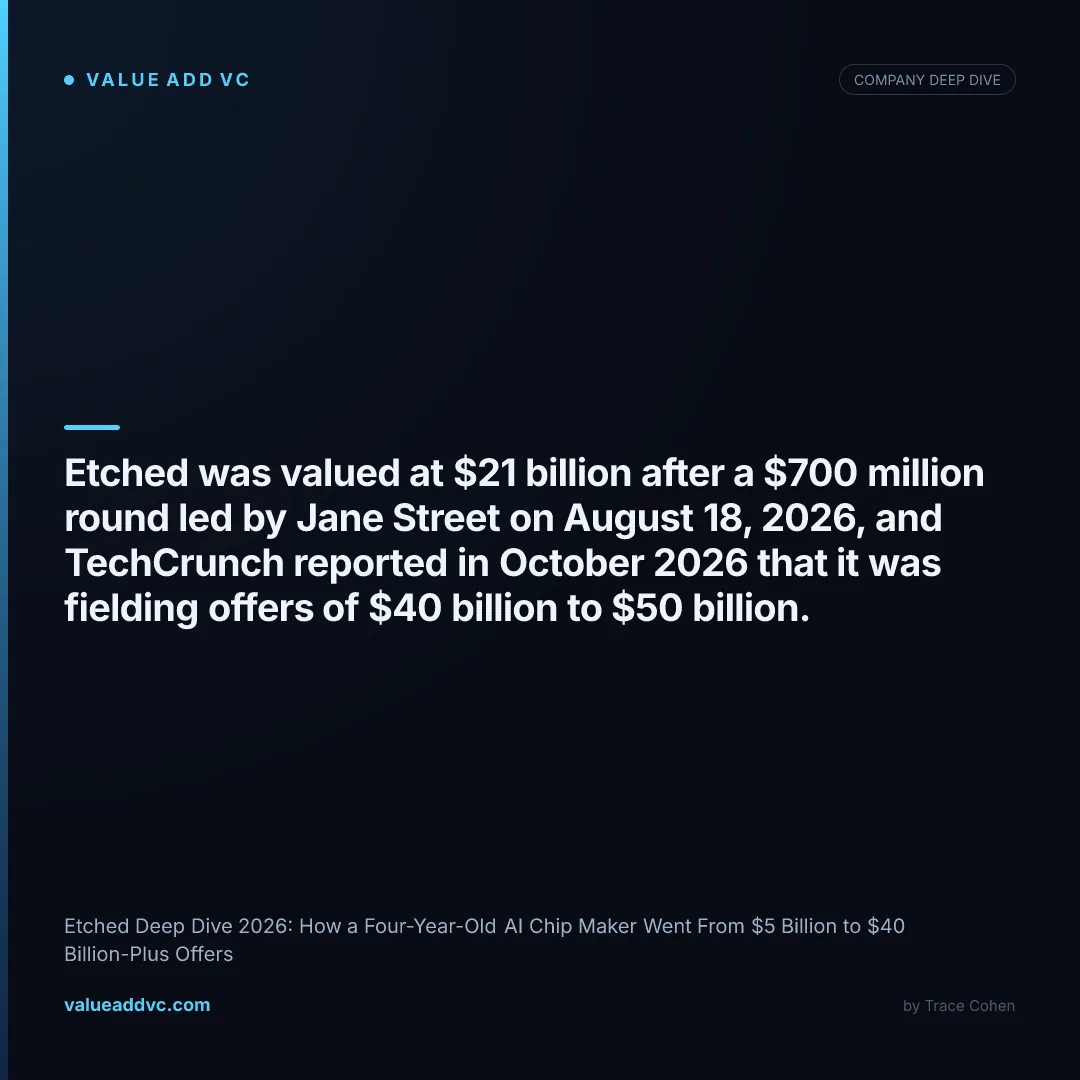
As of November 20, 2026, Etched is valued at $21 billion after a $700 million round led by Jane Street on August 18, 2026, and TechCrunch reported in October that the AI inference chip maker was fielding offers of $40 billion to $50 billion — four times the $5 billion price it carried eleven months earlier.
Etched has gone from a 35-person team pitching a transformer-only chip in 2024 to a company of about 400 people with working silicon from TSMC, a shipped rack in a customer's data center, and what it says is more than $1 billion in signed contracts. We track Etched's rounds and news as they happen. This deep dive pulls the funding history, the hardware, the competition and the open questions into one place, and links out to our narrower pieces on how Etched makes money and the back-to-back July and August rounds.
Etched Company Deep Dive: Snapshot
Etched is a San Jose, California chip company founded in 2022 that designs custom silicon for running AI models (inference) and sells it as complete rack-scale systems. Its last priced valuation is $21 billion, it has raised roughly $1.8 billion, it employs about 400 people, and it discloses no revenue.
Sources: TechCrunch (July 23, August 18 and October 5, 2026). Total raised is Value Add VC's arithmetic on disclosed rounds.
What Does Etched Actually Do?
Etched builds hardware for AI inference, the work of running an already-trained model to answer prompts, rather than for training models. It splits inference into its two stages and designs a separate component for each, then packages chips, custom racks and software into what it calls "frontier inference clusters."
The first stage, prefill, is the compute-heavy step of reading the prompt and its context. Etched's prefill chip runs at unusually low voltage, which lets it pack in more transistors without the heat limits that throttle high-end GPUs; Robert Wachen told TechCrunch in July 2026 that the approach, which the company calls low-voltage inference, makes the chip "dramatically" faster than other AI chips. The second stage, decode, is memory-heavy: generating output tokens one at a time. For decode, Etched built a new memory and interconnect design it calls cluster-scale memory, which lets many chips share one low-latency memory pool.
The company's name comes from its original thesis of hard-wiring the transformer architecture into silicon. That pitch has widened. By July 2026 Etched said its systems could run any AI model, including mixture-of-experts models such as DeepSeek and Qwen and non-transformer designs such as Mamba. Those performance claims come from Etched itself; no independent benchmark has been published.
How Does Etched Make Money?
Etched makes money by selling inference hardware outright as full systems, not by renting compute by the hour or charging per token. In a June 30, 2026 progress report covered by TechCrunch, Etched said it had booked $1 billion in contracts for those systems, and it has since described the figure as more than $1 billion.
That model puts Etched closer to Nvidia's packaged systems business than to chip startups that built cloud APIs on top of their own silicon, a path our Groq business-model breakdown covers. Hardware sales mean lumpy, order-driven revenue and heavy upfront manufacturing cost. Etched has not said how much of its contract book is binding purchase orders versus letters of intent, or when the contracts convert to recognized revenue.
How Much Has Etched Raised? Funding History
Etched has raised roughly $1.8 billion across at least five financings since 2022, by Value Add VC's arithmetic on disclosed figures. The early money was small: TechCrunch put total funding at $125.36 million after a $120 million Series A in June 2024 co-led by Primary Venture Partners and Positive Sum, with Peter Thiel and GitHub CEO Thomas Dohmke among the angels. That implies about $5.4 million raised before the Series A.
The step change came in December 2025, when Etched closed a $500 million round led by Stripes at a $5 billion post-money valuation, first reported by Bloomberg on January 13, 2026. When Etched came out of stealth in June 2026 it said it had raised $800 million in total, which leaves roughly $175 million in financings between mid-2024 and late 2025 that were never itemized.
Then came two rounds in four weeks. On July 23, 2026, Sequoia Capital led a $300 million Series C at $10.3 billion, with Andreessen Horowitz, SK Hynix, Jane Street and Diffusion participating; Etched says that is the highest valuation ever for a Sequoia-led Series C, according to TechCrunch. Series A co-lead Primary wrote in its Series C announcement that it has invested in every Etched round. On August 18, Jane Street led a $700 million round at $21 billion, joined by Kleiner Perkins, Tiger Global, Bain Capital Ventures, Blackstone and others, per TechCrunch.
| Date | Round | Amount | Valuation | Lead investor(s) |
|---|---|---|---|---|
| 2022-2023 | Pre-Series A | ~$5.4M (implied) | Not disclosed | Not disclosed |
| Jun 2024 | Series A | $120M | Not disclosed | Primary Venture Partners, Positive Sum |
| Mid-2024 to 2025 | Unitemized rounds | ~$175M (implied) | Not disclosed | Not disclosed |
| Dec 2025 | Growth round | $500M | $5B post-money | Stripes |
| Jul 23, 2026 | Series C | $300M | $10.3B | Sequoia Capital |
| Aug 18, 2026 | Growth round | $700M | $21B | Jane Street |
| Oct 2026 | Offers (not closed) | Not disclosed | $40B-$50B offered | Not disclosed |
How we counted: every Etched financing with a disclosed amount or valuation; 2022 to October 2026; 7 rows; as of November 20, 2026. "Implied" rows are Value Add VC's arithmetic on TechCrunch's reported totals. Sources: TechCrunch (June 2024; June, July, August and October 2026), Bloomberg (January 2026).
Etched Valuation by Round, December 2025-October 2026 ($B)
Etched's price doubled twice in eight months; the October figure is an offer range, not a closed round.
Bloomberg (Jan 2026); TechCrunch (Jul, Aug and Oct 2026)
Data
| Item | Value |
|---|---|
| Dec 2025 (Stripes) | $5B |
| Jul 2026 (Series C) | $10.3B |
| Aug 2026 (Jane Street) | $21B |
| Oct 2026 offers (not closed) | $40B-$50B |
Etched Product Portfolio
Etched's product line is one integrated system, not a menu of chips. The frontier inference cluster combines the low-voltage prefill chip, the cluster-scale memory fabric for decode, custom racks and the software stack that schedules models across them. Etched sells the whole box; it does not sell bare chips to server makers.
- Sohu: the original transformer ASIC Etched unveiled in June 2024, according to TechCrunch, built on TSMC's 4nm process. CEO Gavin Uberti claimed then that one Sohu server would replace 160 Nvidia H100 GPUs, a claim never independently tested.
- Prefill silicon: the low-voltage inference chip produced at TSMC in 2026, which the company says was a first-pass (A0) tapeout success.
- Cluster-scale memory: the decode-side memory and interconnect design; Primary describes it as combining SRAM-class speed with HBM-class capacity.
- Facilities: a 2 MW data center at the San Jose headquarters, a new 80,000-square-foot, 10 MW site in Milpitas, and a Taiwan office that coordinates production near TSMC.
A Sohu Developer Cloud that would let customers try the chip online was announced in 2024; Etched has not said whether it launched or how it fits the systems business.
The Jane Street Rack: Etched's First Shipped System
Etched's single most important proof point is a rack running inside Jane Street's data center. The quant trading firm tested the hardware, bought it, installed what TechCrunch described as the first cluster system Etched has shipped, and then led the company's $700 million August round. In a blog post cited by TechCrunch, Jane Street said early results were good and that Etched's approach gives the precision its most demanding workloads need.
One read on this: a customer that also leads the round is a stronger signal than a pitch-deck valuation, because Jane Street had the hardware in hand before writing the check. It also concentrates risk. As of November 2026, Jane Street is still the sole buyer Etched has named, and trading firms run narrower workloads than the frontier labs and clouds Etched says make up the rest of its contract book. Hudson River Trading and Two Sigma, two other quant firms, sit on the cap table, but neither has been confirmed as a customer.
What Is Etched's Revenue? Key Metrics
Etched's revenue is not publicly disclosed as of November 2026, and neither are unit shipments, gross margin or burn. The disclosed operating metrics are the contract book of more than $1 billion, headcount of about 400, and the fact that roughly 15% of staff previously worked at Nvidia, a Wall Street Journal count cited by TechCrunch on October 5, 2026.
The best public proxy for spending is runway. A source told TechCrunch in October 2026 that if Etched raises as much as its last round, it could have up to 3.5 years of runway. By Value Add VC's arithmetic, that suggests annual spending of roughly $200 million, though the source's framing is loose and Etched has confirmed none of it. At $21 billion, Etched is priced at about 21 times its stated contract book, a contract figure rather than revenue.
Who Are Etched's Competitors?
Etched's main competitor is Nvidia, whose packaged "AI factory" systems are what Etched's clusters are built to displace. Among independent chip makers, the closest comparisons are Cerebras, which went public in May 2026, and Groq, which now runs mostly as an inference cloud.
Cerebras priced its IPO at $185 per share on May 13, 2026, raising at least $5.5 billion at a fully diluted market value of $56.4 billion, according to SiliconANGLE; the same report said G42 and Mohamed bin Zayed University of Artificial Intelligence accounted for 24% and 62% of Cerebras's 2025 revenue, 86% combined by Value Add VC's arithmetic. Groq raised $350 million at $3.5 billion in August 2026 in a round led by Disruptive with Nvidia participating, per Crunchbase News, the same week Etched closed its $700 million round.
Etched vs Cerebras vs Groq: Latest Valuation and Latest Raise
TechCrunch (Aug 2026), SiliconANGLE (May 2026), Crunchbase News (Aug 2026)
Cerebras has public revenue to price against; Etched's $21 billion rests on contracts and hardware it has just begun to ship.
The other competitive pressure is in-house silicon. According to TechCrunch's June 2026 report, Amazon, Google and Microsoft design their own AI chips, OpenAI announced a custom chip built with Broadcom, and TechCrunch reported that Google is developing a chip that builds model architecture into silicon, the same idea Etched started with. See our Cerebras deep dive and Groq's valuation history for the full picture on each rival.
Etched Leadership Team
Etched is run by its three co-founders, who met at Harvard and left to start the company in 2022; all three are Thiel Fellowship alumni.
- Gavin Uberti, co-founder and CEO: previously worked at OctoML and Xnor.ai. He framed the founding thesis in 2024: "In 2022, we made a bet that transformers would take over the world."
- Robert Wachen, co-founder and COO: Uberti's college roommate and the company's main public voice on its 2026 rounds. On the early years he told TechCrunch: "We had no idea how hard it was going to be."
- Chris Zhu, co-founder: met Uberti in an advanced math course at Harvard.
- Mark Ross: former CTO of Cypress Semiconductor, listed with the founding team in TechCrunch's 2024 coverage. His current title has not been disclosed.
The cap table adds weight beyond the leads: angels include Andrej Karpathy, Geoffrey Hinton, Fei-Fei Li and Mistral CEO Arthur Mensch, and Stanley Druckenmiller and Peter Thiel are investors. In 2023, TechCrunch reported, the company struggled to raise and ran month to month near the edge of its cash.
Etched Bull Case / Bear Case
The bull case
- Etched builds solely for inference, the workload that grows every time a deployed model answers a prompt.
- Working A0 silicon, a shipped rack and a paying customer that became lead investor are rarer than a big valuation among chip startups.
- The pivot to running any model removes the main objection to the original transformer-only design.
- Sequoia, SK Hynix and Jane Street on one cap table give Etched an investor, a memory supplier and a customer at once.
What the headline misses: the bear case
- No revenue, margin or shipment numbers are public; the contract book has not been broken into binding orders and letters of intent.
- One named customer. Scaling from one rack to volume production at TSMC is where many chip startups have stalled.
- Nvidia absorbed Groq's technology and most of its staff through a licensing deal rather than competing head-on, and could answer Etched the same way.
- Hyperscalers building their own inference chips shrinks the pool of large buyers.
- A $40 billion-plus round would price Etched at roughly 40 times its contract book by Value Add VC's arithmetic, leaving little room for a delay.
Will Etched IPO? IPO Outlook
Etched has not filed to go public as of November 20, 2026, and there is no reported bank mandate, executive IPO comment or target date. None of the TechCrunch reports on the company's 2026 rounds mention listing plans.
The strongest signal points the other way: private investors offering $40 billion or more and a possible 3.5-year runway remove any pressure to list. Cerebras's May 2026 debut, which opened at $350 against a $185 offer price, shows public demand for AI chip stocks exists. Our read is that Etched would need repeat customers and disclosed revenue before an S-1 could support its private price, which makes 2027 the earliest plausible window and a later date more likely.
The Bottom Line
Etched has done the hard part that most AI chip startups never reach: working silicon, a shipped system and a customer willing to lead its round. Investors have priced that at $21 billion and are offering far more. What the company has not shown is the revenue, the second named customer, and the production ramp that would make those numbers more than a bet on its architecture. The next priced round, and whether it names new buyers, is the figure to watch.
All figures are from company statements and credible reporting as of November 20, 2026; the $40 billion-to-$50 billion range reflects reported offers for a round that has not closed. Track private AI valuations and rounds with Value Add VC's funding tracker and our free Startup Funding Dataset.
Latest from the Pulse
Get VC data most people never see
— free to subscribe
Trace's notes on venture, AI and startups, a few times a week. Join 5,000+ subscribers. No spam.
No spam, unsubscribe anytime. Sent via Substack · Privacy · or subscribe on Substack ↗