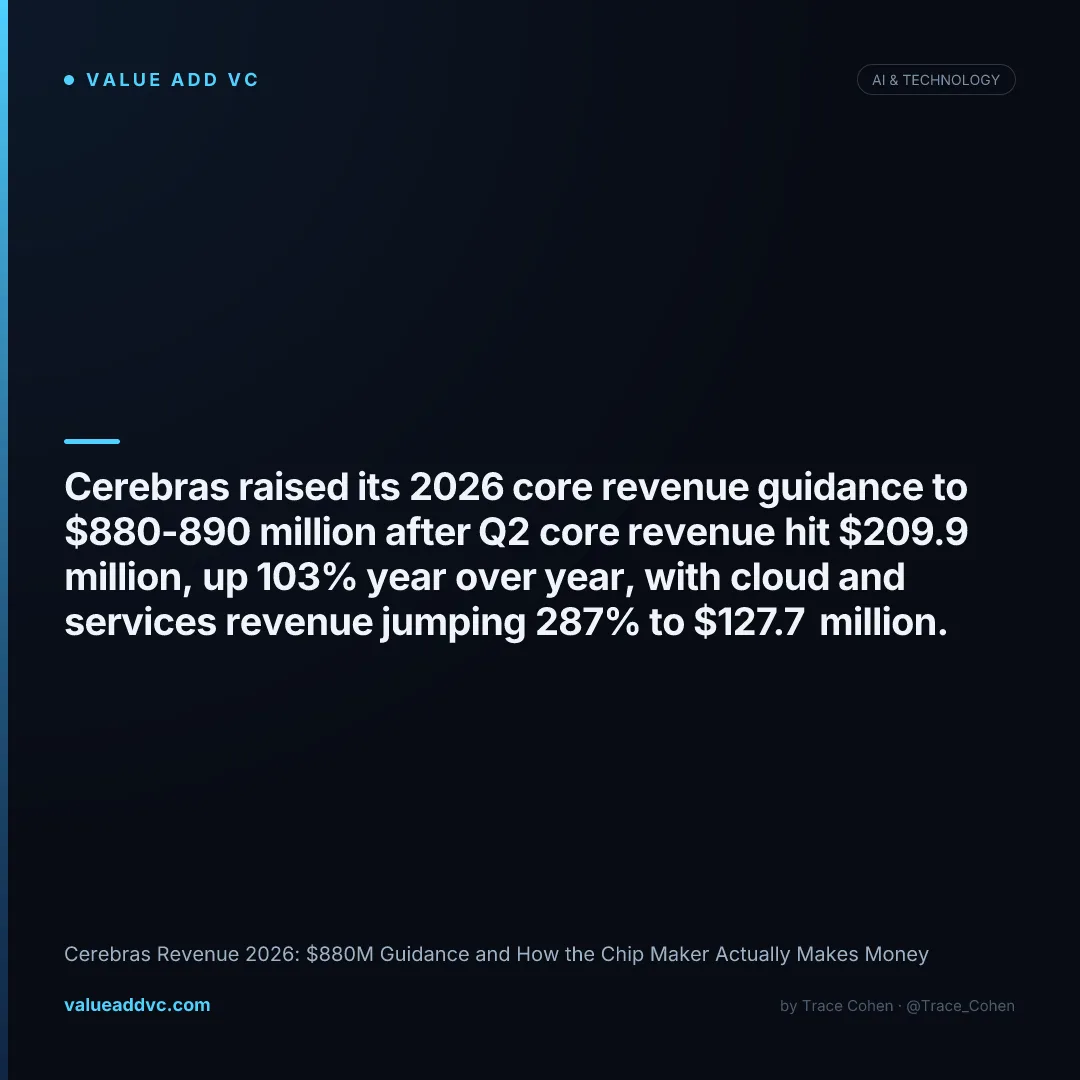
Cerebras made $209.9 million in core revenue in Q2 2026, up 103% year over year, and just raised its full-year guidance to $880-890 million. The catch: roughly 86% of last year's revenue traced back to two related entities in Abu Dhabi.
Cerebras went public in May 2026 on the strength of a wafer-scale chip that's genuinely faster than Nvidia GPUs at inference. Three months later, the first two full quarterly earnings reports as a public company tell a more complicated story than "fastest AI chip beats Nvidia" — real growth, real margin improvement, a real operating loss, and a customer concentration profile that would make most public-market investors nervous. Here's how Cerebras actually makes money, and what the numbers say about whether the business can stand on its own.
Figures from Cerebras Systems Q2 2026 earnings release and earnings call transcript, August 12, 2026.
Cerebras Revenue 2026: The Growth Numbers
Cerebras reported core revenue of $209.9 million in Q2 2026, up 103% year over year, and management used that print to raise full-year 2026 core revenue guidance to $880-890 million — nearly double the $509.99 million the company generated across all of 2025. That 2025 figure was itself up 75.71% from 2024, so the growth rate has actually accelerated in the first year as a public company rather than decelerated, which is unusual for a business this size. Management also projected more than 3x revenue growth heading into 2027, a target that only makes sense if the current wave of AI infrastructure spending keeps compounding rather than plateauing.
For context on how that stacks against the rest of the inference-chip field, see our breakdown of how Groq makes money off its LPU chips and GroqCloud — Groq is running a similar hardware-to-cloud transition on a smaller revenue base.
How Does Cerebras Make Money? Hardware vs. Cloud
Cerebras generates revenue three ways: direct sales of its CS-3 wafer-scale systems, bundled supercomputing packages sold mostly to sovereign and government customers, and usage-based cloud inference sold through its own API — the same model Groq and SambaNova run. Historically, roughly three-quarters of revenue came from hardware, with the rest split between cloud and services. That mix is now inverting fast: Q2 2026 cloud and services revenue jumped 287% year over year to $127.7 million while hardware revenue actually declined 23% to $54.1 million from $70.3 million a year earlier, according to the Q2 earnings release.
| Metric | Q2 2026 | Q2 2025 | YoY Change |
|---|---|---|---|
| Core revenue (total) | $209.9M | $103.4M | +103% |
| Cloud & services revenue | $127.7M | $33.0M | +287% |
| Hardware revenue | $82.1M | $70.3M | +17% |
| Core gross margin | 40.6% | ~31.2% | +940 bps |
| Core operating margin | -16% | ~-42% | +2,600 bps |
| Core operating loss | -$33.6M | n/a | narrowing |
| Remaining performance obligations | $25.4B | n/a | up from $24.6B |
| Full-year 2025 revenue | $510.0M | $290.3M (2024) | +76% |
Sources: Cerebras Systems Q2 2026 earnings release (GlobeNewswire, August 12, 2026); Cerebras S-1/DRS filings; MacroTrends.
The G42 and MBZUAI Concentration Problem
The number that should worry anyone underwriting Cerebras revenue isn't growth — it's concentration. G42, the Abu Dhabi AI conglomerate, accounted for 85% of Cerebras' 2024 revenue, a figure so extreme it triggered a national security review by CFIUS and forced Cerebras to withdraw its original 2024 IPO filing entirely. By 2025, G42's direct share had fallen to 24% of revenue — the kind of diversification story a growth investor wants to see. Except the S-1 also discloses that Mohamed bin Zayed University of Artificial Intelligence (MBZUAI) made up 62% of 2025 revenue on its own, and Cerebras states plainly that G42 and MBZUAI are related parties to each other.
Add those two together and roughly 86% of Cerebras' 2025 revenue traced back to a single UAE-linked relationship network, according to the company's IPO disclosures. That's not diversification — it's the same concentration risk wearing a different entity name. G42 itself is a related party to Cerebras in another sense too: G42 has been both a customer and an investor, having provided $335 million in past investment.
The bull case is that the OpenAI compute deal — worth more than $20 billion and covering 750 megawatts of capacity through 2028 — is exactly the kind of Western hyperscaler revenue that dilutes the UAE dependency over time as it ramps into the backlog. The bear case is that the $25.4 billion remaining performance obligations figure is still mostly unrealized backlog, not booked revenue, and any slowdown in either the UAE relationship or the OpenAI ramp would hit reported revenue hard given how few large customers exist in either bucket.
Cerebras Revenue Mix Shift: Q2 2025 vs. Q2 2026
Cerebras Systems earnings releases
Is Cerebras Profitable? The Margin Picture
No — Cerebras is not profitable, and management isn't promising it will be soon. Core operating loss was $33.6 million in Q2 2026 on a negative 16% operating margin, though that's a roughly 2,600 basis-point improvement from a year earlier, when the company was burning far more relative to revenue. Core gross margin improved to 40.6%, up about 940 basis points year over year — a meaningful signal that as cloud and services revenue scales, the unit economics are getting healthier, since cloud utilization on already-deployed hardware carries higher incremental margin than one-off system sales.
Data center capacity is the current bottleneck on growth, not demand. Management said on the Q2 earnings call that the company has secured 600 megawatts of capacity but still can't deploy fast enough to meet order flow, which is the inverse problem of most AI infrastructure companies — Cerebras has the backlog, it just needs the power and floor space to convert it into revenue.
Cerebras Revenue vs. the Stock's Valuation
CBRS priced its IPO at $185 a share in May 2026 and has traded in a wide band since — a 52-week range of roughly $160.81 to $386.34, and a market cap that's swung from a first-day close near $67 billion down toward the high-$40 billions to high-$50 billions depending on the week, as detailed in our Cerebras stock post-IPO tracker. Even at the lower end of that range, the stock trades at somewhere around 50-60x trailing 2025 revenue of $510 million — a multiple that only makes sense if the $880-890 million 2026 guide holds and the backlog keeps converting on schedule.
On the underlying hardware, Cerebras' pitch has always been speed: the CS-3 delivers Llama 3.1 70B inference at over 1,800 tokens per second, roughly 20 times faster than a single hyperscale GPU instance, and Cerebras prices inference at 10 cents per million tokens for smaller models — the kind of price-performance gap that wins sovereign and government contracts even if it hasn't yet won broad enterprise diversification. See Cerebras' own CS-3 vs. DGX B200 benchmarks for the technical comparison.
What the headline misses
A 103% year-over-year revenue growth number sounds like an unambiguous win, and on the top line it is. But growth alone doesn't tell you whether Cerebras has escaped its customer concentration problem — it's told you the company found a new large buyer (OpenAI) fast enough to keep the headline number climbing while the UAE relationships are still, by the company's own S-1 disclosure, roughly 86% of last year's revenue base. Revenue diversification by customer count matters as much as revenue growth by dollar amount for a company this reliant on a handful of relationships, and Cerebras hasn't proven that yet — it's proven it can add one more giant customer on top of the concentrated base it already had.
Bottom line: Cerebras' Q2 2026 core revenue of $209.9 million, up 103% year over year, and the raised $880-890 million full-year guidance are genuinely strong numbers for a company three months removed from its IPO. The mix shift toward cloud and services — up 287% while hardware revenue actually shrank — is the more important story for long-term margins than the headline growth rate. But roughly 86% of 2025 revenue tracing to two related UAE entities, alongside a still-negative operating margin and a stock trading at 50x-plus trailing revenue, means the bull case still rests on the $25.4 billion backlog and the OpenAI relationship converting cleanly over the next two years, not on the business having already proven it can stand on a diversified customer base.
Latest from the Pulse
Get VC data most people never see
— free to subscribe
Trace's notes on venture, AI and startups, a few times a week. Join 5,000+ subscribers. No spam.