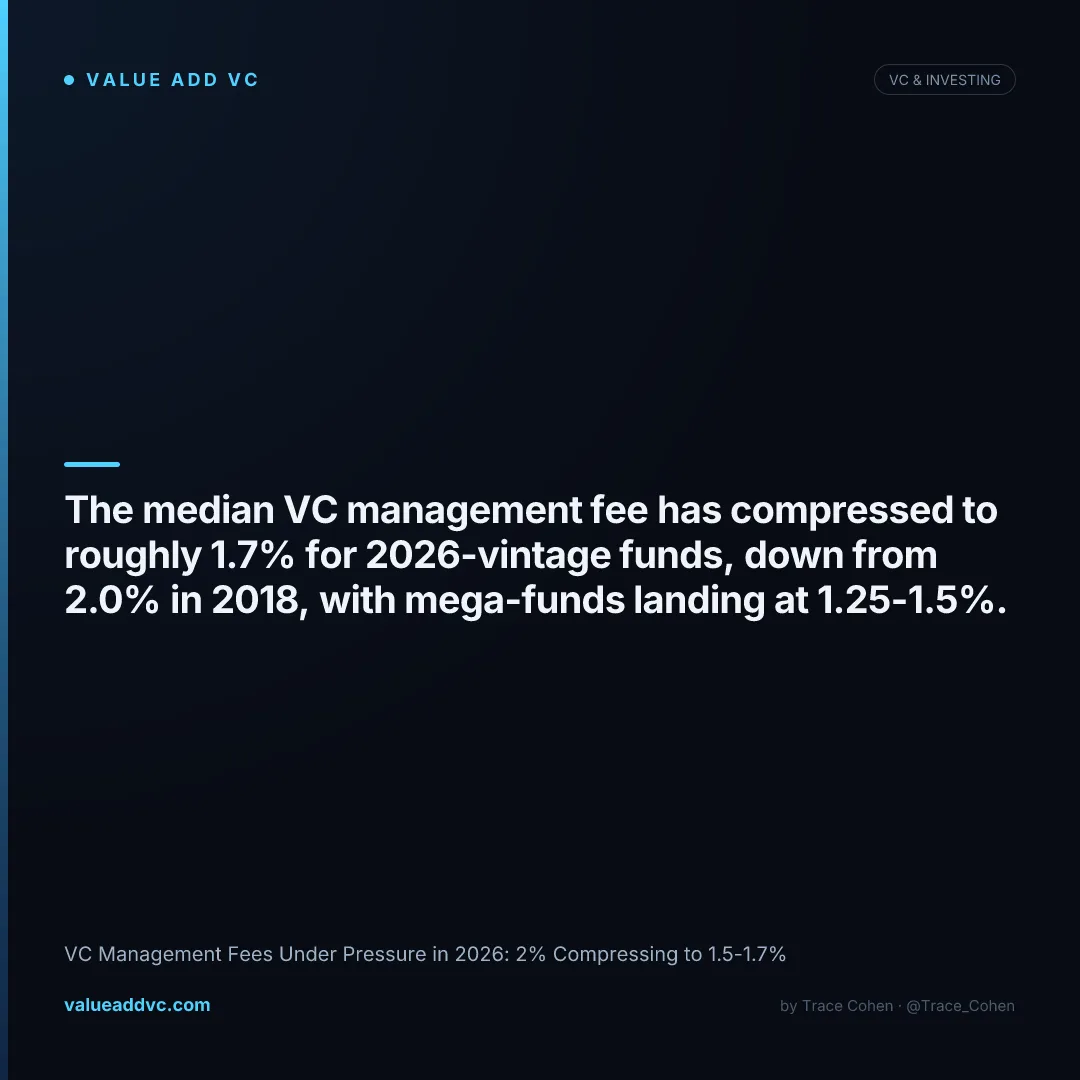
The median VC management fee for 2026-vintage funds has compressed to roughly 1.7%, down from 2.0% for 2018-vintage funds, and mega-funds above $1 billion are increasingly landing at 1.25-1.5%. That's the short answer. The longer answer is that fee pressure is landing unevenly — hardest on proven managers raising successor funds, barely at all on debut managers who have no leverage to negotiate with.
The standard "2-and-20" VC fee structure — a 2% annual management fee plus 20% carried interest — held remarkably stable for two decades. That's now cracking, not because LPs suddenly discovered fee math, but because a multi-year stretch of weak distributions gave them the leverage to finally act on it.
Figures are 2026 estimates blended from Venture Capital Journal's LP Perspectives 2026 Study, PitchBook-NVCA Venture Monitor Q1-Q2 2026, and VC Lab emerging manager reporting.
Why VC Management Fee Pressure From LPs Is Real in 2026
VC management fee pressure from LPs in 2026 is concentrated at the top of the market: institutional limited partners are pushing fund managers with a proven track record toward fees near 1.5-1.7%, using step-downs and management fee offsets as the primary negotiating levers, while debut and sub-$50 million funds still close at the traditional 2% because they lack comparable leverage. The shift reflects a multi-year run of weak distributions rather than any change in the underlying 2-and-20 template.
Roughly half of LPs surveyed for the 2026 LP Perspectives Study say their venture holdings are underperforming benchmarks, yet most report no plans to cut back commitments — they're staying in the asset class but getting more aggressive about the price they pay to access it. Offering a straight 2% fee with no offset mechanism now draws far more scrutiny from institutional allocators than it did before the 2022 downturn began compressing paper returns across the industry.
Fee Terms by Fund Size: 2018 vs 2026
The clearest way to see fee compression is by fund size tier. Larger, more institutional funds have the LP base sophisticated enough to negotiate hard, and the track record to give that negotiation teeth — which is exactly where the compression shows up first.
| Fund Tier | Mgmt Fee | Step-Down Timing | Carry | LP Negotiating Leverage |
|---|---|---|---|---|
| Sub-$50M (emerging/debut) | 2.0% | Rare, or year 5-6 | 20% | Low — LPs accept standard terms to access the manager at all |
| $50M-$250M | 1.85-1.9% | Year 5, to ~1.5% | 20% | Moderate — some offset negotiation on successor funds |
| $250M-$1B | 1.7-1.8% | Year 4-5, to ~1.0-1.25% | 20% | Meaningful — institutional LPs push on fee base and timing |
| $1B+ (mega-fund) | 1.25-1.5% | Year 4, to ~1.0% | 20-25% | High — largest LPs negotiate side letters and co-invest rights |
| 2018-vintage median (all sizes) | 2.0% | Uncommon before year 6 | 20% | Low — pre-2022 seller's market favored GPs |
| 2026-vintage median (all sizes) | 1.7% | Year 4-5 standard | 20% | Rising — 2022-2026 downturn shifted leverage toward LPs |
Figures are 2026 estimates blended from Venture Capital Journal's LP Perspectives 2026 Study, Katten Muchin Rosenman LP trends reporting, and Withum's 2026 Private Funds CFO Fees and Expenses Survey. 2018-vintage figures reflect pre-2022 market conditions before the current downturn began shifting leverage toward LPs.
The Paradox: LPs Are Consolidating Toward the Managers Charging the Least
Here's the counterintuitive part. Fee pressure hasn't slowed the concentration of LP capital into established managers — if anything, it's accelerated it. Established firms captured 90.9% of Q1 2026 fundraising, and funds greater than $1 billion accounted for 71.9% of total capital raised year-to-date, up sharply from 34.2% in 2025 and 49% in 2024. LPs are getting the lower fees they've been asking for precisely by consolidating into the largest, most proven managers — the same managers who now have enough scale and track record to negotiate favorable terms on their own capital-raising, creating a fee discount that flows almost entirely to institutions large enough to write checks into mega-funds.
Emerging managers face the opposite dynamic: median fundraising periods for a second fund now run around 16 months, and nearly 90% of emerging funds that closed in Q1-Q2 2026 targeted sub-$15 million fund sizes, with funds above $15 million making up just 13% of the total. Debut managers aren't winning the fee negotiation — they're winning smaller checks at unchanged fee percentages, which keeps the absolute dollar cost low even as the rate stays at 2%. You can track how fund performance benchmarks vary by vintage and size on our VC and PE performance dashboard.
Fundraising Concentration: 2025 vs 2026 YTD
PitchBook-NVCA Venture Monitor, Q1-Q2 2026
Management Fee Offsets: The Real Lever LPs Are Pulling
Headline fee percentage gets the attention, but the more consequential negotiation in 2026 is happening around management fee offsets — mechanisms that credit a portion of deal-related fees, board fees, or transaction fees the GP collects back against the management fee LPs pay. In every institutional term sheet reviewed in 2025, the fee step-down started in year four or five, moving the effective rate from 2% down toward 1%, and most LPs accepted the timing without pushing to move it earlier.
Carried interest, by contrast, has barely moved. 20% carry remains the near-universal standard across fund sizes in 2026, which means the entire fee-compression story is really a management-fee story — LPs are negotiating the fixed cost of access, not the variable cost of performance, because carry only gets paid on actual returns while management fees get paid regardless of outcome. Regulatory scrutiny has added another layer of pressure: 90% of firms examined by the SEC in their most recent audit were asked about fees and expenses, pushing GPs toward cleaner, more disclosed fee structures even before an LP raises the issue directly.
How Fee Negotiation Actually Plays Out at the Term Sheet
Most LPs aren't negotiating the headline percentage line by line — they're negotiating side letters. Larger commitments, "frequent flyer" LPs who've re-upped across multiple funds, and anchor investors who commit early in a raise routinely secure most-favored-nation clauses, fee rebates tied to co-investment volume, or enhanced reporting rights that don't show up in the fund's standard limited partnership agreement at all. That's part of why aggregate fee data can understate the real spread: two LPs in the same $500 million fund can be paying meaningfully different effective rates once side letter terms are layered in.
Venture funds also remain more resistant to fee concessions than private equity peers of comparable size, which is a structural quirk worth understanding if you're benchmarking across asset classes. PE funds have longer histories of institutional-scale LP bases pushing on fees, while venture's smaller check sizes and higher return dispersion give GPs more room to argue that a strong fund's fee is immaterial next to the return spread between top-quartile and median performance. That argument gets harder to make in a market where half of LPs say their VC allocation is underperforming benchmark, which is exactly the dynamic pushing 2026 fee terms lower even as GPs resist the comparison to private equity.
What This Means If You're Raising a Fund in 2026
If you're a GP raising a debut or Fund II in the sub-$50 million range, don't lead with a below-market fee to compete for LP attention — institutional allocators read an underpriced fee as a signal of desperation, not value, and it undermines your ability to raise the standard 2% on your next fund once you actually have a track record. Compete instead on fund size discipline (matching your check size to your actual sourcing edge), transparent expense allocation, and GP co-investment terms that align your incentives without touching the headline rate.
If you're an LP, the leverage you actually have concentrates on successor funds from managers you've already backed — that's where a track record exists to negotiate against, and where step-down timing and offset mechanisms are genuinely on the table. Pushing a debut manager below 2% mostly just signals you don't understand what you're buying: at the earliest stage, the fee covers the GP's ability to operate at all, not a discount you're entitled to extract.
Bottom line: VC management fees are compressing — 1.7% median in 2026 versus 2.0% in 2018, with mega-funds at 1.25-1.5% — but the compression is a story about LP leverage over proven managers, not a broad repricing of the asset class. Carry is unchanged at 20%, debut managers are still paying full freight, and the 90.9% of Q1 2026 capital that flowed to established firms shows LPs are getting lower fees by concentrating with fewer, larger managers rather than by winning concessions across the board. Understand which side of that divide your fund sits on before you assume the fee-pressure headlines apply to your next raise.
Latest from the Pulse
Get VC data most people never see
— free to subscribe
Trace's notes on venture, AI and startups, a few times a week. Join 5,000+ subscribers. No spam.
No spam, unsubscribe anytime. Sent via Substack · Privacy · or subscribe on Substack ↗