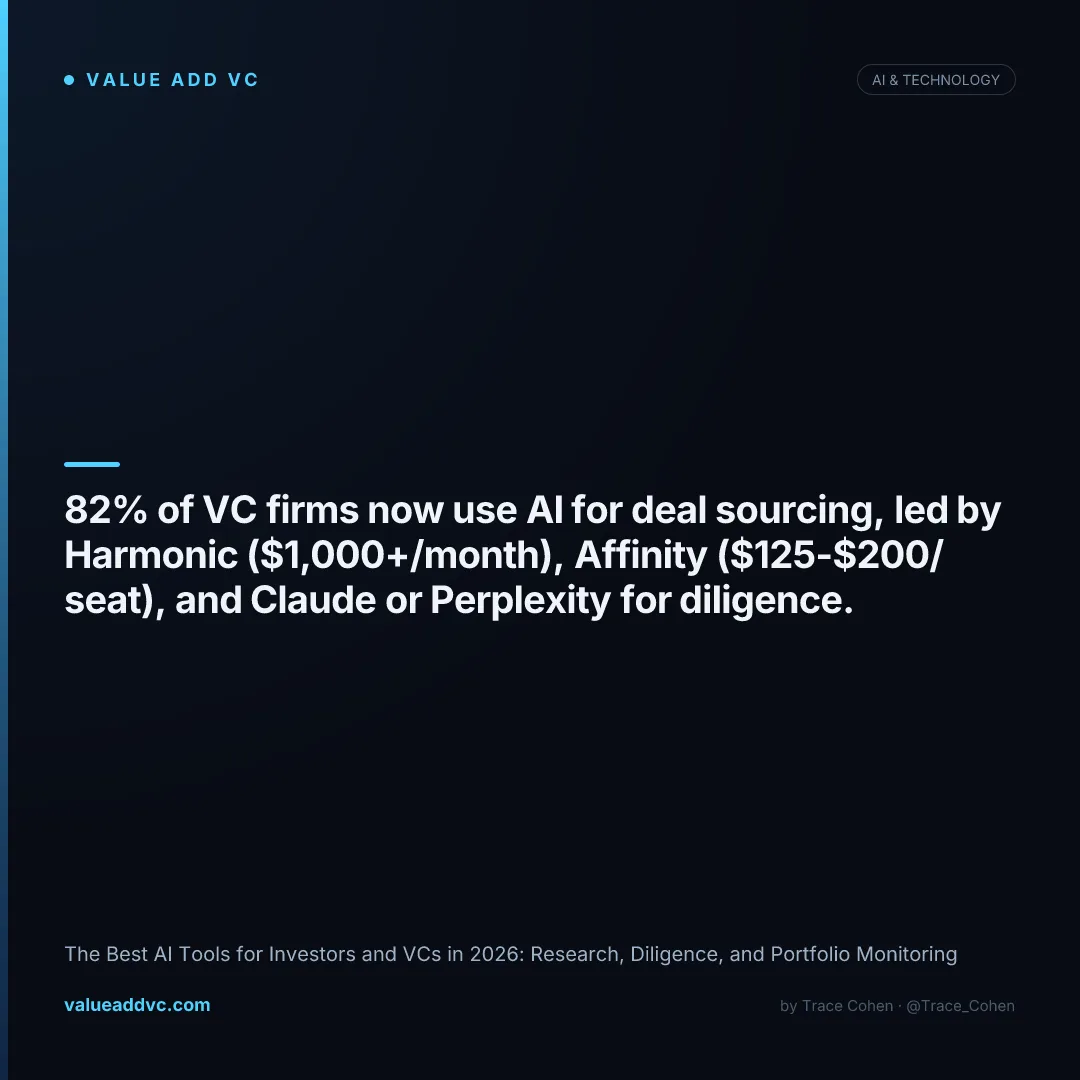
82% of VC firms now use AI tools for deal sourcing, and 85% use AI to automate daily tasks — up from 76% a year ago. That's the short answer. The longer answer is which tools are actually worth paying for.
Every fund pitch deck now claims an "AI-powered" workflow, but the tools that survive renewal season are a much shorter list than the ones getting demoed, and plenty are expensive dashboards nobody opens after month two. This is the real 2026 stack, with real pricing.
Figures from Affinity's 2026 survey of ~300 private capital dealmakers and vendor-reported adoption data as of July 2026.
What Are the Best AI Tools for Investors and VCs in 2026?
The best AI tools for investors and VCs in 2026 split into three categories: deal sourcing (Harmonic, PitchBook, SourceScrub), diligence and research (Claude, Perplexity, Brightwave), and portfolio monitoring (Chronograph, Standard Metrics). No single platform covers all three well, which is why most funds now run three to five AI tools instead of one all-in-one suite.
| Tool | Category | Typical Cost | Best For |
|---|---|---|---|
| Harmonic | Deal sourcing | $1,000+/mo | Finding pre-seed and stealth companies 2-4 months early |
| Affinity | CRM / relationship intel | $125-$200/seat/mo | Automating warm-intro and pipeline tracking |
| PitchBook | Market data / sourcing | ~$20K-$30K/yr | Comps, market maps, predictive thesis matching |
| SourceScrub | Deal sourcing | $50K-$200K/yr | Proprietary and bootstrapped company discovery |
| Claude | Diligence / document synthesis | $20-$200/mo | Long-context deck, cap table, and model review |
| Perplexity | Research | $20/mo (Pro) | Citation-backed, fast market research |
| Brightwave | Investment research | Enterprise (contact sales) | Synthesizing filings, earnings calls, competitive maps |
| Chronograph | Portfolio monitoring | Enterprise (contact sales) | Institutional LPs/GPs, multi-fund reporting at scale |
| Standard Metrics | Portfolio monitoring | Custom pricing | VC-focused KPI collection, Aumni replacement |
Figures are 2026 estimates blended from Affinity, Peony, Harmonic, and vendor pricing pages. Enterprise tools with custom quotes are marked "contact sales" rather than assigned a fabricated number.
The Best AI Tools for VCs Doing Deal Sourcing
Deal sourcing is where AI adoption is furthest along — 82% of VC firms already use it here, more than any other workflow. Harmonic indexes more than 30 million companies and tracks founder movements, hiring signals, and early traction indicators, which is why funds using it report surfacing companies two to four months before they'd otherwise see them. SourceScrub plays a similar role for bootstrapped and off-radar companies that never show up in a Crunchbase search, and it commands enterprise pricing to match — $50,000 to $200,000 a year depending on seat count and data scope. PitchBook remains the default for market-level data, and its AI-assisted filters now let you screen by funding stage, geography, growth signals, and investor history in one query instead of five.
Best AI Diligence Tools for Investors in 2026
Once a deal is in the pipeline, the job shifts from finding companies to understanding them fast. Claude has become the diligence tool of choice for investors who need depth — its long context window processes an entire pitch deck, partnership agreement, or financial model in a single prompt, which matters when a Series B data room has 40 documents and a partner meeting is in three hours. Perplexity earns its spot for a different reason: every answer comes with a source citation, which is the difference between a research note you can put in an investment memo and one you have to re-verify yourself. Brightwave sits between the two, applying LLMs specifically to investment research — synthesizing earnings calls, SEC filings, and news into structured competitive analysis that would otherwise take an analyst a full day. Some analysts are also stacking Google's source-grounded research notebook on top of a data room to keep every citation traceable back to the original document.
None of these replace a partner's judgment, and any fund that says otherwise should be viewed skeptically. What they do is compress the first draft of diligence from days to hours, which frees up the actual partner meeting for the questions that matter — team, market timing, and why this founder wins. If you're building out your own research process, our VC Performance dashboard is a useful complement for benchmarking a target fund or manager once the qualitative diligence is done.
Portfolio Monitoring: The Best AI Tools for VCs After Aumni's Shutdown
Portfolio monitoring got disrupted in a way nobody asked for: J.P. Morgan discontinued Aumni, the AI-powered platform that extracted legal terms, cap table data, and KPIs from portfolio company documents, with client access cut off March 31, 2026. That left a real gap — no other platform has fully replicated Aumni's legal-term extraction at scale — and funds have split into two camps to fill it. Larger institutional LPs and GPs with complex multi-fund structures have consolidated around Chronograph, which now monitors more than $19 trillion in assets across 100,000-plus underlying companies. Smaller and mid-sized VC funds have mostly moved to Standard Metrics, which is purpose-built for VC-style KPI collection rather than the private-equity-first design Chronograph started with.
If you're an emerging manager rebuilding your monitoring stack this year, don't just replace Aumni's feature list — ask which tool actually gets your portfolio companies to respond to a quarterly data request. Track your own fund's numbers alongside category benchmarks on our Funds Tracker.
How VC Firms Are Actually Building Their 2026 AI Stack
The pattern across funds building out an AI stack is consistent: nobody buys one AI platform and calls it done. A typical seed-to-Series-A fund with 3-6 investment professionals runs Affinity or a comparable CRM for pipeline (~$20K/year), layers in Harmonic or PitchBook for sourcing (~$12K-$36K/year), and then uses Claude or Perplexity on a per-seat consumer or team plan for diligence rather than buying an enterprise research contract. That's a $35K-$60K annual stack, well below the $200K+ that a growth-stage or PE-adjacent fund pays once SourceScrub or Specter enters the mix.
Stage matters more than firm size when it comes to which tools are worth the spend. Pre-seed and seed funds get the most leverage out of sourcing tools like Harmonic, because the entire value proposition is finding a company before it has a data room anyone else can see. Series B and later funds get more value from diligence and monitoring tools, because by growth stage the sourcing problem is largely solved through existing relationships and the real bottleneck is processing S-1-sized data rooms and tracking 20-40 portfolio companies' KPIs every quarter without a dedicated ops hire.
One thing worth flagging for any fund evaluating this stack for the first time: vendor churn risk is real. Aumni going from a J.P. Morgan-backed category leader to a shutdown notice in under two years is a reminder that "enterprise-grade" doesn't mean permanent. Whatever you adopt, keep raw exports of your cap table data, KPI history, and diligence notes outside the vendor's walled garden — that single habit would have saved every Aumni customer a scramble in Q1 2026.
85% of dealmakers automate tasks with AI in 2026, up from 76% a year ago.
The tools worth paying for are the narrow ones that do one job well — not the ones that promise to do all three.
The Practical Take: Building an AI Stack as a VC in 2026
The practical approach is a lean stack: one sourcing tool, one CRM, and Claude or Perplexity for anything that needs fast synthesis. The common mistake among emerging managers is buying the full enterprise suite before they have the deal flow to justify it — a $125,000 SourceScrub contract makes sense for a fund doing 400 diligence processes a year, not one doing 40. Start with the free or cheap layer (Perplexity, Claude's consumer tiers) and only move to enterprise sourcing once you can point to specific deals missed without it.
The bigger shift to watch is portfolio monitoring. Aumni's shutdown proved that even a JPMorgan-backed platform can disappear overnight, and every fund that outsourced its legal-term extraction to a single vendor is now re-doing that work. Whatever a fund picks next, keeping the underlying data portable matters — the tool will change again before a Fund II closes.
The Bottom Line
82% of VC firms use AI for deal sourcing and 85% automate daily tasks with it, but the tools that earn their renewal are still narrow and specific: Harmonic for early discovery, Affinity for relationship tracking, Claude or Perplexity for diligence, and Chronograph or Standard Metrics for monitoring after Aumni's exit. Pricing ranges from a $20-a-month Perplexity subscription to a $200,000-a-year SourceScrub contract, and the right stack depends entirely on how many deals you're actually running through it.
Compare your own fund's performance against category benchmarks on our VC Performance tracker, or see how AI-native companies themselves are being valued on AI Valuations. None of these tools will find you a better deal than a strong network will — they just make sure you don't lose the deal to a slower diligence process once you're in the room.
Follow VC tooling and fund benchmarks on Value Add VC. Reach out at t@nyvp.com or @Trace_Cohen.
Latest from the Pulse
Get VC data most people never see
— free to subscribe
Trace's notes on venture, AI and startups, a few times a week. Join 5,000+ subscribers. No spam.