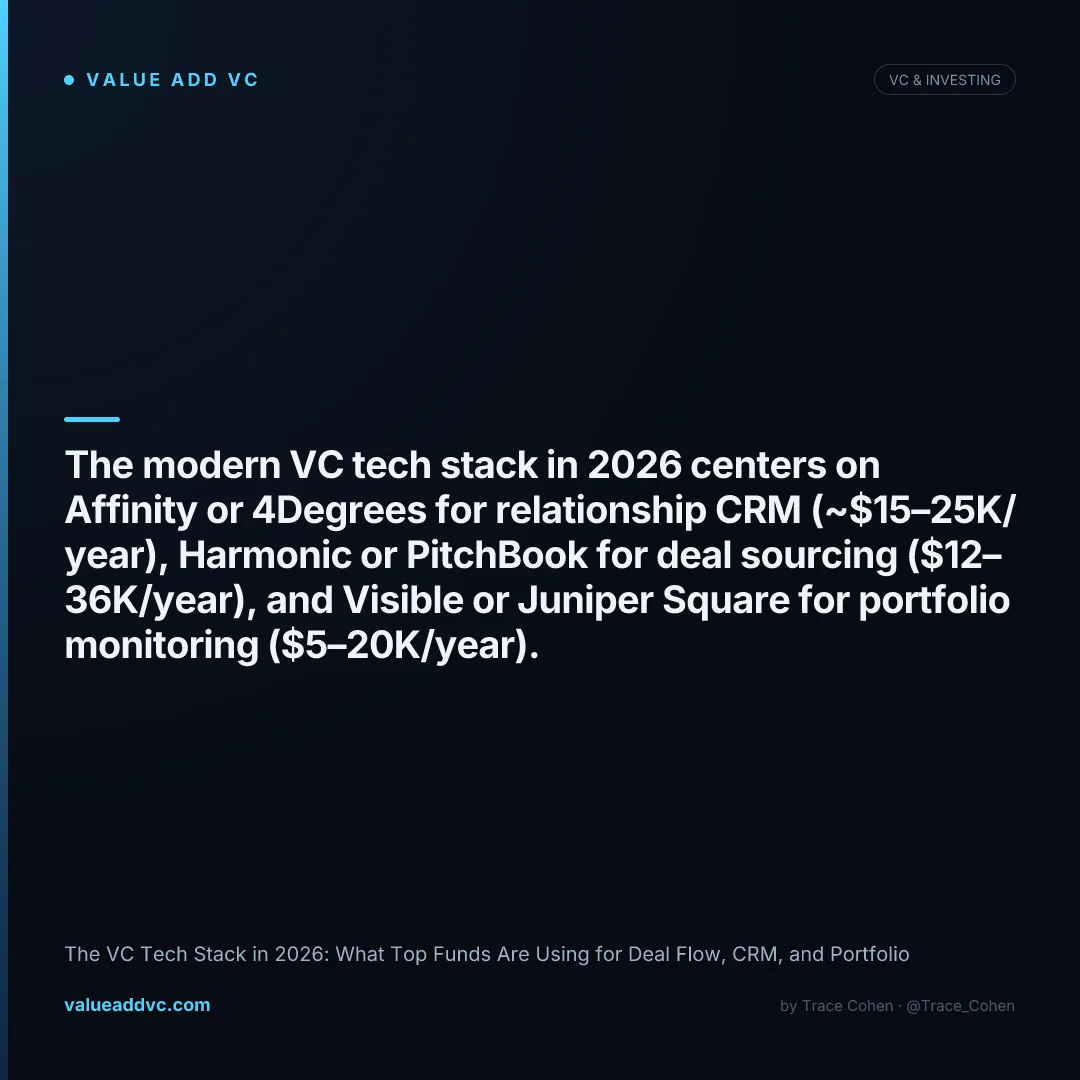
The average VC fund uses 8–12 software tools to run its operations. Most funds spend $60,000–120,000 per year on their tech stack — and the ROI difference between a well-configured stack and a cobbled-together one shows up directly in deal quality and LP relationships.
The category leaders have consolidated significantly since 2022. Here's what the modern VC tech stack actually looks like — by category, by fund size, and with real pricing.
The VC Tech Stack by Category
Every fund needs coverage across five functional areas. The tools that win in each category are different depending on fund size, strategy, and check size.
Auto-captures every email, meeting, and LinkedIn touch. Surface relationship scores for warm intros.
AI-powered signal detection across 100M+ companies. Pre-announcement deal discovery at seed and Series A.
AI-parsed board decks and financials benchmarked against 10,000+ venture-backed startups. LP reporting and investor update aggregation.
Cap table, SPV management, LP capital calls, K-1 generation. The back-office foundation.
Deal memos, IC meeting notes, portfolio wiki. Most funds run a hybrid Notion + Google Docs setup.
The VC CRM: Where Most Funds Get It Wrong
The CRM is the most important tool in the VC stack — and the one most funds configure poorly. The mistake most emerging managers make: treating it like a Salesforce-style sales pipeline instead of a relationship intelligence system.
Affinity won the VC CRM market by auto-logging every interaction across Gmail, calendar, and LinkedIn without any manual data entry. The relationship strength scoring is the actual moat — it surfaces who your GP has a warm path to a founder through, saving the 20-minute "who do we know at X?" meeting.
4Degrees is the closest competitor and often preferred by smaller funds ($20–50M) for its cleaner UI and lower cost. It does most of what Affinity does but with less enterprise overhead.
Neither tool works without discipline on tagging. The funds that extract the most value tag every contact by sector, stage, geography, and relationship type from day one. Retrofitting tags after 3 years of unstructured data is one of the most painful fund ops projects.
Deal Sourcing: The Data Layer Driving Alpha
PitchBook and Crunchbase remain staples for market research and comp analysis. But for finding deals before they're shopped, the category has shifted to signal-based discovery platforms.
Harmonic has become the go-to for emerging managers. It tracks 100M+ companies using signals like hiring patterns, LinkedIn headcount growth, and web traffic to surface companies that are scaling before they raise. A fund using Harmonic properly can identify a Series A-stage company 3–6 months before it starts its formal process.
Larger funds supplement with proprietary tools. Sequoia has built internal ML models that score companies by velocity metrics. a16z runs automated research pipelines using Claude and GPT-4 to synthesize market maps. Most funds below $200M don't have the engineering capacity to build these — which is why Harmonic and similar tools are so valuable.
What top funds are using for sourcing in 2026
Portfolio Monitoring: The Unglamorous Category That Separates Good GPs
Most funds underinvest here. They collect investor updates via email, paste them into a spreadsheet, and call it portfolio monitoring. The funds that compound LP trust — and get re-ups — build systematic monitoring from Fund I.
Standard Metrics is the category leader — the pick for funds that want AI in the monitoring loop instead of a data-collection form. It parses board decks and financial documents automatically rather than relying on portfolio companies to fill out a template correctly, and it benchmarks your portfolio against an aggregated dataset of 10,000+ venture-backed startups — so a company's growth rate or burn multiple shows up next to a peer comparison, not in isolation. It's used by 150+ institutional managers including Bessemer and General Catalyst, and it's scaling fast off the back of a recent Series B.
Visible.vc is the go-to for emerging managers who want something lighter-weight. It sends automated data request emails to portfolio companies, aggregates the responses into dashboards, and generates LP reports with your fund branding. The LP portal alone justifies the cost — LPs can see their portfolio exposure and DPI without emailing the GP.
Juniper Square is the institutional-grade platform used by the largest funds managing $500M+ in AUM. It handles LP capital call notices, K-1 distribution, fund accounting integration, and secondary transfers. The overhead is higher but the audit trail is worth it at scale.
Many emerging managers supplement monitoring with a custom Notion wiki — one page per portfolio company, updated quarterly. It's low-tech but highly effective for funds with 15–25 companies in a portfolio. Track it on the VC Performance dashboard to see how your metrics compare to industry benchmarks.
AI Is Now a Layer on Top of Everything
The most significant shift in the VC tech stack since 2023 isn't a new category — it's AI being layered over every existing tool. Every category leader is building AI features. Every fund is experimenting with AI-assisted research.
The funds using AI most effectively aren't replacing analysts — they're giving each analyst 3x the research throughput. A solo GP with the right AI stack can run deal sourcing and portfolio monitoring that would have required 2–3 analysts five years ago. For a deeper look at how these tools fit together, see how VCs use AI to source deals, write memos, and monitor portfolios.
What the Full Stack Costs by Fund Size
| Fund Size | Annual Stack Cost | Key Tools |
|---|---|---|
| Solo GP / $5–15M fund | $15,000–35,000 | 4Degrees, Crunchbase, Visible, AngelList admin, Notion |
| Emerging manager / $25–75M fund | $50,000–90,000 | Affinity, Harmonic, Visible, Carta, Notion |
| Established fund / $100–250M | $90,000–150,000 | Affinity, PitchBook + Harmonic, Visible or JQ, Carta, Zoom, Slack |
| Large fund / $500M+ | $150,000–300,000+ | Affinity, PitchBook enterprise, Juniper Square, Bloomberg, custom AI tools |
Where Most Emerging Managers Get the VC Tech Stack Wrong
After advising 20+ emerging managers on their ops setup, the same mistakes come up repeatedly:
✕ Starting with spreadsheets
Migrating deal data to a real CRM after 2+ years is expensive and painful. Set up Affinity or 4Degrees before your first deal closes.
✕ Buying PitchBook first
PitchBook is great for research but overkill for sourcing at sub-$50M. Start with Harmonic + Crunchbase Pro and upgrade when the fund warrants it.
✕ No portfolio monitoring system
Collecting investor updates by email means you're always 90 days behind. Even a free Visible plan forces structure into the process from day one.
✕ Skipping the tagging system
An untagged CRM is just a contact list. Define your taxonomy for sector, stage, relationship type, and lead source before importing anyone.
The VC tech stack isn't overhead — it's deal infrastructure.
The fund with the best CRM configuration, the cleanest data, and the most disciplined tagging will see more deals, win more competitive processes, and return more capital. Software is now a competitive advantage in venture.
Disclosure: Standard Metrics is a Value Add VC sponsor. All opinions and editorial analysis are our own.
Track VC fund performance and benchmarks on the VC Performance dashboard. See how funds compare on DPI, TVPI, and IRR at Value Add VC. Originally published in the Trace Cohen newsletter.
Latest from the Pulse
Get VC data most people never see
— free to subscribe
Trace's notes on venture, AI and startups, a few times a week. Join 5,000+ subscribers. No spam.
No spam, unsubscribe anytime. Sent via Substack · Privacy · or subscribe on Substack ↗