The average VC fund sees 1,000–2,500 companies per year and invests in fewer than 15. The funds that consistently outperform aren't seeing more deals — they're seeing better ones, earlier.
Proprietary deal flow isn't brand and it isn't luck. It's a system. Most funds treat it as a passive byproduct of reputation and wait for it to accumulate. The top quartile builds it deliberately from day one.
Why How to Build Deal Flow Is the Real Alpha Question
Portfolio construction and check-writing strategy matter, but they operate on a constrained input: what you actually see. If your funnel matches every other fund — shared syndicates, mutual network intros, the same AngelList scout leads — you cannot generate differentiated returns. You are picking from the same pool with the same information at the same time.
40–60%
of top fund best investments from proprietary channels
Sequoia, Benchmark, First Round LP letters
3x
higher meeting conversion for thesis-specific vs. cold inbound outreach
Deal flow benchmarks across 50+ early-stage funds
18 mo
average time to build material inbound from zero brand
Emerging manager cohort data, 2023–2025
The Four Channels That Build a Real Deal Flow Engine
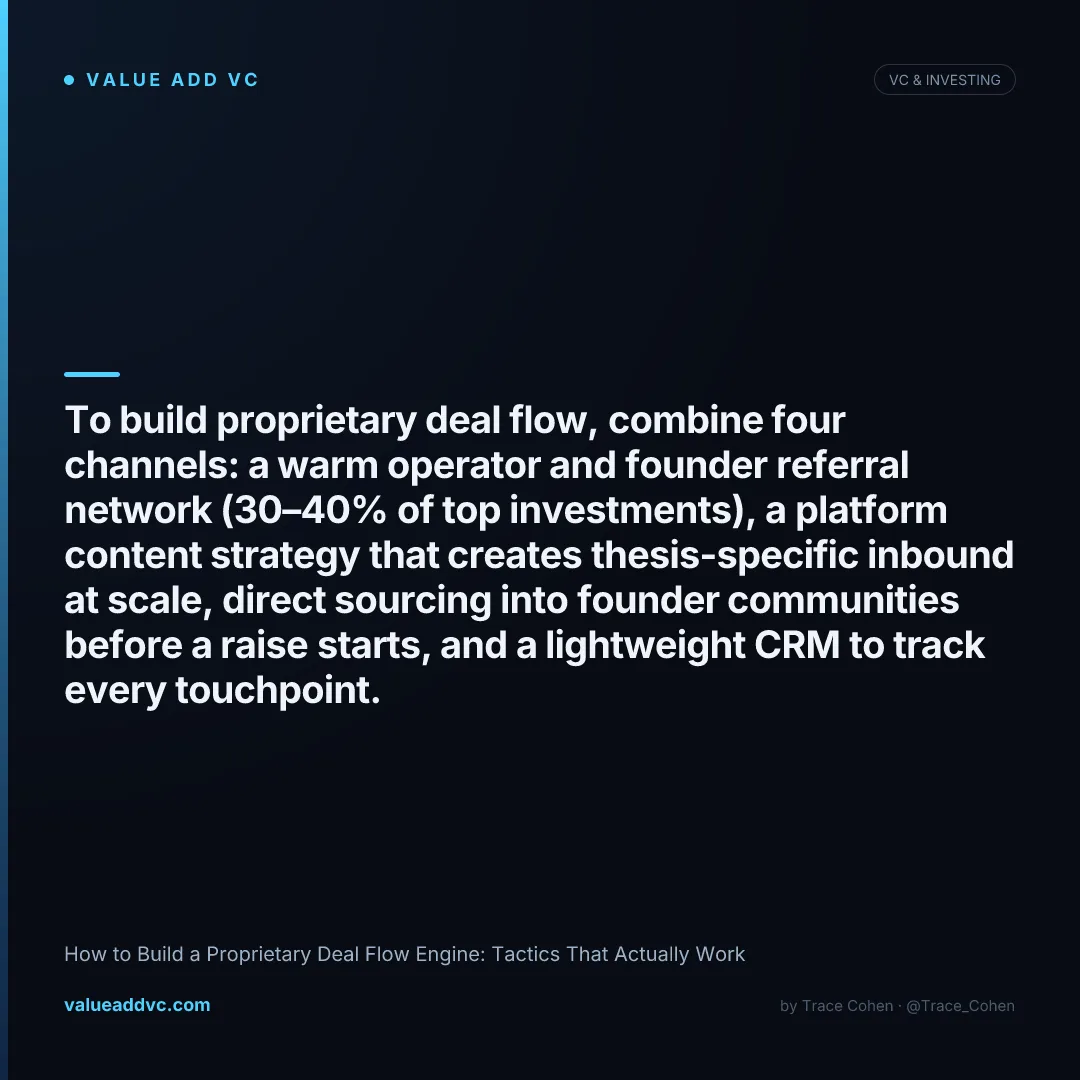
Every durable deal flow engine runs on four parallel channels. Funds that rely on a single one — typically warm intros — are one network disruption away from a dry year.
Operator and Founder Referral Network
This is the highest-signal channel and the hardest to shortcut. Founders who have worked with you — or who respect your reputation — will refer the best deals without being asked. Build this by being genuinely useful to portfolio companies, showing up for former colleagues who become founders, and helping people before there is a deal on the table. A referral from a trusted founder converts to investment at 5–8x the rate of cold inbound.
Typical contribution: 30–40% of best investments at top seed-stage funds
Platform Content That Creates Thesis-Specific Inbound
Writing publicly about your thesis tells the exact founders you want to meet where to find you. A16z's blog, First Round Review, and Bessemer's State of the Cloud all work as deal flow engines — the founders who read them are exactly who those funds want to back. Newsletters, data tools, and public frameworks generate compound inbound over time. This channel is slow for the first 12–18 months and then becomes a sustainable moat. The VC Performance Dashboard at Value Add VC generates thousands of monthly founder visits — that is direct inbound pipeline.
Typical contribution: 20–30% of inbound at content-focused funds
Proactive Thesis-Driven Direct Sourcing
If you have a real thesis, you know what a company looks like before it has raised. That means scanning GitHub for interesting open-source projects, attending domain-specific conferences rather than generic VC events, monitoring job boards for founding teams, and reaching out directly to technical founders before they start a formal process. This feels uncomfortable because it resembles cold outreach — but it is how the best-ownership positions get built, because you are the first call instead of the fifth.
Typical contribution: 15–25% of deals, often the highest-ownership positions
Scout and LP Network Extension
Scouts extend your geographic and sector reach without proportional cost. Sequoia pioneered the model and now hundreds of funds run structured programs. The best scouts are operators in a specific domain — fintech, climate, defense, health — who know who is building before anyone else. Well-structured programs pay $20–50K per year to 5–20 scouts in exchange for first-look rights on their deal flow. Even a Fund I can launch a scout program with 3–5 operators in target sectors.
Typical contribution: 10–15% of deals, disproportionately early and proprietary
The Deal Flow Tech Stack in 2026
Systems do not replace relationships, but they make relationships compound. A weak CRM means warm leads go cold. A strong one means every touchpoint builds signal over a multi-year horizon.
| Function | Best Tool | Annual Cost |
|---|---|---|
| Relationship CRM | Affinity or 4Degrees | $15–25K |
| Market scanning / prospecting | Harmonic + PitchBook | $12–36K |
| Founder outreach | LinkedIn Sales Navigator | $2–5K |
| Portfolio monitoring | Visible or Juniper Square | $5–12K |
| Content / inbound engine | Substack, Beehiiv, or in-house blog | $0–3K |
Total annual tooling for a $50–100M fund: $34–81K. A fund that skimps on CRM and sourcing infrastructure will lose more in missed deals than the software costs in a year.
What Emerging Managers Get Wrong
The same deal flow mistakes repeat consistently across first-time funds:
What Kills Deal Flow
- ✕ Waiting for brand to build before investing in content — the window to compound starts at Fund I
- ✕ Relying entirely on shared syndicates — you see what everyone else sees
- ✕ No specificity: "we look at B2B SaaS" attracts every company, attracts no particular founder
- ✕ A CRM no one updates — stale data is worse than no CRM
- ✕ Treating deal flow as passive — it requires active weekly investment of time
What Actually Compounds
- ✓ Narrow thesis, visible execution — become the most known investor in a specific category
- ✓ Create something founders use before they fundraise: data tools, frameworks, community
- ✓ Give warm intros generously — be as valuable a connector as you want to receive
- ✓ Formalize a scout network early, even at Fund I with 3–5 operators
- ✓ Log every interaction — a cold email today is a first check in 18 months
Deal Flow Benchmarks: Top Quartile vs. Median
Based on fund performance data tracked in the VC Performance Dashboard, top-quartile funds with $50–250M AUM show consistent deal flow metrics that separate them from median performers:
- →New companies reviewed per week: 25–40 at top-quartile funds vs. 8–15 at median funds
- →% from direct or proprietary sources: 35–55% top-quartile vs. 15–20% median
- →Time from first touch to term sheet (proactive sourcing): 45–90 days vs. 20–30 days for referred inbound — slower but higher ownership
- →Scout network size at $100M+ funds: 8–25 active scouts across sectors and geographies
- →Content-driven inbound as % of total pipeline: 15–25% at funds with active platforms vs. near zero at funds with no content strategy
Deal flow is not a feature of your brand. It's a function of your system.
The funds that compound over a decade don't wait for founders to find them — they build infrastructure so the best founders have no reason to go anywhere else first.
Track VC fund performance benchmarks at the VC Performance Dashboard and compare emerging manager metrics at Benchmarking. Originally published in the Trace Cohen newsletter.
Latest from the Pulse
Get VC data most people never see
— free to subscribe
Trace's notes on venture, AI and startups, a few times a week. Join 5,000+ subscribers. No spam.
No spam, unsubscribe anytime. Sent via Substack · Privacy · or subscribe on Substack ↗