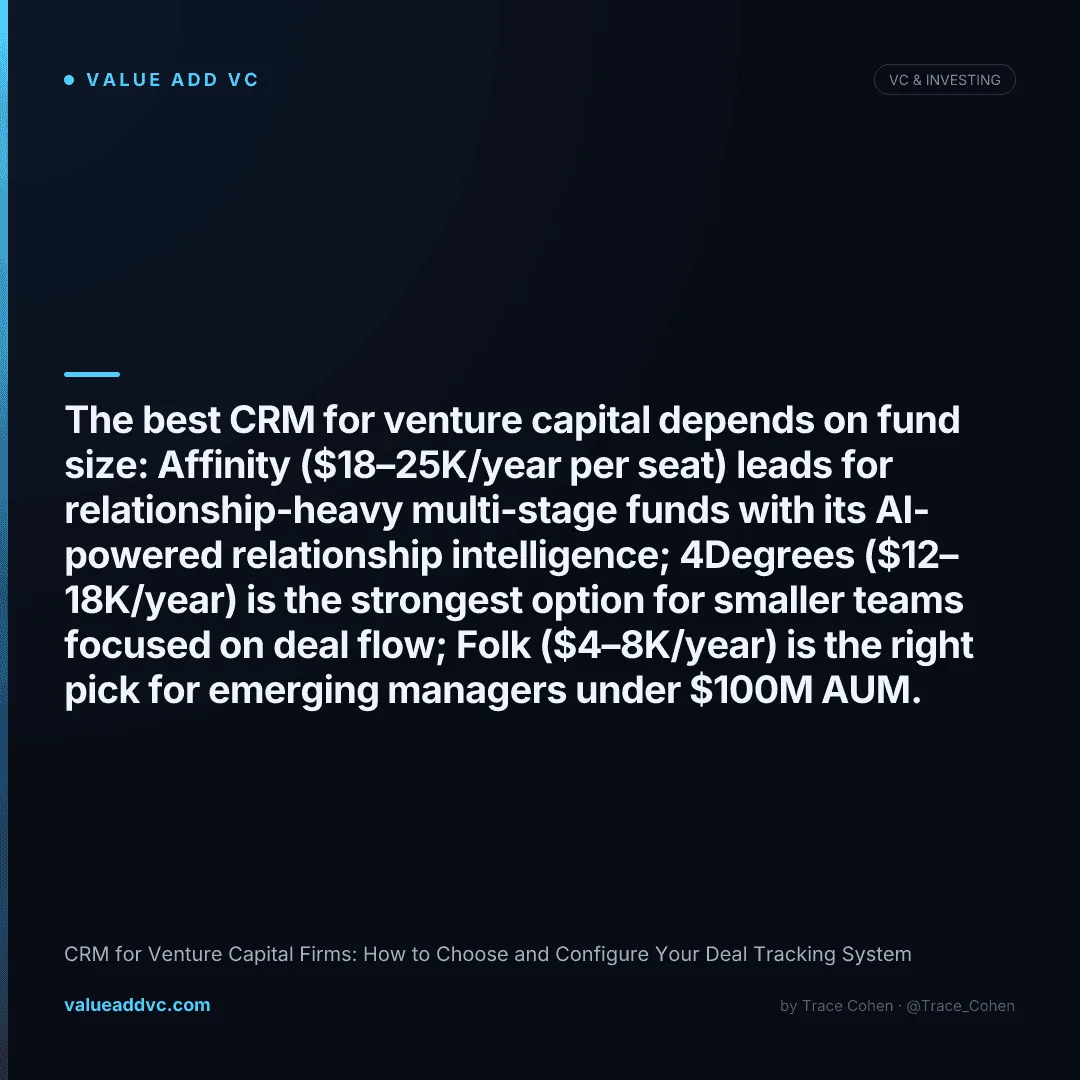
Most VC funds pick the wrong CRM because they optimize for the wrong thing — they evaluate features when they should be evaluating workflow fit.
A CRM for venture capital is not a sales tool. It's a relationship operating system. The job isn't to track a pipeline — it's to surface the right founder at the right time, remember who introduced you to whom three years ago, and make sure no promising company falls through because nobody logged the follow-up.
Here's a framework for choosing and configuring one correctly. If proprietary sourcing — not just pipeline tracking — is your bottleneck, see our ranked breakdown of deal flow and sourcing tools for how Grata, Sourcescrub, and PitchBook fit alongside a CRM.
The CRM for Venture Capital Landscape in 2026
There are four tiers of tools. The right tier depends almost entirely on AUM and team size, not on which has the most features.
What Makes a VC CRM Different From a Sales CRM
Every bad VC CRM implementation starts with someone saying "let's just use Salesforce." The problem is that Salesforce was designed for a fundamentally different sales motion. In enterprise SaaS sales, you are chasing a prospect who may not know you exist. In venture, you are cultivating a relationship with someone who's usually been introduced through your network, and the deal may take 18 months from first meeting to term sheet.
Relationship intelligence
Who introduced you, how many touchpoints, relationship strength score — Affinity and 4Degrees auto-compute this from email metadata
Auto-capture from inbox
Every email to a founder auto-logs. No manual entry. This is the single biggest productivity unlock in VC CRM
Portfolio monitoring
Separate workflow for tracking 10-K+ updates, news mentions, and LP reporting across your portfolio companies
LP tracking
Manage limited partner relationships, capital calls, and communication cadence in the same system as deal flow
The auto-capture feature is where most funds fall apart on generic CRMs. If your team has to manually log every interaction, they won't — and within six months your CRM is a ghost town. Affinity and 4Degrees both auto-ingest from Gmail and Outlook, which is why they dominate the space despite the price premium. Both are now adding AI layers — for a full breakdown, see how VCs use AI to source deals, write memos, and monitor portfolios.
Affinity vs 4Degrees: The Real Difference
Both are purpose-built CRMs for venture capital. The choice between them comes down to whether you're primarily managing relationships (Affinity) or managing deal flow (4Degrees).
| Feature | Affinity | 4Degrees |
|---|---|---|
| Pricing (per seat/year) | $18–25K | $12–18K |
| Relationship intelligence | Best in class | Strong |
| Deal pipeline | Good | Excellent |
| Auto email capture | Yes (Google/Outlook) | Yes (Google/Outlook) |
| PitchBook integration | Native | Native |
| Portfolio monitoring | Add-on | Included |
| LP tracking | Limited | Moderate |
| Best for fund size | $100M+ AUM | $25M–$250M AUM |
How to Configure Your VC CRM Correctly
A CRM is only as good as how you configure it. Most funds spend two weeks picking a platform and two hours setting it up — the exact inverse of the right ratio. Here's what a properly configured VC CRM looks like:
Total Cost of a VC CRM Stack
CRM is just one layer. A typical emerging manager runs three to four tools that together constitute their deal tracking stack. Here's what the full cost looks like for a three-person fund:
Mid-market tier
Essential for sourcing intelligence
LP reporting + company tracking
Optional but used widely
For a 3-person team at mid-market tier
Funds at Affinity's emerging manager tier (under $100M AUM) can get this down to $25–45K/year by using Folk or 4Degrees instead. Track VC fund benchmarks and software spend norms at the Value Add VC Benchmarking Dashboard.
The Mistakes That Kill CRM Adoption
Many funds pay for Affinity and use it like a glorified contact list. The failure modes are predictable:
- ✗No designated CRM owner. Someone specific needs to own configuration, data hygiene, and training.
- ✗Over-engineering the pipeline. More than seven stages means nobody updates stages.
- ✗Ignoring the mobile app. VC deal flow happens at events and coffee meetings — if the mobile UX is bad, you won't log in real time.
- ✗Not reviewing the data monthly. A CRM that isn't audited becomes inaccurate within 90 days. Schedule a monthly hygiene pass.
- ✗Letting data enrichment subscriptions sit unconfigured. PitchBook integration takes two hours to configure. Most funds pay for it and never turn it on.
The bottom line on CRM for venture capital:
Your CRM compounds over time. The fund that has five years of clean relationship data on every founder in their focus sector has a structural edge that no amount of capital can replicate.
Affinity for large funds. 4Degrees for lean teams. Folk for emerging managers. Configure it right in the first 30 days or spend the next year cleaning up the mess.
Track the VC fund landscape and emerging manager data at Value Add VC Funds Dashboard. VC performance benchmarks at VC Performance. Originally published in the Trace Cohen newsletter.
Latest from the Pulse
Get VC data most people never see
— free to subscribe
Trace's notes on venture, AI and startups, a few times a week. Join 5,000+ subscribers. No spam.
No spam, unsubscribe anytime. Sent via Substack · Privacy · or subscribe on Substack ↗