The average VC fund looks at 1,000–3,000 companies per year and invests in 10–15. AI doesn't change those ratios — it changes the quality of those 1,000.
I've been on both sides of this: as a founder raising money and as an investor writing checks. The funds that have built AI into their workflow aren't moving faster by luck. They're seeing different companies, making better-informed decisions in half the time, and catching portfolio problems while they're still solvable. Here's exactly how that works in 2026.
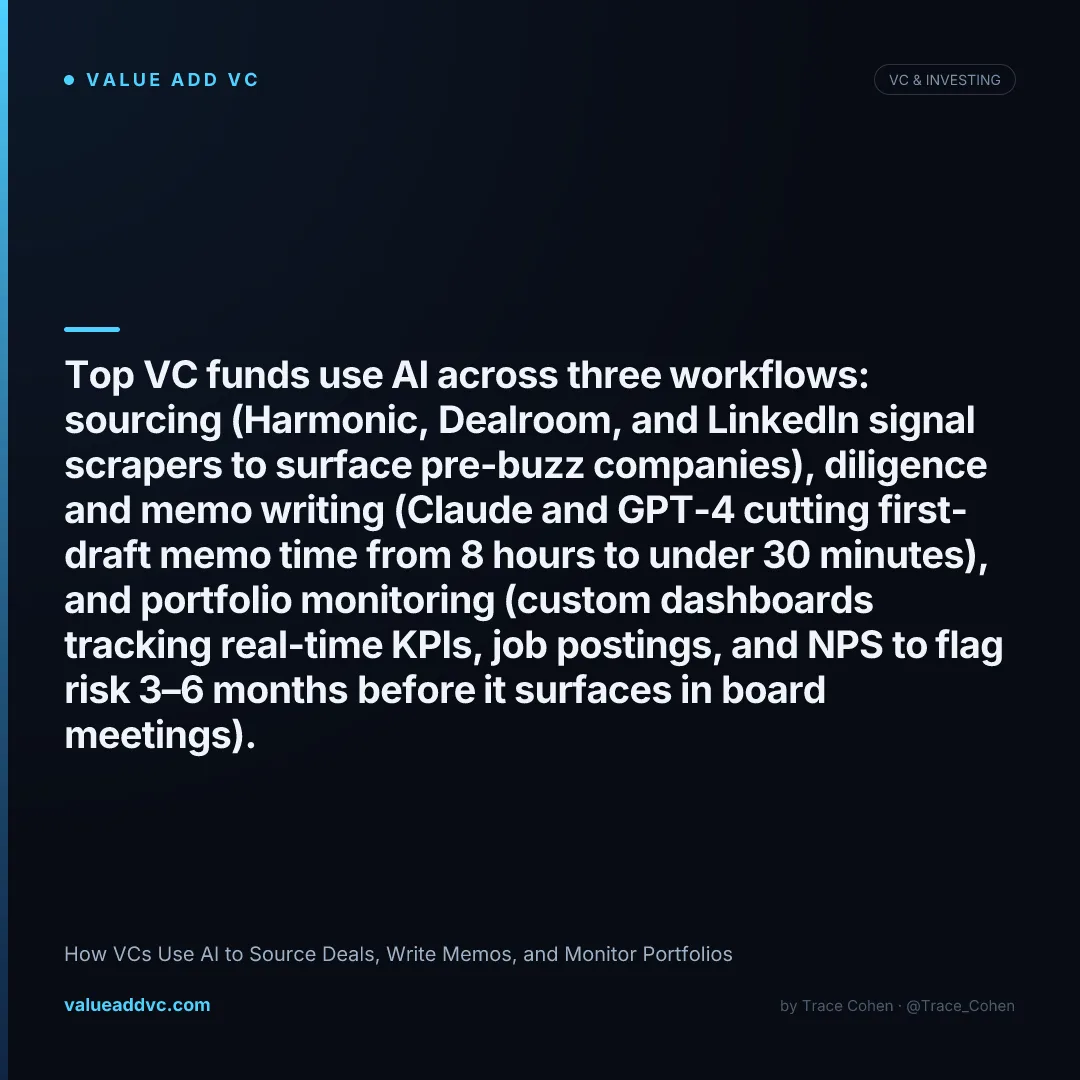
AI for VC Deal Sourcing: What the Top Funds Are Actually Running
The signal that matters in sourcing isn't press coverage — it's the 6–12 months before press coverage. AI tools ingest thousands of weak signals and surface companies before a TechCrunch article or a warm intro arrives.
GitHub commit velocity
Tracks whether engineering output is accelerating or stalling — a leading indicator of product-market fit attempts
Job posting trajectory
A company posting 3 engineering roles in Q4 2025 and 18 in Q1 2026 is accelerating faster than their AngelList profile suggests
LinkedIn headcount growth
Harmonic and Dealroom track this at scale — 40%+ quarter-over-quarter headcount growth precedes most Series A announcements by 3–4 months
Web traffic and app store rank
SimilarWeb and Sensor Tower data, when combined with company size estimates, reveal traction before any public metrics are shared
Founder social graph proximity
Affinity and 4Degrees map which founders in a fund's portfolio network are connected to target founders — warm intros close faster than cold outreach
Funds running Harmonic report seeing 2–3x more relevant companies per analyst-hour than before, with higher pre-screening accuracy. The cost: ~$24K/year for Harmonic's full API, plus engineering time to build custom scoring on top.
AI for Investment Memo Writing: 30-Minute Drafts vs 8-Hour Analyst Work
The investment memo is the most time-intensive artifact in early-stage VC. A typical first-pass memo takes a junior analyst 6–10 hours: reading the deck, researching the market, pulling competitive data, reviewing founder backgrounds, and synthesizing it into a coherent argument for or against investment.
AI compresses that to 25–45 minutes for the first draft. The workflow at most funds using this looks like:
1. Ingest the deck
Attach the pitch deck PDF to Claude or GPT-4. Extract key claims, metrics, and market assumptions automatically.
2. Pull context
Query Crunchbase, LinkedIn, and PitchBook for founder history, company funding, and comparable exits. Feed results into the prompt.
3. Draft the memo
A structured prompt instructs the model to write the thesis, market sizing, competitive landscape, risks, and open questions sections.
4. Partner review
A GP or senior associate reviews the draft, adds conviction from the live meeting, and expands the risk section with deal-specific judgment.
Funds running this workflow report that AI-drafted memos are consistent in structure and comprehensive in coverage, but weaker on conviction and deal-specific texture — which is exactly right. AI fills in the research scaffold; partner judgment fills in the investment thesis.
Portfolio Monitoring: Catching Problems 6 Months Before the Board Meeting
The dirty secret of portfolio management is that most funds learn about problems when founders finally admit them in a board meeting — which is typically 3–6 months after the problem became visible in external signals.
| Signal | What It Reveals | Lead Time |
|---|---|---|
| Headcount drop on LinkedIn | Layoffs before public announcement or CEO disclosure | 4–8 weeks |
| G2 / Capterra review velocity | Customer satisfaction trend before NPS surveys surface it | 6–12 weeks |
| Engineering job posting freeze | Budget constraint or strategic pivot in progress | 6–10 weeks |
| Web traffic decline (SimilarWeb) | Top-of-funnel deterioration ahead of pipeline weakness | 8–12 weeks |
| App Store rating shift | Product quality or support deterioration in consumer products | 4–6 weeks |
| Founder Twitter/LinkedIn activity | Unusual PR offensive can signal a distressed fundraise attempt | 2–4 weeks |
Funds building this layer — typically with custom Airtable or Notion automations, or purpose-built tools like Visible — report that proactive outreach to struggling portfolio companies improves outcomes. When you reach out in month 3 of a problem versus month 6, the options are meaningfully different.
The AI VC Tech Stack in 2026: What's Actually Being Used
Deal Sourcing
AI-powered company discovery across 80M+ companies, scored by signal strength
European-focused deal flow with AI filtering by sector, stage, and founder background
Quantitative signal scoring for VC deal sourcing, used by 50+ funds
CRM & Relationship Intelligence
Automated CRM with AI email summarization and relationship scoring
Relationship graph for deal flow with warm intro mapping
Memo & Diligence
First-draft memo generation, transcript summarization, competitive research synthesis
Deck analysis, market sizing, comparable company research
Meeting transcription feeding into AI-generated summaries and action items
Portfolio Monitoring
Portfolio company reporting, LP update automation, and KPI dashboards
Financial modeling and portfolio scenario planning
Signal aggregation from LinkedIn, SimilarWeb, App Store, G2
For a full breakdown of the emerging manager stack, see the Emerging Manager Tech Stack post. Track real-time fund performance data at the VC Performance Dashboard.
What This Means for Founders: The VC AI Stack From the Other Side
If top funds are running AI-powered sourcing that surfaces companies by signal, not by inbound, founders who generate external signals — meaningful GitHub activity, visible hiring, consistent content, app store momentum — are more likely to appear in those pipelines without a warm intro.
What Surfaces in AI Sourcing
- ✓ Companies with measurable, consistent hiring momentum
- ✓ Founders with strong second-degree connections to the fund
- ✓ Products with publicly visible traction metrics
- ✓ Teams whose GitHub, LinkedIn, and web presence all tell a coherent story
What Gets Filtered Out
- ✕ Companies in stealth with no external signal footprint
- ✕ Founders with thin professional network overlap with the fund
- ✕ Early-stage companies in low-priority categories for the fund
- ✕ Businesses without measurable online traction or community
AI doesn't replace partner judgment in venture capital.
It eliminates the 80% of work that doesn't require it — and surfaces 3x more of the deals that do.
Track fund performance benchmarks at the VC Performance Dashboard and see LP benchmarking data at Benchmarking. Originally published in the Trace Cohen newsletter.
Latest from the Pulse
Get VC data most people never see
— free to subscribe
Trace's notes on venture, AI and startups, a few times a week. Join 5,000+ subscribers. No spam.
No spam, unsubscribe anytime. Sent via Substack · Privacy · or subscribe on Substack ↗