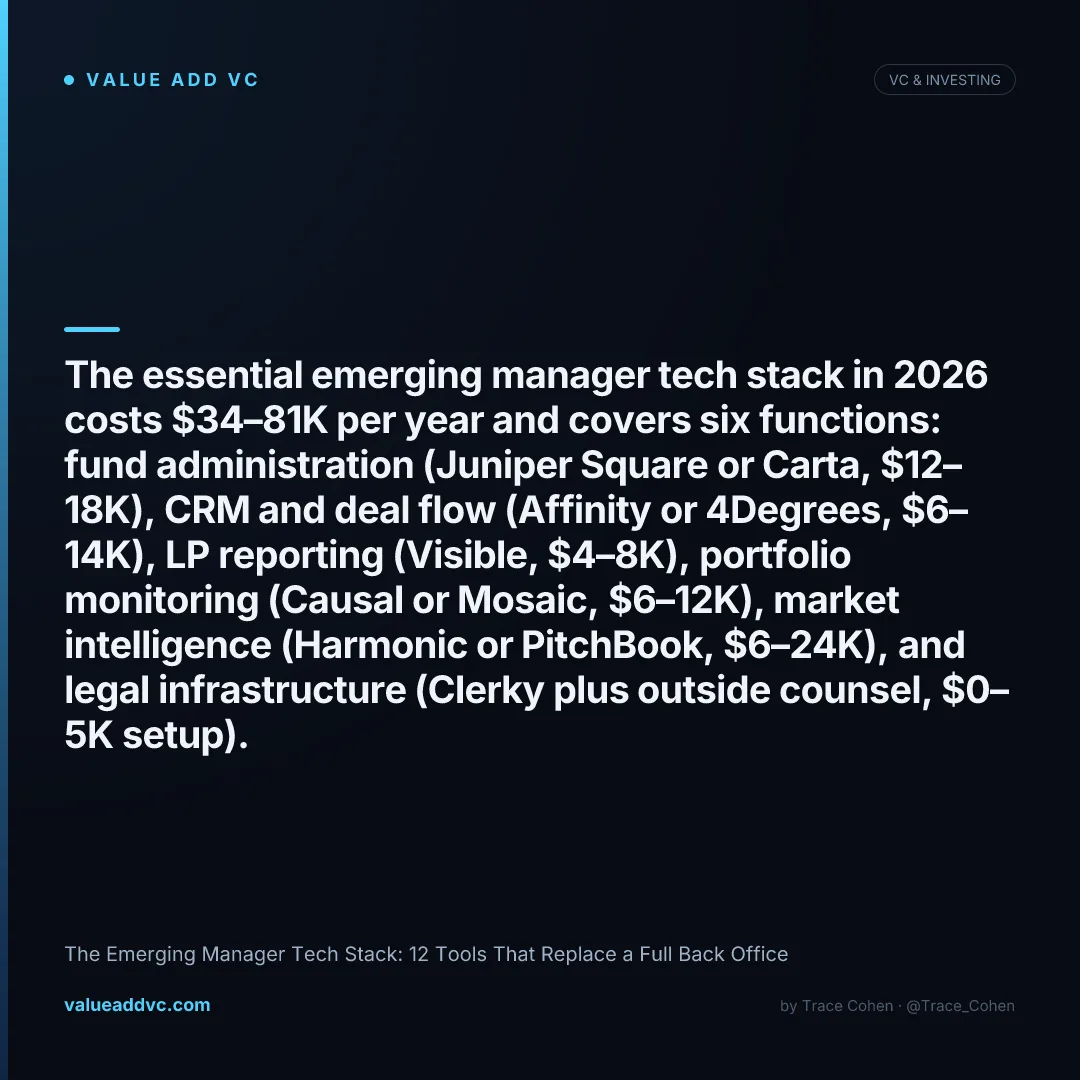
A $30M fund manager in 2020 needed a back-office hire, a fund administrator, an accountant, and a legal team on retainer just to stay compliant and operational. In 2026, the right 12 tools handle all of it — for under $81K per year.
The ones who are operationally clean — fast capital calls, tight LP communications, organized deal pipelines — almost always run the same core stack. The ones who are struggling with back-office chaos are usually running half-measures: a generic CRM, a shared Google Sheet for the cap table, and no LP portal.
This is the full stack. It's what actually works for a $15–75M emerging manager fund in 2026, organized by function, with real pricing.
The 12 Emerging Manager Tools by Function
1. Fund Administration & Back Office
This is the non-negotiable foundation. Fund admin software handles capital calls, LP distributions, K-1s, NAV calculations, and audit-ready reporting. Getting this wrong is the fastest way to lose LP trust. For a closer look at what fund administrators actually charge in 2026, we broke down pricing by AUA tier separately.
2. CRM & Deal Flow Management
Top-quartile funds source 40–60% of their best investments from proprietary channels. That doesn't happen with a spreadsheet. You need a CRM that understands relationship context, not just pipeline stages. See our full guide to VC CRMs for a deeper breakdown.
3. LP Reporting & Investor Communications
LPs want clean quarterly updates, accessible performance data, and a portal that doesn't require a phone call to navigate. This is also a fundraising tool — how you report to current LPs is your audition for their re-up and their referrals. For the underlying KPI dashboard some managers build alongside these tools, see our Databox vs Google Looker Studio comparison.
4. Portfolio Monitoring & Analytics
The funds that outperform are the ones that actually monitor their companies — quarterly KPI collection, burn tracking, hiring velocity, and early warning signals. This is the category most managers underinvest in until it's too late.
5. Market Intelligence & Deal Sourcing
Proprietary deal flow doesn't mean ignoring data. The best emerging managers combine relationship sourcing with real-time market signals — company formation data, hiring velocity, product launches, and funding events.
6. Legal Infrastructure
The Annual Cost of the Full Stack
Here's what a fully-loaded emerging manager tech stack actually costs at three fund sizes:
| Tool Category | Lean ($15M fund) | Mid ($30M fund) | Full ($75M fund) |
|---|---|---|---|
| Fund Admin | $3–8K | $12–16K | $16–18K |
| CRM | $6K | $8K | $14K |
| LP Reporting | $4K | $6K | $8K |
| Portfolio Monitoring | $1K | $7K | $12K |
| Market Intelligence | $2.4K | $9K | $24K |
| Legal (ongoing) | $500 | $2K | $5K |
| Total Annual Stack | ~$17–22K | ~$44–48K | ~$79–81K |
Compare to a full-time fund operations hire: $150–200K base + benefits + overhead = $250–350K total annual cost.
What You Can't Outsource to Software
The tech stack handles operations. It doesn't replace judgment. The things that actually separate top-quartile emerging managers from the rest:
Pattern recognition on founders
No CRM tells you whether this person will figure it out. That comes from doing 1,000 founder calls.
LP relationship quality
Visible.vc doesn't build trust. Your track record and communication consistency does. The tool is just the delivery mechanism.
Thesis conviction
Harmonic surfaces signals. It doesn't tell you which signals matter for your thesis. That's your job.
Portfolio value-add
The best portfolio monitoring tool is a weekly founder call. Software tracks the numbers; you track the person.
How to Phase the Build-Out
You don't need the full stack on Day 1. Here's the sequencing that makes sense:
Pre-Close (Fund Formation)
Clerky or fund counsel → AngelList Stack or Juniper Square → Notion for deal tracking
Get legal structure right first. Everything else can be retrofitted.
First 6 Months (Deployment)
Add Affinity or 4Degrees → Add Visible for LP updates → Add Crunchbase for basic sourcing
Focus on deal flow infrastructure. LP reporting matters once you have capital deployed.
Year 2+ (Scale)
Upgrade to Harmonic for proactive sourcing → Add Causal for portfolio analytics → Consider PitchBook for comps
Upgrade tools as AUM and portfolio complexity justify the cost.
The operational gap between institutional GPs and emerging managers used to be a $500K/year staffing problem.
In 2026, it's a $50–81K software decision. The managers still running on spreadsheets are giving up time, LP confidence, and deal flow to competitors who aren't.
Track VC fund performance and benchmarks on the VC Performance Dashboard and explore the Fund Universe at Value Add VC. Originally published in the Trace Cohen newsletter.
Latest from the Pulse
Get VC data most people never see
— free to subscribe
Trace's notes on venture, AI and startups, a few times a week. Join 5,000+ subscribers. No spam.
No spam, unsubscribe anytime. Sent via Substack · Privacy · or subscribe on Substack ↗