Every VC on the planet says they add value beyond the check. Fewer than 20% of them can actually prove it.
I have been on both sides of this equation — as a founder who raised from VCs, and as an investor who has made 65+ investments. The gap between what VCs promise and what they deliver is the most consistently misrepresented variable in venture capital.
That said, the best funds do something genuinely different. Here is what VC portfolio acceleration actually looks like when it works — and how founders should diligence it before signing a term sheet.
The "Check and Intro" Trap
The standard VC value-add promise is three things: capital, introductions, and advice. Capital is table stakes. Introductions are wildly inconsistent in quality. And advice, without operational context, is often noise.
In a 2024 survey of 300+ founder-VC relationships conducted by First Round Capital, 78% of founders said their VCs were "helpful on strategy" but only 34% said their VC delivered a customer intro that converted to revenue in the first 18 months. Only 22% said their VC materially helped them make a critical hire.
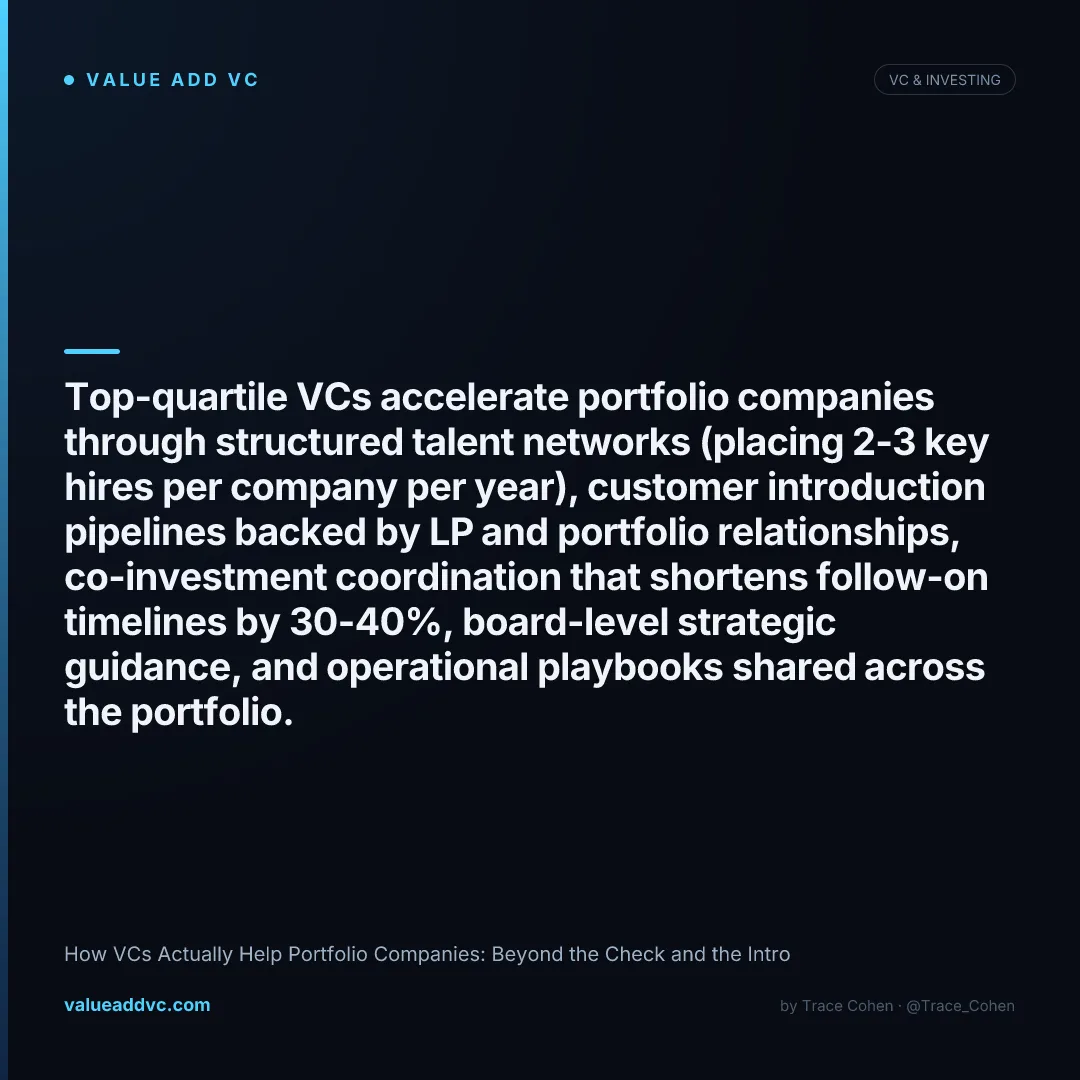
The top quartile of funds — measured by VC portfolio acceleration outcomes, not just returns — look structurally different from the rest. They have dedicated operating infrastructure, not just GP bandwidth. Check out the VC Performance dashboard to see how fund structure correlates with returns across vintages.
The 5 Areas Where Top VCs Actually Move the Needle
Platform Teams vs. Partner Bandwidth
There are two philosophies on how to deliver portfolio support, and both have credible track records.
Platform Model (a16z, Sequoia)
- ✓ Dedicated operating staff per function
- ✓ Scalable across large portfolios (100+ companies)
- ✓ Consistent program delivery independent of GP bandwidth
- ✓ Specialized expertise (legal, finance, GTM, PR)
- Best for: Large funds, enterprise-focused portfolios
High-Touch GP Model (Benchmark, USV)
- ✓ Direct GP relationship with every portfolio company
- ✓ Higher accountability — no diffusion of responsibility
- ✓ Faster decisions with fewer layers
- ✓ More personal and founder-aligned
- Best for: Small funds, concentrated portfolios (20-30 companies)
The worst outcome is a fund that has neither: too large a portfolio for GPs to give real attention, but no platform team to fill the gap. Many mid-sized funds fall into this trap — 60+ portfolio companies, 3-4 GPs, and a shared executive assistant. See how fund structures affect outcomes on the Benchmarking dashboard.
How Founders Should Diligence VC Value-Add
Before taking any check, founders should run a structured diligence process on their VC's ability to accelerate — not just fund. Here is what to ask:
- •Ask for three specific examples of non-capital help delivered to portfolio companies in the last 18 months — hiring, customer intro, or operational guidance — and the measurable outcome that resulted.
- •Ask which operating partner or platform team member will work with your company, how many hours per month they commit, and request references from portfolio founders at your stage (not just the fund's unicorns).
- •Ask what the fund's process is for helping companies raise their next round — who gets introduced, when, and how the narrative is built. A fund with no answer to this question is not running a process.
- •Ask how many portfolio companies they have active today and how much time each GP can realistically give you. A GP managing 15 boards cannot give you 10 hours a month.
- •Ask for the fund's operator or LP network in your specific industry. A B2B healthcare SaaS company needs a VC whose LP base includes health system CIOs, not general tech executives.
The Compounding Effect of Real Portfolio Acceleration
The most underappreciated thing about VC portfolio acceleration is that it compounds. A fund that helps you hire your VP of Sales 6 months faster means 6 extra months of revenue before your Series A. Six months of extra revenue at a $1M ARR trajectory means $500K more ARR going into the round — which at a 10x NTM revenue multiple changes your pre-money valuation by $5M.
That is not a soft metric. That is a measurable economic difference — for the founder, the fund, and every LP in it.
The best VC-portfolio company relationships I have seen are ones where the GP has a real operating model in their head for what the company could become — and is actively working backward from that model every quarter, not just waiting for the next board meeting.
The best VC is not the one who writes the biggest check. It is the one who makes the next check unnecessary.
Track VC fund performance and portfolio acceleration metrics on the VC Performance dashboard at Value Add VC. Originally published in the Trace Cohen newsletter.
Latest from the Pulse
Get VC data most people never see
— 100% free
Weekly benchmarks, valuations, and fund data. Join 5,000+ investors. No spam.