
Over 20% of priced U.S. venture rounds in 2025 were down rounds, and 75% of venture-backed companies never return cash to investors — the difference between a fund that catches a cash problem at month 3 and one that finds out at month 9 is almost always a monitoring gap, not a diligence gap.
Most of the value destruction in venture doesn't come from a bad initial thesis — it comes from a fund finding out too late that a portfolio company's burn rate had already made the next round unraisable.
VC Portfolio Monitoring Best Practices: What Top Funds Actually Do
VC portfolio monitoring best practices in 2026 center on a two-speed cadence: monthly tracking of cash burn, runway, and headcount, paired with quarterly collection of the fuller KPI set — revenue growth, gross margin, net revenue retention, and customer metrics. The funds that do this well use a standardized template across every portfolio company (so a burn multiple or growth rate is comparable company to company) and a dedicated platform tool rather than a rotating cast of spreadsheets. The funds that skip this, or treat it as an annual valuation exercise, are the ones that get surprised by a bridge request with 60 days of cash left.
The Numbers That Make the Case for Disciplined Monitoring
The bear case for VC as an asset class is well known: 75% of venture-backed companies never return cash to their investors, per Harvard Business School lecturer Shikhar Ghosh's widely cited research, as reported by The Wall Street Journal, and in 30-40% of cases investors lose most or all of the money they put in. Early-stage VCs specifically report failing on roughly 80% of individual bets, with fund-level returns depending on a small number of outsized winners to offset the rest. A loss ratio under 40% is generally considered healthy for a venture fund — which is another way of saying that even good funds expect most of their portfolio to underperform or fail.
What's changed in 2025-2026 is the pace at which trouble shows up. Down rounds — a round priced below the company's prior valuation — made up more than 20% of all priced U.S. rounds tracked by Carta in 2025, and Carta recorded 2,725 VC funds disappearing in 2023 alone as the market thinned out. Cash-out remains the single most cited cause of startup failure, responsible for 61% of shutdowns, ahead of product-market-fit misses or team breakdowns. Every one of those failure modes shows up in the numbers — burn, runway, growth deceleration — well before it shows up in a founder's voice on a board call.
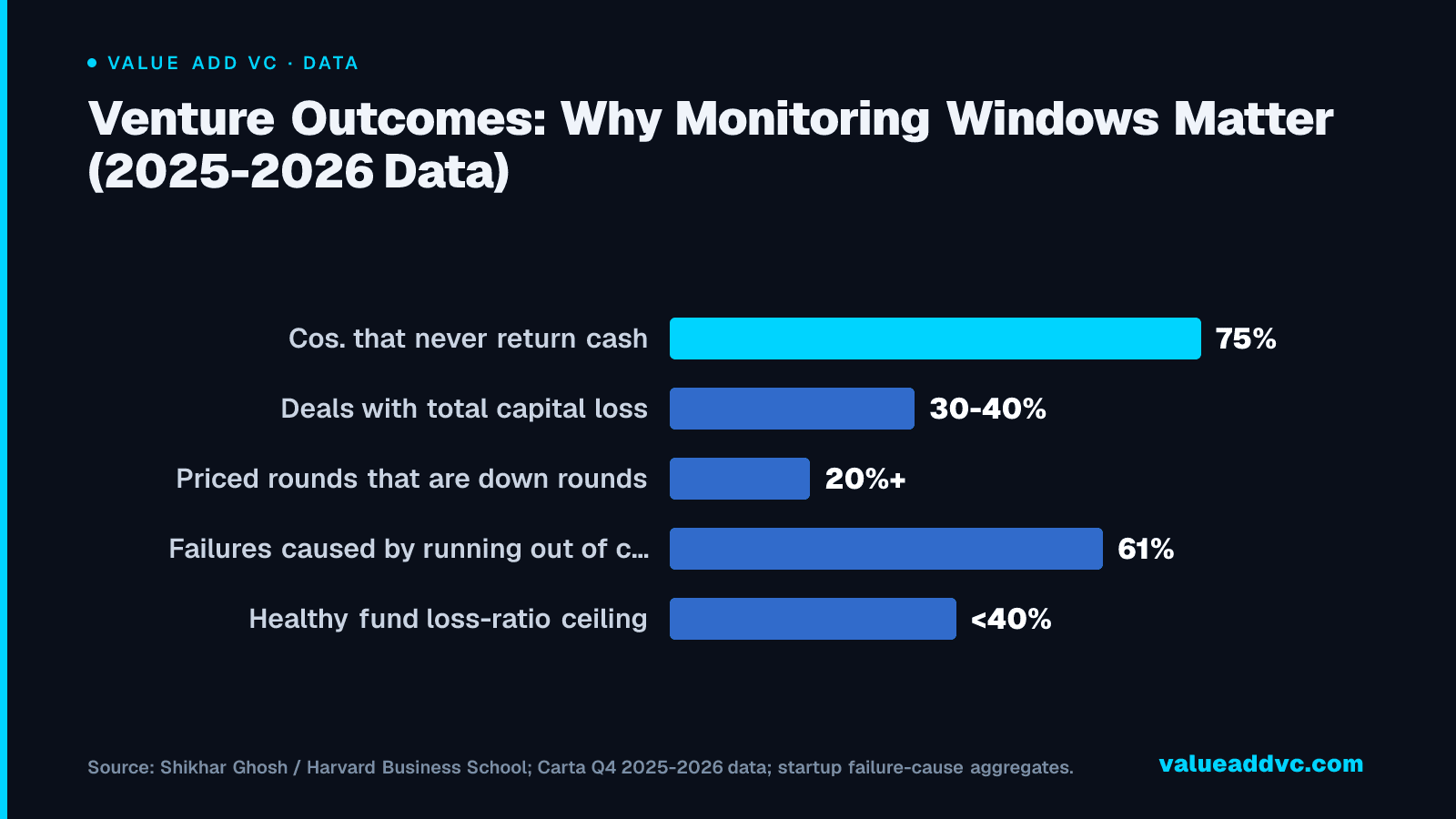
Venture Outcomes: Why Monitoring Windows Matter (2025-2026 Data)
Roughly three in four venture-backed companies never return capital, and a fifth of all priced rounds are now down rounds — the earlier a fund sees the underlying cash trend, the more options it has left.
Shikhar Ghosh / Harvard Business School; Carta Q4 2025-2026 data; startup failure-cause aggregates.
Data
| Item | Value |
|---|---|
| Cos. that never return cash | 75% |
| Deals with total capital loss | 30-40% |
| Priced rounds that are down rounds | 20%+ |
| Failures caused by running out of cash | 61% |
| Healthy fund loss-ratio ceiling | <40% |
Monthly Cash Tracking vs. Quarterly-Only Reporting
The single highest-leverage change a fund can make to its monitoring process is separating cash metrics from growth metrics and tracking them on different clocks. Revenue growth, gross margin, and net revenue retention move slowly enough that quarterly collection captures the trend without much information loss. Cash burn and runway move fast — a company can go from a comfortable 14-month runway to a 4-month runway in a single quarter of accelerated hiring or a missed enterprise renewal, and a fund that only checks in quarterly can lose half of its remaining reaction window before anyone notices.
Monthly vs. Quarterly-Only Portfolio Monitoring: What Each Cadence Catches
Visible.vc, Standard Metrics, and Carta portfolio monitoring guidance, 2025-2026.
Data
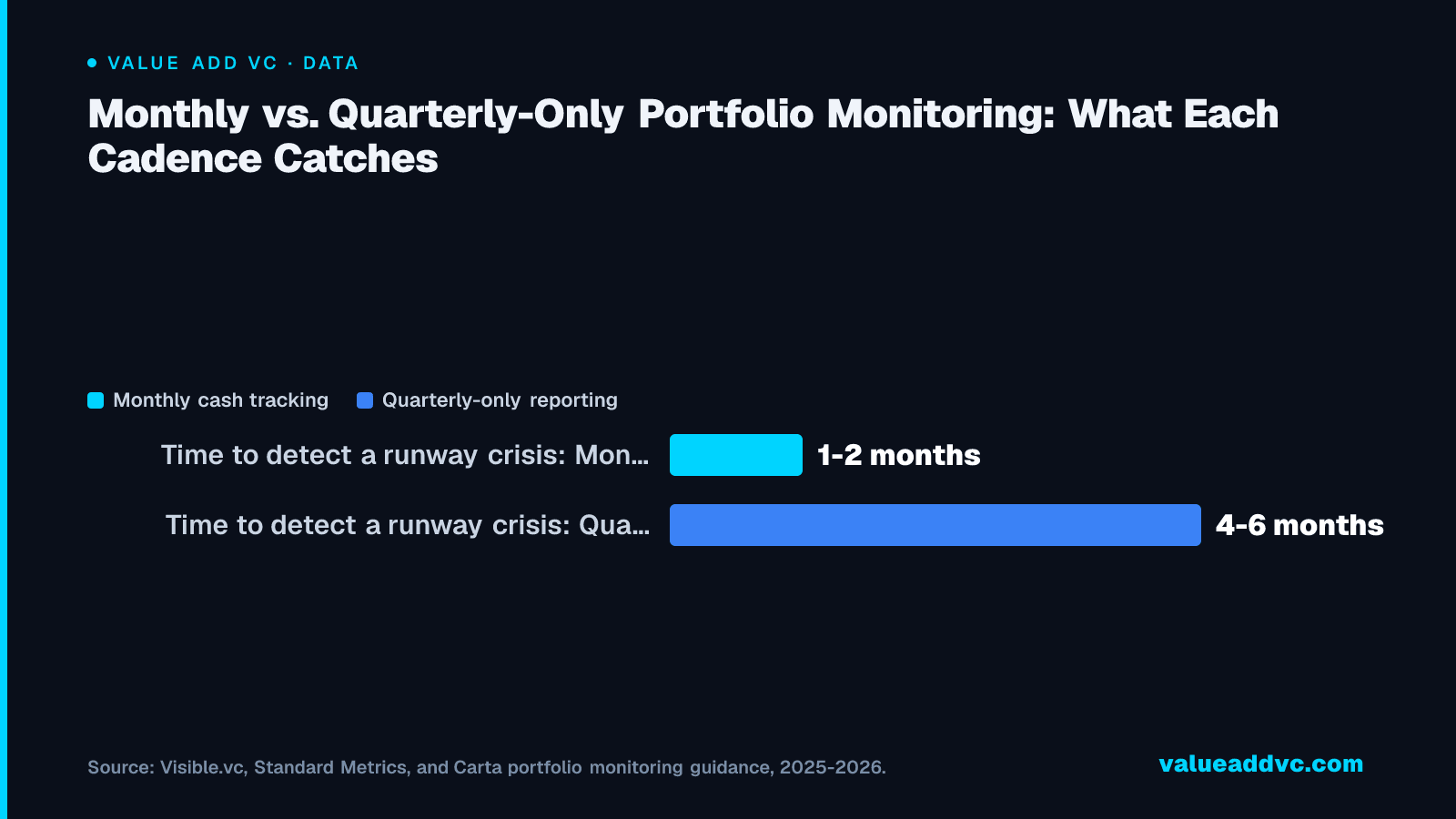
That gap — one to two months versus four to six — is the difference between a fund that can help arrange a bridge or push for a strategic sale, and one that finds out a portfolio company is out of cash after the fact.
| Metric | Recommended cadence | Why it moves at this speed |
|---|---|---|
| Cash balance / burn | Monthly | Changes with every payroll cycle and can shift materially within weeks |
| Runway (months of cash left) | Monthly | Directly derived from burn; the earliest true warning signal |
| Headcount | Monthly | Biggest single driver of burn; hiring sprees show up here first |
| Revenue / ARR growth | Quarterly | Meaningful trend takes 60-90 days to separate from monthly noise |
| Net revenue retention | Quarterly | Requires a cohort of renewals/expansions to be statistically useful |
| Gross margin | Quarterly | Structural, changes slowly outside of pricing or COGS shifts |
| Full valuation mark | Annually / on financing event | Requires a priced round or formal 409A-style process to update |
Cadence recommendations blended from Visible.vc portfolio monitoring guidance, Standard Metrics' provider benchmarks, and Carta's private fund monitoring framework, 2025-2026.
Why Monitoring Is Now a Headcount Line Item, Not a Side Task
Portfolio monitoring used to be something an associate did in a spreadsheet between deals. It's now a dedicated function. Platform and portfolio-support professionals made up an average of 12.9% of core venture team headcount as of the most recent full industry survey, rising to 14.6-15.1% at funds managing over $1 billion in AUM — and total core team headcount at the average fund grew 124% between 2000 and 2022, with platform among the fastest-growing categories. a16z is the extreme end of this: the firm runs 300-plus non-investment staff across recruiting, marketing, policy, and business development, largely in service of a portfolio it needs to monitor and support at scale.
That headcount shift lines up with a tooling shift. The average VC fund now runs 8-12 software tools, and dedicated portfolio monitoring platforms — Visible, Standard Metrics, Carta's portfolio tools — have become as standard as a CRM like Affinity for deal flow. Roughly 64% of investors report using AI tools to accelerate the research and data-collection side of monitoring in 2026, which is starting to close the gap between a two-partner seed fund and a platform-heavy multi-stage firm on data quality, even if headcount stays lean. Funds get more visibility into 20-plus portfolio companies without needing 20-plus analysts to chase down each one.
There's a founder-experience angle here too, and it cuts against the naive assumption that more monitoring is automatically better. Research supported by the Kauffman Fellows Program found that more than 60% of VCs claim to offer talent and business-development support to their portfolio, but less than half of portfolio companies actually use those services — and separately, 61% of founders rate their VC's value-add experience as below average, with only 15% calling it critical. The lesson for funds building out a monitoring function: collecting data is necessary but not sufficient. The funds getting real returns on their platform headcount are the ones using the monitoring data to trigger specific, timely help — an intro, a bridge conversation, a hiring push — not just filling out an internal dashboard nobody outside the investment team ever acts on.
A Practical Monitoring Framework for Funds of Any Size
You don't need a 300-person platform team to run disciplined portfolio monitoring — you need a standard template, a fixed cadence, and a habit of actually reading it. Every portfolio company gets the same monthly form: cash balance, burn, runway, headcount. Every portfolio company gets the same quarterly form: revenue/ARR, gross margin, growth rate, NRR if applicable, and a short qualitative note on hiring plans, competitive pressure, and fundraising timeline. The template matters more than the tool — a shared Google Sheet enforced consistently beats a $30K/year platform nobody actually opens.
The trigger that separates monitoring-as-theater from monitoring-that-works is a runway threshold: any portfolio company reporting under 9 months of runway gets flagged for a direct partner conversation within the week, not folded quietly into the next board deck. Given that 61% of startup failures trace back to running out of cash and that 20%+ of priced rounds are now down rounds, a 9-month threshold gives a fund enough runway of its own — pun intended — to help arrange a bridge, push for an accelerated process, or in the worst case, help a founder wind down in a way that preserves relationships and reputation rather than limping to zero.
For funds thinking about how monitoring discipline rolls up into fund-level numbers, see our breakdown of how VC fund performance is actually measured , and for LP-facing benchmarking across vintage years and strategies, our VC performance dashboard tracks IRR, TVPI, and DPI trends that ultimately reflect how well portfolios were monitored and supported after the check cleared.
The Bottom Line
VC portfolio monitoring best practices in 2026 come down to a simple discipline most funds still don't enforce: track cash monthly, track everything else quarterly, and act on a runway threshold instead of waiting for a founder to ask for help. With 75% of venture-backed companies never returning cash, 20%+ of priced rounds now down rounds, and cash-out responsible for 61% of failures, the fund that finds a cash problem at month 3 has real options — a bridge, a strategic sale, a controlled restructuring. The fund that finds out at month 9 is usually just documenting a write-off. Monitoring doesn't create winners, but disciplined monitoring is one of the few post-investment levers a fund fully controls, and most still leave it on autopilot.
Latest from the Pulse
Get VC data most people never see
— free to subscribe
Trace's notes on venture, AI and startups, a few times a week. Join 5,000+ subscribers. No spam.
No spam, unsubscribe anytime. Sent via Substack · Privacy · or subscribe on Substack ↗