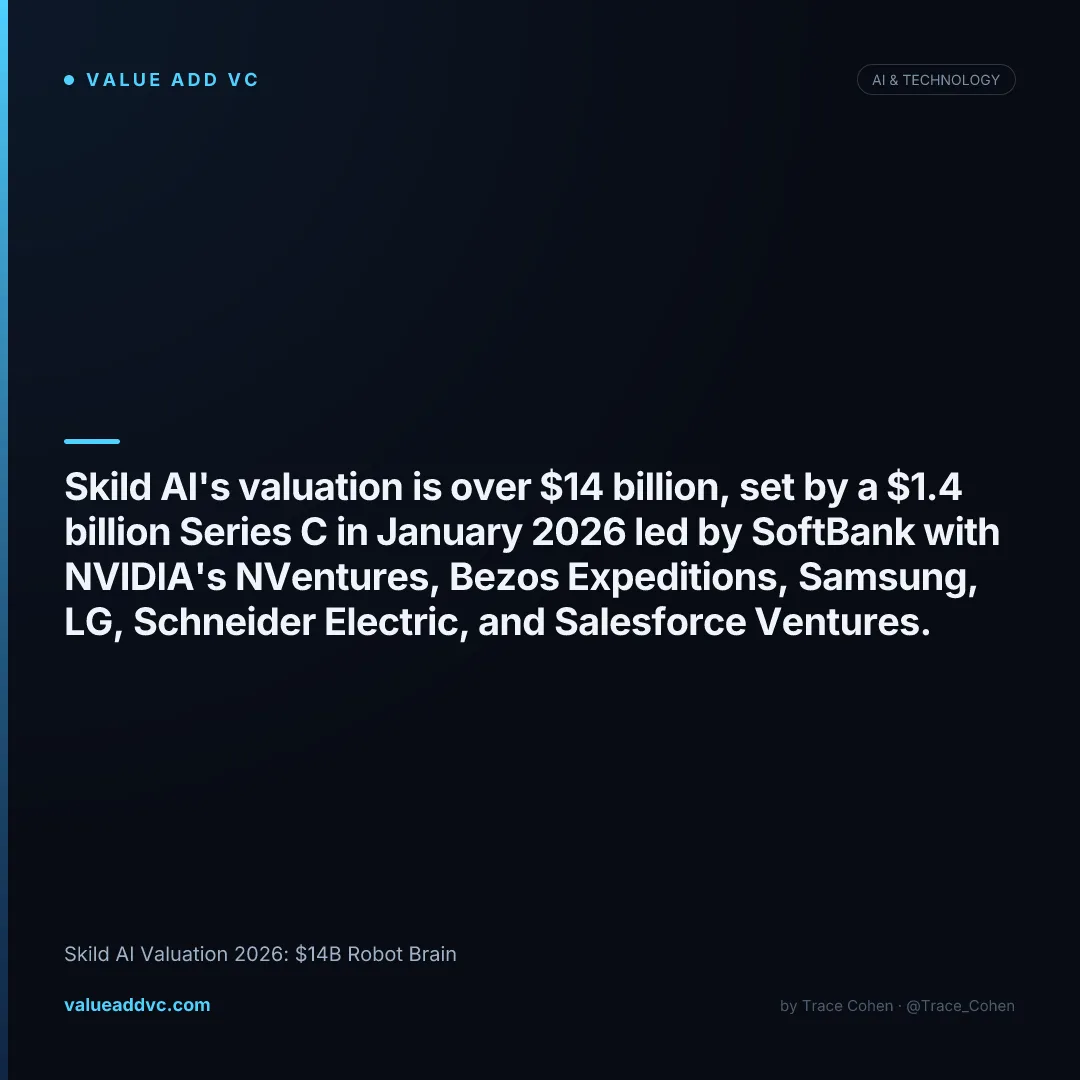
Skild AI is valued at more than $14 billion — the price SoftBank and a syndicate of industrial strategics agreed to in a $1.4 billion Series C that closed in January 2026. That's roughly triple the company's own valuation from just seven months earlier, one of the sharpest re-pricings anywhere in AI right now. And like Physical Intelligence, Skild builds zero robots. It builds the brain.
What makes Skild's price distinct isn't just the size — it's who's paying it. This isn't a syndicate of AI research labs betting on a generalization benchmark. It's SoftBank, Samsung, LG, and Schneider Electric, companies that build or run factories and supply chains and have a direct reason to want a robot brain that works across whatever hardware they already own. See how that price compares to the rest of the sector on our AI Valuations dashboard.
Figures compiled August 2026 from Skild AI's Series C announcement, Bloomberg, TechCrunch, and Businesswire.
The Robot Foundation Model Category: The Brain, Not the Body
A useful way to sort the humanoid-robotics gold rush is by what a company is actually trying to own. Figure AI, Unitree, 1X, and Apptronik are hardware companies — they design actuators, chassis, and grippers, and build software to run their specific machine. Skild AI and Physical Intelligence are the other bet entirely: general-purpose AI models meant to control any robot, the way a large language model can power many different applications without being rebuilt from scratch for each one.
Skild calls its version "omni-bodied" — a single model designed to run across humanoids, quadrupeds, and stationary industrial arms alike, licensed as shared cognition rather than sold bundled into one piece of hardware. The company has zero factory and no chassis of its own. Its addressable market isn't the humanoid category specifically; it's every existing and future robot that needs a brain it doesn't have to build in-house.
Skild AI's Valuation: From $1.5B to $14B in 18 Months
Skild AI was founded in 2023 in Pittsburgh by Deepak Pathak and Abhinav Gupta, both former Carnegie Mellon professors. The company raised roughly $14.5 million in seed funding that year, then a $300 million Series A in July 2024 at a $1.5 billion valuation, followed by a $500 million Series B in summer 2025 that pushed the price to roughly $4.5 billion. In January 2026, a $1.4 billion Series C led by SoftBank valued the company above $14 billion — nearly triple the Series B mark in about seven months.
That's roughly $2.2 billion raised across three rounds in eighteen months, one of the fastest capital-raising paces in the robotics-AI category, and it puts Skild ahead of Physical Intelligence's confirmed $5.6 billion by a factor of about 2.5x — making Skild the highest-valued pure robot-model company, even though Figure AI still commands a higher price overall as a hardware-plus-software business.
Who Invested in Skild AI?
SoftBank led the January 2026 Series C. Participants included NVIDIA's NVentures, Jeff Bezos through Bezos Expeditions, and three industrial strategics: Samsung, LG, and Schneider Electric, plus Salesforce Ventures. That lineup is notably different from Physical Intelligence's AI-lab-heavy cap table — Samsung, LG, and Schneider Electric are companies that manufacture goods and manage industrial infrastructure, and each has an obvious reason to want a working general-purpose robot brain deployed inside its own operations rather than purely as a financial bet.
SoftBank's involvement also fits its broader pattern of concentrated, high-conviction bets on physical-AI infrastructure — the same playbook it has run in robotics and semiconductors for years, now pointed at the model layer specifically rather than any single robot maker.
What the Skild Brain Actually Does
Skild's flagship product is the Skild Brain, and in late May 2026 the company released Skild Brain 1.0 — a single neural network with roughly 500 billion parameters that the company says can take control of a robot it has never encountered before, run about 15 seconds of on-the-fly calibration, and begin manipulating objects with sub-millimeter precision. The pitch is deliberately embodiment-agnostic: the same brain adapting to a humanoid, a quadruped, or a fixed industrial arm without being re-trained for each.
Skild has paired that model with a concrete push into deployment. In April 2026 it acquired Zebra Technologies' robotics automation business, including the Symmetry Fulfillment orchestration platform used to coordinate multiple robot types inside a single warehouse — moving Skild from purely supplying the underlying model to also owning a piece of how robots get orchestrated on a floor. The company has also announced partnerships with ABB Robotics, Universal Robots, MiR, NVIDIA, and Foxconn, targeting security and facility inspection, last-mile delivery, warehouses, manufacturing, data centers, and construction as initial verticals.
What the headline misses
"$14 billion" and "500 billion parameters" both sound decisive, but neither is a disclosed revenue number. Skild has not published customer counts, contract values, or trailing revenue — the valuation is priced on a combination of the model's technical claims, the credibility of its industrial partner list, and SoftBank's willingness to pay up for physical-AI infrastructure broadly. The Zebra acquisition is a genuine commercial signal — it's hard to fake owning a real orchestration platform with existing enterprise customers — but it's still early evidence, not proof the $14 billion price is backed by matching revenue.
Skild AI's Valuation Compared to the Rest of Robotics AI
At $14 billion-plus, Skild AI is the second-highest-valued company in robotics AI after Figure AI's $39 billion, and it's the highest-valued pure model-layer company — ahead of 1X Technologies (~$10 billion) and well ahead of Physical Intelligence's confirmed $5.6 billion. That gap between the two "brain, not body" companies is the more interesting number for investors watching the category, because it's a real bet on go-to-market strategy, not just technical capability: Skild's industrial partnerships and warehouse acquisition versus Physical Intelligence's research-forward, open-model approach.
Should Investors Care Which Robot Brain Wins?
Skild's investor list and its Zebra acquisition suggest the market currently rewards a model company that also owns pieces of the deployment stack over one that stays purely at the research layer — that's the most plausible explanation for why Skild trades at nearly 2.5x Physical Intelligence's confirmed price despite both companies pursuing the same fundamental thesis. Whether that premium holds depends on whether Skild's industrial partnerships convert into disclosed revenue before the next round, the same test every foundation-model company in physical AI eventually faces. We track how these robot-model valuations stack up against the hardware side of the category on our Humanoid Robot Race tracker.
Skild AI's $14B price makes it the highest-valued pure robot-brain company, ahead of Physical Intelligence's $5.6B.
Its industrial investor base and Zebra acquisition are the clearest bet yet that the model layer wins by owning deployment, not just research.
The Bottom Line
Skild AI's $14 billion-plus valuation is real, current, and backed by a syndicate — SoftBank, Samsung, LG, Schneider Electric — with obvious commercial reasons to want a working general-purpose robot brain, not just financial upside. It's also less than a year removed from a $1.5 billion valuation, a re-pricing pace that assumes the Zebra acquisition and industrial partnerships convert into real deployment revenue fast. Whether that happens will say a lot about the entire robot-foundation-model category, and about whether the money in robotics ultimately concentrates in the model layer at all, or splits back toward whoever builds the best hardware to run it on.
Track the humanoid robotics and physical AI funding cycle alongside deal flow at Value Add VC. Reach out at t@nyvp.com or @Trace_Cohen.
Latest from the Pulse
Get VC data most people never see
— free to subscribe
Trace's notes on venture, AI and startups, a few times a week. Join 5,000+ subscribers. No spam.