
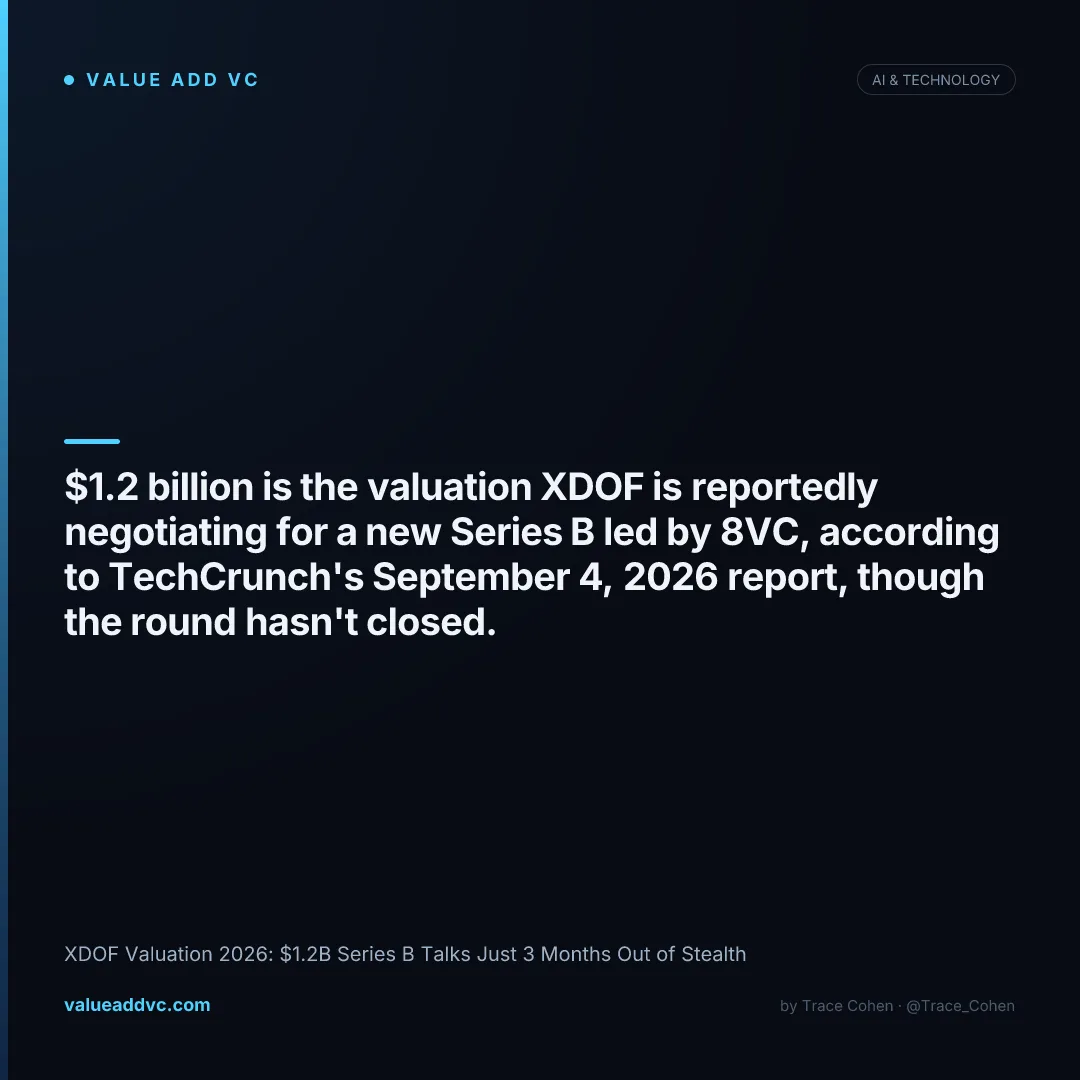
XDOF, a startup that pays people to record everyday physical tasks and teleoperate robotic arms so AI labs can train robots, is in late-stage talks for a Series B that would value it at roughly $1.2 billion — a number first reported by TechCrunch on September 4, 2026. The round hasn't closed. It would land roughly three months after XDOF left stealth and five months after a $70 million Series A, with annualized revenue now approaching $50 million.
Sources: TechCrunch, Dealroom News, and Yahoo Finance, checked September 9, 2026.
XDOF Valuation: What Is It Actually Being Talked About At?
XDOF's valuation, as of early September 2026, is being negotiated at roughly $1.2 billion in a Series B that 8VC is reportedly leading. The talks are described as late-stage but unclosed by TechCrunch, meaning the price could still move before any round is signed. XDOF reached this point about three months after ending stealth and just five months after closing a $70 million Series A.
The speed is unusual even by 2026 AI-funding standards. XDOF's Series A, which closed in June 2026 with participation from Thrive Capital, Andreessen Horowitz, Lux Capital, and Spark Capital, came before the company had even exited stealth. The jump from that round to a $1.2 billion Series B conversation roughly reflects a step-up of well over 10x on an as-yet-undisclosed A-round valuation, according to Dealroom News's deal tracking.
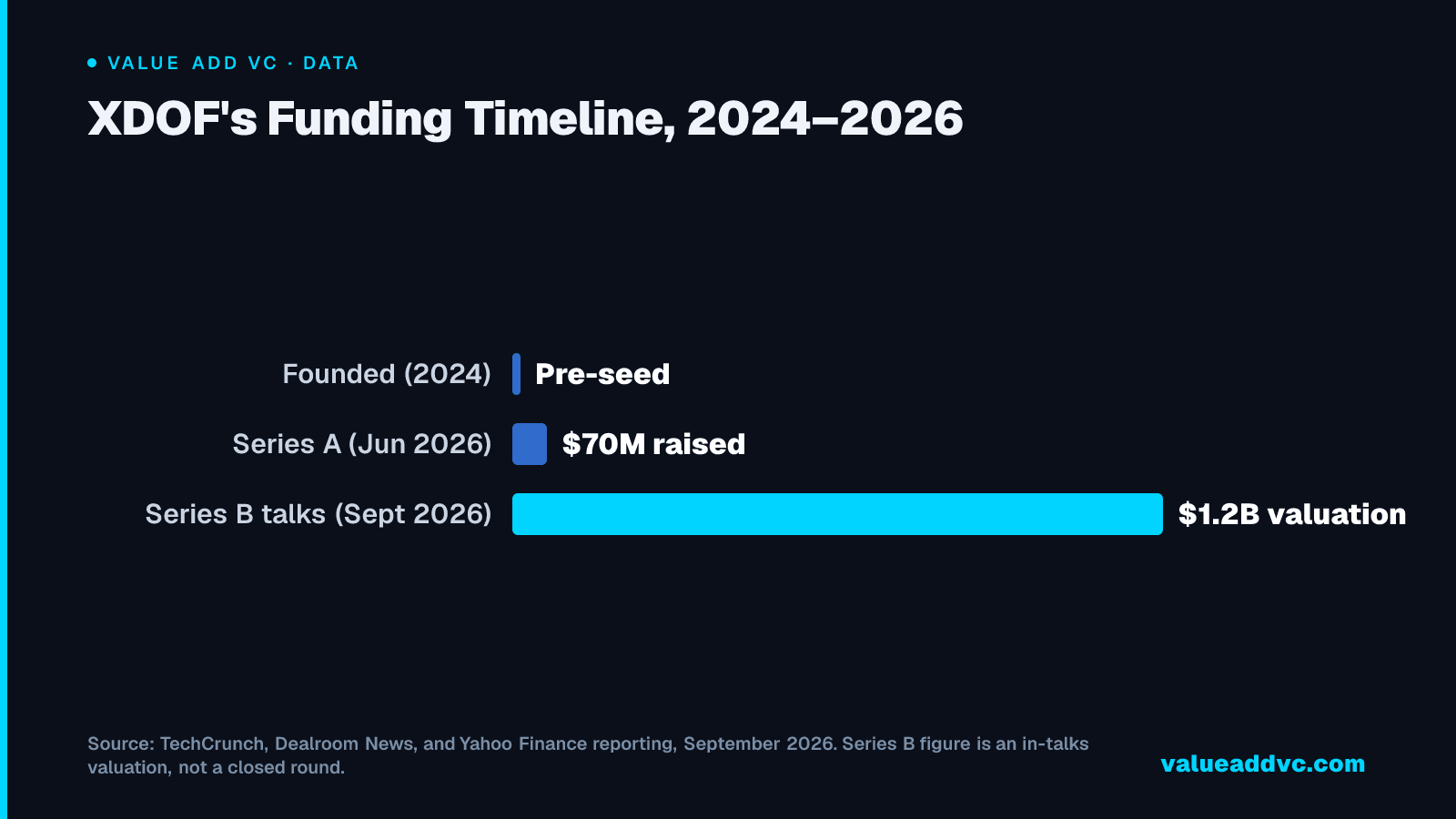
XDOF's Funding Timeline, 2024–2026
XDOF went from a 2024 founding to a $1.2B Series B conversation in about two years, with the last five months carrying nearly all of the visible funding activity
TechCrunch, Dealroom News, and Yahoo Finance reporting, September 2026. Series B figure is an in-talks valuation, not a closed round.
Data
| Item | Value |
|---|---|
| Founded (2024) | Pre-seed |
| Series A (Jun 2026) | $70M raised |
| Series B talks (Sept 2026) | $1.2B valuation |
What Does XDOF Actually Sell?
XDOF is a data-supply-chain company for robotics, not a robot maker. It builds the pipelines, collection tools, and annotation systems that turn physical human activity into training data for general-purpose robots, filling a gap that frontier AI labs and robotics companies have struggled to build for themselves in-house.
The company runs two collection methods side by side. One method is teleoperation: human operators remotely control robotic arms using GELLO, a low-cost teleoperation rig, to generate labeled demonstrations of physical manipulation. A second method is direct human motion capture: data collectors wear body sensors while performing ordinary household and light-industrial tasks — folding clothes, flattening cardboard boxes, sorting objects — so the resulting movement data can be mapped onto a robot's own range of motion.
XDOF sells the resulting datasets to roughly 20 customers, a group that includes several frontier AI labs, per TechCrunch's reporting. Neither TechCrunch nor Dealroom names those lab customers directly in the public reporting cited here, so this piece doesn't guess at specific counterparties beyond what's confirmed.
Who Founded XDOF, and What Happened at the Series A?
XDOF was co-founded in 2024 by Philipp Wu, who now serves as CEO, and Fred Shentu, the company's CTO — both were robotics researchers at UC Berkeley before starting the company, according to reporting picked up by Dealroom News. That two-year gap between founding and today's Series B conversation is short for a company touching robotics hardware, and it worked in XDOF's favor: because the company sells data services rather than building or selling its own robots, it could start signing paying customers well before a hardware-focused peer would typically reach revenue.
The $70 million Series A closed in June 2026, before XDOF had even left stealth, with participation from Thrive Capital, Andreessen Horowitz, Lux Capital, and Spark Capital. The Series A's own valuation hasn't been disclosed in the reporting reviewed for this piece — what is disclosed is the pace that followed it: annualized revenue climbed to nearly $50 million within roughly three months of leaving stealth, which is the growth rate that reportedly prompted 8VC and other investors to approach XDOF about a new round rather than the company running its own process.
How Does XDOF Compare to Other Robotics-Data and Robot-Brain Startups?
XDOF sits in a crowded and fast-moving field of companies chasing the "physical AI" data problem, but its business model — selling raw training data rather than a foundation model or a robot — is closer to Scale AI's original data-labeling playbook than to Physical Intelligence or Skild AI, both of which are building the models themselves. The table below lines up XDOF against five peers by valuation and what each company is actually selling.
| Company | What it sells | Latest valuation | Date set | Status |
|---|---|---|---|---|
| Figure AI | Humanoid robot hardware | $39B | Sept 2025 | Confirmed round |
| Skild AI | General-purpose robot-brain model | $14B+ | Jan 2026 | Confirmed round |
| Physical Intelligence | Robot foundation models | $5.6B | Nov 2025 | Confirmed round |
| Genesis AI | Robot-brain model | ~$3B | Jul 2026 | Reportedly in talks |
| XDOF | Teleoperation + human-motion training data | ~$1.2B | Sept 2026 | Reportedly in talks |
| Scale AI (for reference) | General AI data labeling | $29B | Jun 2025 | Confirmed (Meta stake) |
Figures from company funding announcements and our own reporting at Figure AI, Skild AI, Physical Intelligence, Genesis AI, and Scale AI, plus TechCrunch and Dealroom News reporting on XDOF, checked September 9, 2026.
Why Is a Data-Only Startup Getting Robot-Brain Money?
XDOF's pitch lands at a moment when the humanoid-robot market itself is being repriced upward. Goldman Sachs has raised its humanoid-robot forecast to roughly 6.5 million units shipped by 2035, a market it now estimates could be worth roughly $138 billion by then, up from its previous $38 billion estimate (reported by HumanoidHub); the revision also moved its 2026 shipment estimate from around 51,000 units to closer to 75,000. Every company chasing that market — whether it builds hardware like Figure AI or a foundation model like Skild AI and Physical Intelligence — needs enormous volumes of physical-manipulation data that simulation alone still can't fully replace, and that scarcity is the gap XDOF is selling into.
The wider physical-AI category XDOF sits inside is growing on a shorter timeline too: one market roundup put the global physical AI market at roughly $30.1 billion in 2025, climbing to an estimated $40.8 billion in 2026, according to a statistics summary published by Sci-Tech Today. None of that spending flows to XDOF directly — it's spread across chips, sensors, robot hardware, and software — but it's the demand backdrop against which a $1.2 billion price on a data-only company gets evaluated.
8VC's reported interest fits a pattern of infrastructure-layer bets underneath the more visible foundation-model race: rather than picking which robot-brain company wins, a data-supply investment can profit regardless of which lab or robotics company ends up on top, as long as all of them keep needing labeled physical data. That is the same logic that made Scale AI a $29 billion asset for Meta in the large-language-model era, per the Meta-Scale AI deal reported in June 2025 — before OpenAI, Google, and xAI cut ties with Scale over the perceived conflict of interest.
What the headline misses
The $1.2 billion figure is a number in negotiation, not a signed term sheet — TechCrunch's own framing is "in talks," and Dealroom News describes XDOF as "nearing" the round rather than having closed it. Numbers reported at this stage of a deal can and do move before signing; readers should treat this as a snapshot of where talks stood in early September 2026, not a confirmed post-money valuation.
There's also a structural risk in the business model itself. Human-data-collection companies have historically carried thinner margins than software businesses because the underlying cost — paying people to perform, wear sensors, or teleoperate equipment — scales roughly linearly with volume, unlike a software product that gets cheaper to serve per unit as it grows. Scale AI's own 2026 revenue guidance fell to roughly $1 billion after major customers walked away following its Meta deal, a reminder that data-labeling revenue can be concentrated in a handful of relationships that can unwind quickly. XDOF's roughly 20 customers, including the frontier labs it doesn't name publicly, represents exactly that kind of concentration risk if even two or three of its top contracts don't renew.
Competition is also real and growing. Scale AI, Surge AI, and Turing all have existing data-operations infrastructure they could redirect toward robotics data collection, and Physical Intelligence and Skild AI both collect proprietary demonstration data internally as part of building their own foundation models, meaning some of XDOF's top potential customers are also potential competitors for the same underlying data. Whether XDOF's teleoperation and body-sensor pipeline is defensible against a well-funded in-house effort at any of those companies is untested at scale.
Data quality and scalability are a separate open question. Teleoperated demonstrations and body-sensor recordings capture how one person performs one task in one environment; turning that into data a robot can generalize from — a different kitchen, a different shirt, a different grip strength — is a harder problem than simply collecting more hours of footage. The broader robotics field has spent years debating whether human-demonstration data transfers cleanly to robot actuators at all, given differences in degrees of freedom, sensor placement, and force feedback between a human hand and a robotic gripper. XDOF's revenue growth suggests customers are paying for the data regardless, but paying customers and technically sufficient training data are not automatically the same thing, and neither TechCrunch nor Dealroom's reporting addresses how XDOF's data performs once a customer actually trains a model on it.
Is XDOF's $1.2 Billion Number Justified?
On the numbers XDOF has disclosed, a $1.2 billion valuation against roughly $50 million in annualized revenue works out to a revenue multiple in the mid-20s — rich relative to a typical data-services company, but not unusual for infrastructure-layer AI businesses in 2026, when Skild AI trades at a similar multiple range on its own annualized run rate. The case for the price rests on XDOF being early into a category — real-world physical-task data — that every well-funded robotics and AI lab needs and few can produce cheaply themselves. The case against it is that the round hasn't closed, the revenue base is young, and the business is more exposed to customer concentration and margin pressure than the software companies it's increasingly priced alongside.
For readers tracking the broader private-market pattern, XDOF's trajectory — a two-year-old company, a Series A that hadn't even been followed by a product launch, and a Series B conversation at roughly 17x the dollar size of that A round within three months — says less about XDOF specifically than about how fast late-stage capital is now willing to move once a company shows real revenue growth in a category investors have already decided matters. Whether that speed produces a durable business or an overpriced one likely won't be clear until XDOF's contracts come up for renewal and 8VC's round, if it closes, gets tested against a full year of results rather than three months of momentum.
The bottom line:
XDOF is reportedly in talks for a $1.2B Series B led by 8VC, just three months out of stealth and five months after a $70M Series A — but the round is unclosed, and its human-data business faces real margin and concentration risk.
Track how private AI and robotics valuations are moving on our AI Valuations dashboard, and see how XDOF stacks up against the rest of the robot-brain race in our look at who actually leads in robotics at Value Add VC. Originally published in the Trace Cohen newsletter.
Latest from the Pulse
Get VC data most people never see
— free to subscribe
Trace's notes on venture, AI and startups, a few times a week. Join 5,000+ subscribers. No spam.
No spam, unsubscribe anytime. Sent via Substack · Privacy · or subscribe on Substack ↗