

$500 million at a $3 billion valuation — that's the round Genesis AI is reportedly negotiating, just one year after closing a $105 million seed. What that price buys is a robot-brain startup trying to leapfrog into the same valuation conversation as Figure AI and Skild AI before it has shipped a commercial product.
Physical AI has become the fastest-growing corner of venture capital in 2026, and Genesis AI is the latest entrant asking investors to price a robotics foundation model company at billions before it has meaningful revenue. Bloomberg first reported the talks on July 23, 2026, with Premji Invest said to be in discussions to lead alongside HSG (formerly Sequoia China) and Northzone. Nothing is signed yet — but the numbers on the table say a lot about how fast capital is moving into the sector.
Genesis AI Valuation: What's Actually Being Negotiated
Genesis AI, a robotics foundation-model startup, is in talks to raise approximately $500 million in a new round that would value the company at roughly $3 billion, according to Bloomberg's July 23, 2026 reporting. Premji Invest is reportedly discussing the lead position, with HSG and Northzone also in conversations to participate. The talks have not closed, and the size, price, or investor lineup could still change before any deal is signed — a standard caveat for private rounds still in negotiation.
From a $105M Seed to a $3B Round in 12 Months
Genesis AI emerged from stealth in July 2025 with a $105 million seed round co-led by Eclipse Ventures and Khosla Ventures, with backing from Bpifrance, HSG, French billionaire Xavier Niel, former Google CEO Eric Schmidt, and roboticists Daniela Rus and Vladlen Koltun. The pitch was a universal robotics foundation model — a single AI system meant to control robot bodies from multiple hardware manufacturers, rather than a proprietary humanoid built end-to-end by one company. Genesis has pitched this as addressing a labor market it estimates at $30 trillion globally.
In May 2026, the company demoed a foundation model capable of controlling human-like robotic hands, a milestone TechCrunch covered as evidence Genesis had "gone full stack" on its software stack. Two months later, the talks for a $500 million round at a $3 billion valuation surfaced — a roughly 29x increase in headline valuation from the $105 million seed just twelve months earlier, assuming the seed priced the company somewhere in the low hundreds of millions.
The speed of that progression is the real story here. Most robotics companies historically spent three to five years between a seed round and a valuation north of $1 billion, largely because hardware development, safety testing, and manufacturing partnerships take years to mature regardless of how much capital is available. Genesis AI is attempting to compress that timeline into twelve months by leaning entirely on the software side of the stack — a foundation model that can, in theory, run on robot bodies built by other manufacturers rather than requiring Genesis to build and certify its own hardware from scratch. That's the same bet Skild AI and Physical Intelligence are making, and it's the reason all three have been able to raise faster than humanoid hardware makers like Figure AI, 1X, and Apptronik, which carry the added time and capital burden of manufacturing physical robots at scale.
Genesis AI Valuation vs Figure AI, Skild AI, and Physical Intelligence
Even at $3 billion, Genesis AI would sit at the bottom of the well-funded robot-brain and humanoid cohort. The category splits into two strategies: hardware makers who build both the robot and the model (Figure AI, 1X, Apptronik), and hardware-agnostic labs that sell the "brain" to run on anyone's robot (Skild AI, Physical Intelligence, and now Genesis AI). The valuation gap between the leaders and Genesis is enormous.
| Metric | Genesis AI | Figure AI | Skild AI | Physical Intelligence |
|---|---|---|---|---|
| Latest reported valuation | $3B (in talks) | $39B | $15B | $5.6B confirmed / $11B in talks |
| Latest round size | $500M (in talks) | $1B+ Series C | $1.4B | $600M |
| Prior valuation | Seed-stage (undisclosed) | $2.6B (Feb 2024) | ~$4.5B (reported prior round) | Undisclosed pre-2025 |
| Total funding to date | $105M (pre-round) | $2.5B+ | $1.4B+ | $1B+ |
| Lead investor(s), latest round | Premji Invest (reported) | Parkway Venture Capital-led syndicate | Undisclosed lead, 2026 | Undisclosed lead, 2025 |
| Strategy | Hardware-agnostic robot brain | Humanoid hardware + model | Hardware-agnostic robot brain | Hardware-agnostic robot brain |
Sources: Bloomberg (Genesis AI, July 23, 2026; Physical Intelligence, Nov 20, 2025), TechCrunch, TechFundingNews, and company disclosures. Figures reflect the most recently reported round for each company as of July 2026; rounds described as "in talks" had not closed at time of writing.
How the Robot-Brain Valuations Actually Stack Up
Robot Foundation Model Valuations, 2026
Bloomberg, TechCrunch, TechFundingNews — most recent reported round per company, 2026.
Data
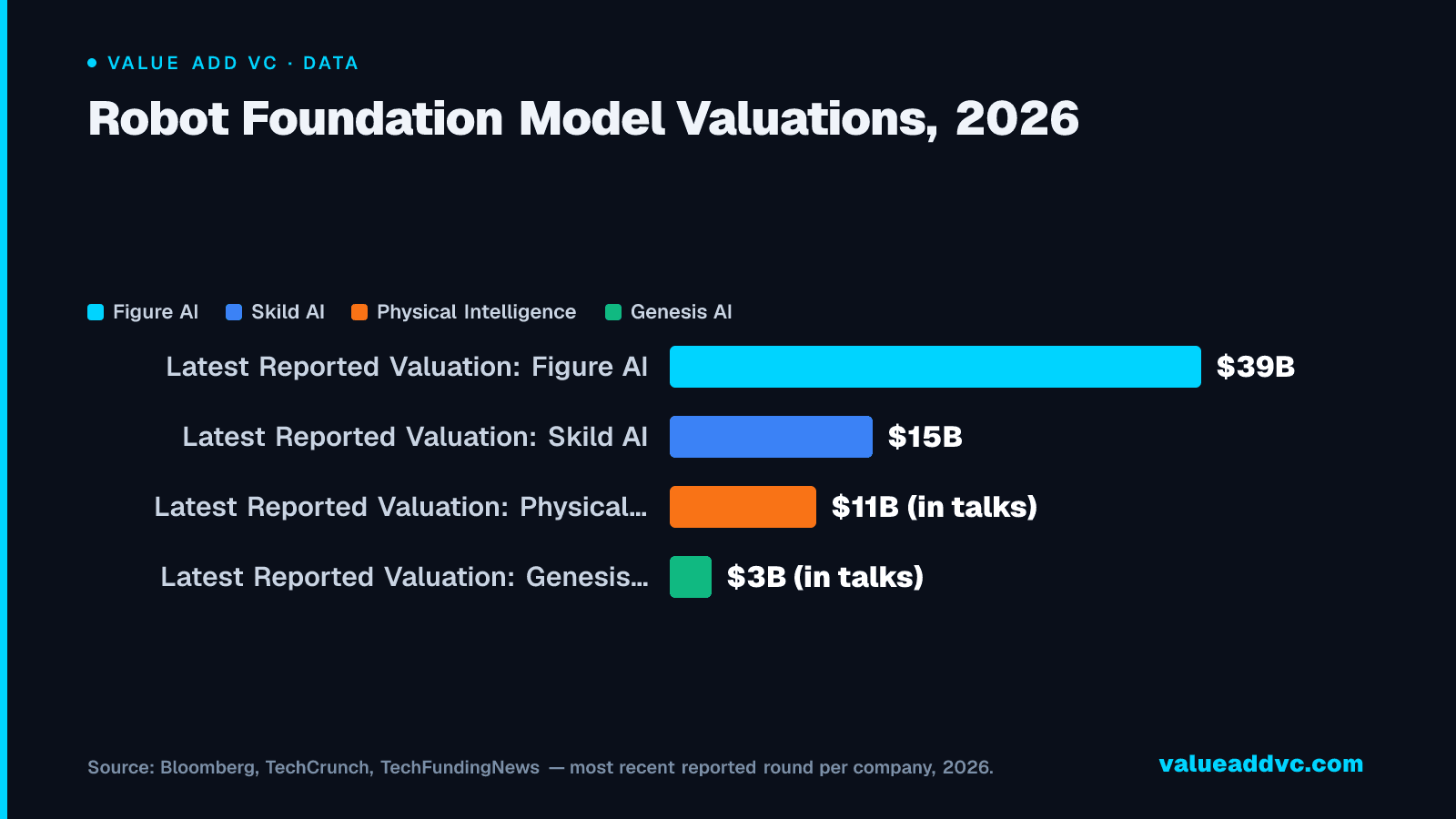
Skild AI is the closest comparable case for how fast this category re-prices: it roughly tripled its valuation to $15 billion in about seven months on the back of a $1.4 billion round in March 2026. If Genesis AI's talks close anywhere near $3 billion, it would be following the same acceleration curve, just a step behind on absolute dollars and roughly a year behind Skild and Physical Intelligence on fundraising maturity.
The gap between Genesis AI and the two leaders is worth sitting with. Figure AI's $39 billion is roughly 13x Genesis AI's reported $3 billion, and Skild AI's $15 billion is 5x. Even Physical Intelligence, the smallest of the three established robot-brain labs at a confirmed $5.6 billion, is still nearly double what Genesis AI is asking investors to underwrite. That gap reflects time in market as much as anything else: Physical Intelligence and Skild AI have both been fundraising and building for close to two years longer than Genesis AI, giving them more opportunity to land manufacturing partnerships, publish benchmark results, and build the kind of track record that compresses the risk premium investors attach to a valuation.
Why Robot-Brain Money Is Moving This Fast
Genesis AI's talks aren't happening in isolation. Robotics and physical AI startups raised a record $27.6 billion across 1,009 deals globally in 2025 — more than double the roughly $13.8 billion raised in 2024, and well past the prior peak of $13.1 billion set during the 2021 venture boom. The pace has kept accelerating into 2026: deals disclosed through Q2 already total about $7.4 billion, ahead of where either 2024 or 2025 stood at the same point.
Robotics and Physical AI VC Funding by Year
2025 funding more than doubled 2024 and blew past the 2021 peak — 2026 is already tracking ahead of both prior years through Q2 alone.
Global VC funding data compiled from Crunchbase News, PitchBook-adjacent reporting, and CB Insights, 2021-2026.
Data
| Item | Value |
|---|---|
| 2021 peak | 13.1 |
| 2024 | 13.8 |
| 2025 | 27.6 |
| 2026 (Q1-Q2) | 7.4 |
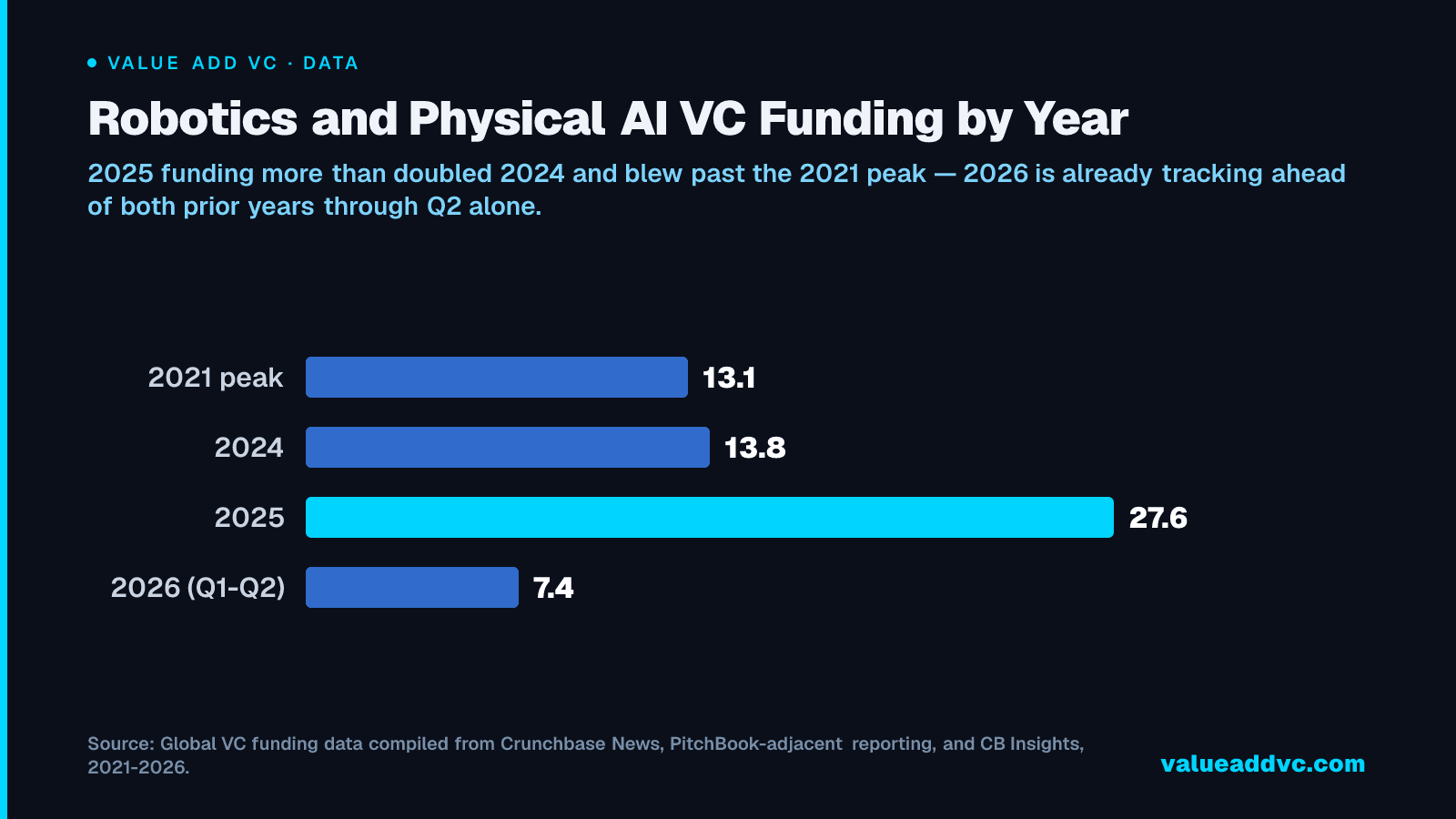
Figure AI's own trajectory illustrates the same pattern at a larger scale: the company went from a $2.6 billion valuation in February 2024 to roughly $39 billion after its 2025 Series C — a 15x increase in under two years. Genesis AI's reported 29x jump from seed to a $3 billion talks-stage valuation is steeper in percentage terms, but on a far smaller absolute base, which is typical of how early-stage AI valuations compress multi-year growth curves into a single follow-on round.
The Skeptical Case on Genesis AI's Valuation
A $3 billion valuation on a company that emerged from stealth twelve months ago, with no disclosed commercial revenue and a product still in the demo stage as of May 2026, is a bet almost entirely on team pedigree and a hot category — not on unit economics. Genesis AI's cap table already includes Eric Schmidt and Xavier Niel, which signals conviction from sophisticated individual investors, but conviction from marquee names has preceded down rounds before in robotics, a capital-intensive category where the gap between an impressive demo and a shippable, revenue-generating product has historically been measured in years, not quarters.
The more useful comparison than raw valuation is capital efficiency: Physical Intelligence and Skild AI have both been operating and raising for longer, with more total capital deployed and more advanced hardware partnerships, and both are still described as pre-revenue or early-revenue in most reporting. If Genesis AI closes at $3 billion, it will be one of the least capital-tested valuations in the group — a reasonable bet on the category's growth trajectory, but a much thinner track record underneath the number than Figure AI or Skild AI can point to.
There's also a signaling risk specific to rounds that are reported before they close. If the Genesis AI talks fall through, or if the final terms land meaningfully below the $3 billion figure currently circulating, that gap between the reported number and the closed number becomes its own data point — one that other robot-brain startups fundraising in the same window will have to account for when they set their own asks. For LPs tracking how fast private AI valuations are moving across categories, our AI valuations dashboard tracks these rounds as they're reported.
The Bottom Line
Genesis AI's reported talks for a $500 million round at a $3 billion valuation would mark a roughly 29x jump from its $105 million seed just a year earlier — steep, but still a fraction of Figure AI's $39 billion or Skild AI's $15 billion. The round hasn't closed, the terms could shift, and the company has yet to show the commercial traction its larger peers are further along in building. What it does show is how fast robot-brain valuations are moving in 2026: a sector that raised $13.8 billion in 2024 is on pace to clear $30 billion in 2026, and even a company one year out of stealth can find itself in $3 billion valuation conversations on the strength of pedigree and category momentum alone.
Latest from the Pulse
Get VC data most people never see
— free to subscribe
Trace's notes on venture, AI and startups, a few times a week. Join 5,000+ subscribers. No spam.
No spam, unsubscribe anytime. Sent via Substack · Privacy · or subscribe on Substack ↗