

$152 million at a $1.35 billion post-money valuation — that's what London-based Humanoid closed on July 21, 2026, making it Europe's first pure-play humanoid robotics unicorn. Behind the milestone is a two-year-old company that already has $2.4 billion in pre-orders and a production line at Bosch.
Humanoid robotics has been an almost entirely American and Chinese story for the past three years — Figure AI, 1X, Apptronik, and Tesla's Optimus program have absorbed most of the capital and headlines. This round changes that. Humanoid's Series A, led by Prime Movers Lab with Bosch and Schaeffler writing checks alongside their commercial orders, is the clearest signal yet that European industrial manufacturers are willing to bet real production capacity — not just venture dollars — on a humanoid robot built on their own continent.
Humanoid Raises $152M at $1.35B: What Actually Happened
Humanoid, a London-based robotics startup founded roughly two years ago, closed a $152 million Series A on July 21, 2026, at a $1.35 billion post-money valuation. Prime Movers Lab led the round, with Schaeffler, Bosch, Fubon Financial Holding Venture Capital, and Aglaé Ventures participating. The raise brings Humanoid's total funding to $270 million and makes it, per the company and multiple outlets including Forbes and Tech.eu, Europe's first pure-play humanoid robotics unicorn — a company focused solely on humanoid robots that has crossed a $1 billion valuation.
Who's Backing Humanoid's $1.35 Billion Robotics Unicorn Status
What separates this round from a typical robotics Series A is that two of the investors — Bosch and Schaeffler — are also customers. That's a structural signal VCs watch closely: when an industrial manufacturer puts capital and a purchase order into the same company in the same window, it's underwriting both the technology and its own future supply chain. Prime Movers Lab, the round's lead, focuses on breakthrough industrial and scientific startups, which fits Humanoid's pitch of building robots for factory and logistics floors rather than consumer homes.
| Investor | Role in Round | Commercial Relationship |
|---|---|---|
| Prime Movers Lab | Lead investor | None disclosed |
| Schaeffler | Participant | 1,000-robot order placed |
| Bosch | Participant | Production capacity for up to 100,000 units |
| Fubon Financial Holding VC | Participant | None disclosed |
| Aglaé Ventures | Participant | None disclosed |
Figures per Forbes, Business Wire, Tech.eu, and TechFundingNews reporting on the July 21, 2026 Series A announcement.
Why Humanoid Chose Wheels Over Bipedal Legs
Humanoid's flagship robot, the HMND 01, uses a wheeled base rather than the fully bipedal legs seen on Figure AI's Figure 02 or 1X's Neo. That's a deliberate trade-off: wheeled locomotion is mechanically simpler, cheaper to manufacture, and — critically for a company selling into European factories — faster to get through safety certification, since regulators have far more experience certifying wheeled industrial equipment than dynamically balancing bipedal machines. The trade-off is mobility: wheeled robots handle flat factory and warehouse floors well but struggle with stairs and rough terrain that bipedal designs are built to navigate.
That design choice is also why Humanoid could book a 1,000-unit order from Schaeffler and 100,000 units of Bosch production capacity so early in its life — a wheeled, certification-friendly robot is a much easier sell to a risk-averse industrial buyer than a bipedal humanoid still working through safety approval. It's the same logic that made Amazon's warehouse robots wheeled rather than legged for a decade before humanoids became commercially viable at all.
Founded roughly two years ago, Humanoid has moved unusually fast for a hardware company: from founding to a $270 million cumulative raise and a $1.35 billion valuation in under 24 months is a pace that puts it closer to the fundraising velocity of a software company than a typical robotics startup, where multi-year gaps between rounds used to be the norm. That speed is itself a signal of how much capital is chasing physical AI right now — investors who might once have waited for a working product at scale are instead pricing in the industrial partnerships and pre-order book as proxies for future revenue.
Humanoid vs Figure AI vs 1X vs Apptronik: Valuation Comparison
At $1.35 billion, Humanoid is the smallest of the well-capitalized humanoid robotics companies by valuation — a fraction of Figure AI's roughly $39 billion after its 2026 Series C, 1X Technologies' targeted $10 billion raise, and Apptronik's roughly $5.5 billion valuation following $935 million in combined Series A funding. What Humanoid has that the others don't is geography: it's the only one of the four headquartered outside the US, and the only one built specifically around European industrial certification and supply chains.
Humanoid Robotics Valuations, 2026
Forbes, Bloomberg, CNBC, Crunchbase News — company funding disclosures, 2026.
Data
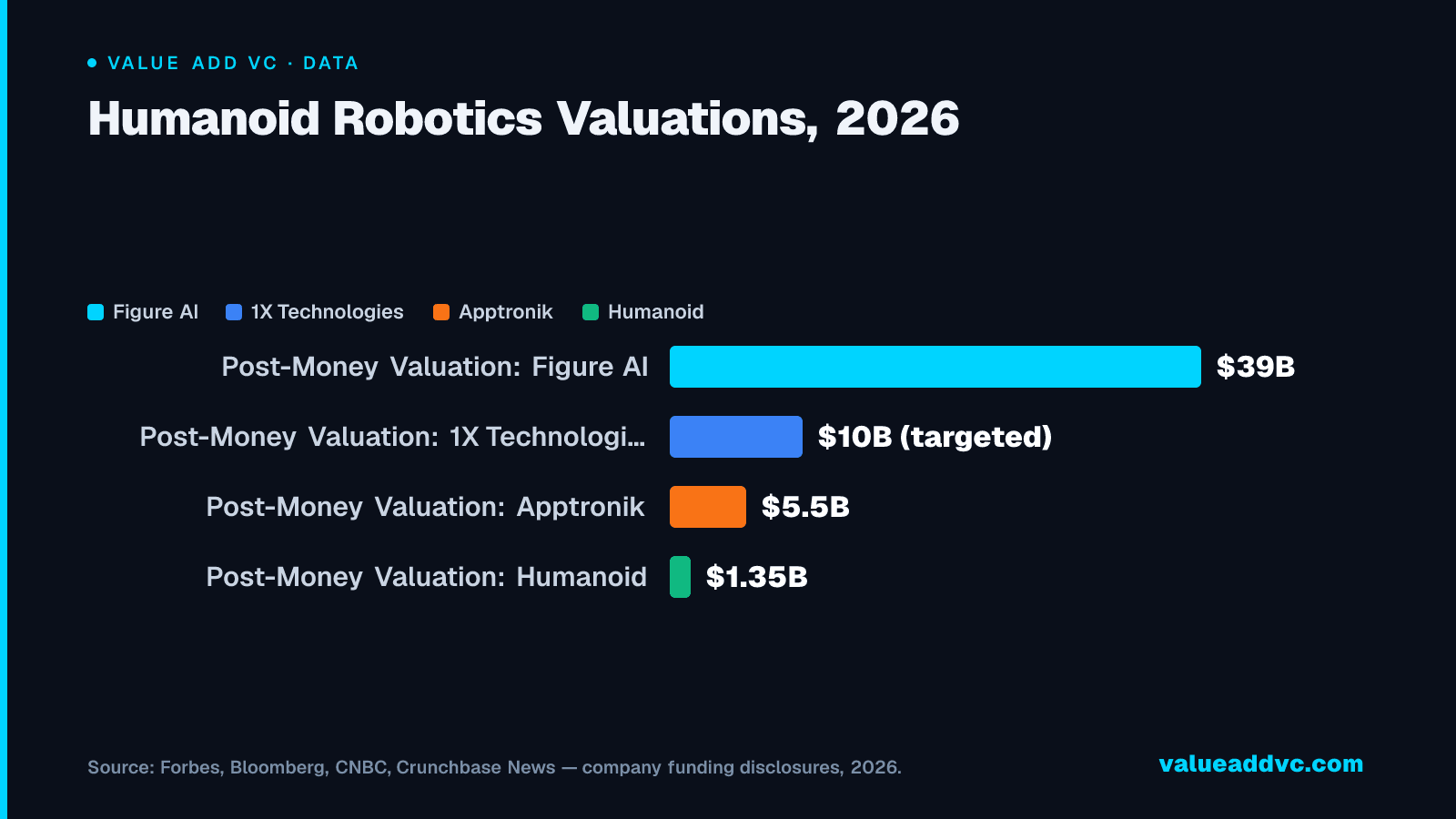
The valuation gap is a headquarters story as much as a technology story. All three US companies have raised from Nvidia, OpenAI, Jeff Bezos, or Brookfield-scale institutional capital chasing the same American humanoid narrative; Humanoid instead built its cap table around German industrial giants who are also its first customers. That's a smaller, more concentrated bet — but one with revenue visibility ($2.4B in pre-orders) that some of the larger, more speculative US rounds don't disclose in comparable detail.
The Order Book: 34,000 Pre-Orders Worth $2.4 Billion
Humanoid says it has received roughly 34,000 robot pre-orders worth a combined $2.4 billion — a figure that implies an average pre-order price of around $70,000 per unit, in line with early industrial humanoid pricing from competitors. Pre-orders aren't delivered, revenue-recognized units, and the conversion rate from pre-order to shipped, paid robot is the single biggest unknown in this story. But the 1,000-unit Schaeffler order and Bosch's 100,000-unit production commitment give the pre-order number more weight than a typical hardware startup's waitlist claim.
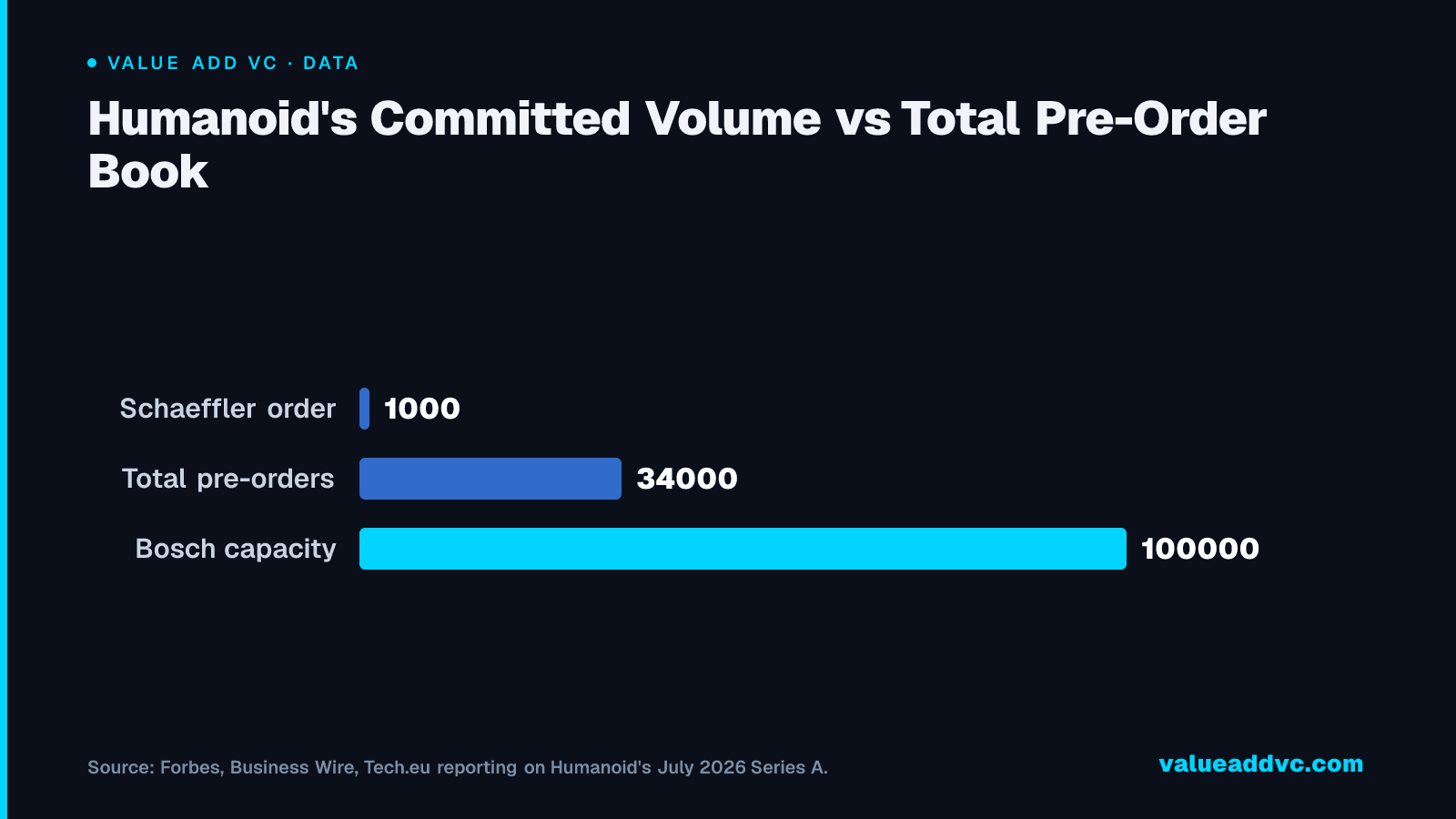
Humanoid's Committed Volume vs Total Pre-Order Book
The Schaeffler order (1,000 units) and Bosch production capacity (100,000 units) are a small fraction of the 34,000-unit pre-order book — most of that book has not converted to a signed, priced order yet.
Forbes, Business Wire, Tech.eu reporting on Humanoid's July 2026 Series A.
Data
| Item | Value |
|---|---|
| Schaeffler order | 1000 |
| Total pre-orders | 34000 |
| Bosch capacity | 100000 |
The Skeptical Case: Why 34,000 Pre-Orders Isn't $2.4B of Revenue
Every humanoid robotics company at this stage of the hype cycle publishes a headline pre-order number, and Humanoid's $2.4 billion figure deserves the same scrutiny as Figure AI's or 1X's. A pre-order is typically a non-binding letter of intent or a small deposit against a future unit — not a signed purchase agreement with delivery dates, penalties for cancellation, or committed capital held in escrow. The more meaningful numbers in this raise are the two that came with actual commercial terms attached: Schaeffler's 1,000-robot order and Bosch's commitment to build production capacity for up to 100,000 units. Even those depend on Humanoid actually hitting manufacturing milestones that no humanoid robotics company — American, Chinese, or European — has yet proven it can do at scale.
There's also a valuation-versus-revenue gap worth naming directly: a $1.35 billion valuation on a two-year-old, pre-revenue-at-scale hardware company implies investors are pricing in a large fraction of that $2.4 billion order book converting to real, delivered units within a few years. Hardware companies historically convert pre-orders at rates well below 100%, and humanoid robotics has no multi-year track record yet to benchmark against — Figure AI, 1X, and Apptronik are all still in the same early-commercialization phase Humanoid is entering now.
What This Means for European AI and Robotics VC
European venture capital has spent the last two AI cycles playing catch-up on foundation models, where US and Chinese labs had a multi-year head start. Physical AI and robotics is a different game — it rewards proximity to industrial manufacturing, safety regulation expertise, and deep-pocketed corporate customers, all of which Europe has in abundance through companies like Bosch, Schaeffler, Siemens, and ABB. Humanoid's raise is a data point that European funds and corporates can win a category by leveraging that industrial base rather than trying to out-spend Silicon Valley on compute.
It also reframes how LPs should think about robotics as an asset class. Most of the humanoid capital deployed globally in 2025-2026 — Figure AI's $1.9B+ raised, 1X's targeted $1B round, Apptronik's $935M — has gone to US companies selling a largely unproven consumer or general-purpose vision. Humanoid's pitch is narrower and, arguably, more de-risked: sell a purpose-built industrial robot to the same manufacturers who are also underwriting the round. That's a smaller total addressable market in the short term, but it's one with a faster path to a first real customer check clearing.
For LPs and funds tracking where robotics capital is actually landing, our unicorns dashboard tracks new billion-dollar companies as they're minted, and our broader look at Figure, Apptronik, 1X, and Tesla Optimus gives the fuller competitive picture Humanoid is now part of.
The Bottom Line
Humanoid's $152 million Series A at a $1.35 billion post-money valuation makes it Europe's first pure-play humanoid robotics unicorn — smaller than Figure AI's $39 billion, 1X's targeted $10 billion, or Apptronik's $5.5 billion, but backed by the two industrial customers (Bosch and Schaeffler) that matter most to whether a $2.4 billion pre-order book actually converts into shipped, paid robots. The wheeled HMND 01 trades some mobility for faster certification and manufacturing simplicity, a bet that's already paid off in the form of a 1,000-unit order and 100,000 units of committed production capacity. Whether that translates into real revenue over the next 12-18 months is the number worth watching next.
Latest from the Pulse
Get VC data most people never see
— free to subscribe
Trace's notes on venture, AI and startups, a few times a week. Join 5,000+ subscribers. No spam.
No spam, unsubscribe anytime. Sent via Substack · Privacy · or subscribe on Substack ↗