Figure has the cleaner commercial story and a $40B valuation. Tesla is on track to ship 50x more units in 2026 at one-third the price. They are not competing for the same crown.
That's the short answer. The longer answer is more interesting — because the metric you care about (deployment depth, unit volume, software, or unit economics) decides who wins, and the answer flips depending on which one you pick.
Tesla Optimus vs Figure 02 in the 2026 Humanoid Robot Race: Who's Actually Winning?
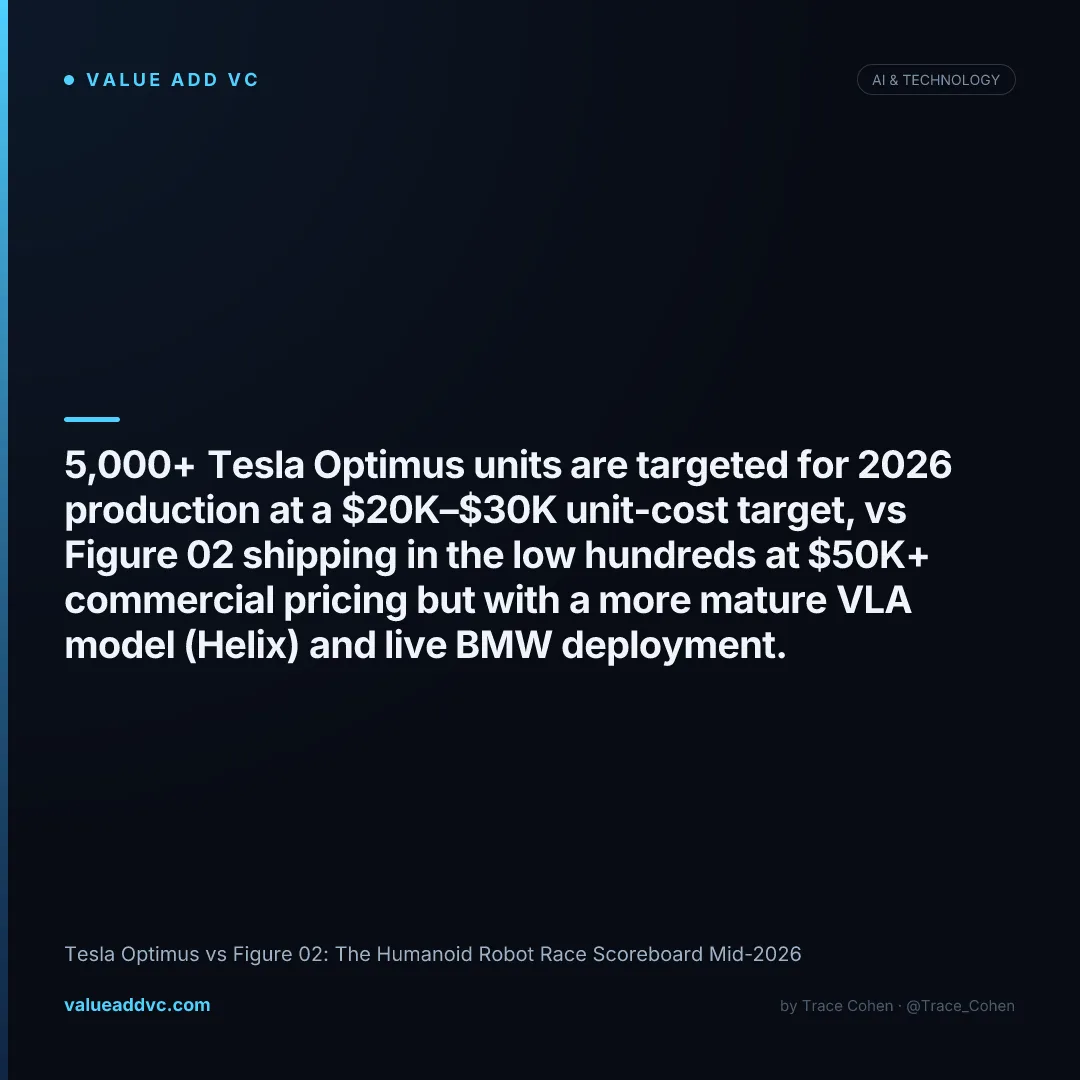
Figure has the cleanest commercial deployment story with paying enterprise customers and its Helix vision-language-action model, while Tesla Optimus leads on production volume, vertical integration, and unit economics. Tesla's $20K–$30K cost target is roughly half of Figure's commercial pricing, and Tesla is targeting 5,000+ units in 2026 — though Figure's software stack is currently more advanced for autonomous task execution.
Both companies are real. Both are funded above $1B in lifetime equity. Neither has solved the humanoid robot fully. The race in mid-2026 is between Tesla's volume-and-cost approach (which mirrors the early Model 3 ramp) and Figure's software-and-deployment approach (which mirrors how Boston Dynamics tried — and failed — to commercialize for two decades, but with modern foundation-model AI instead of pure control theory).
Head-to-Head: The Mid-2026 Scoreboard
| Metric | Tesla Optimus | Figure 02 |
|---|---|---|
| 2026 unit production target | 5,000–10,000 units | 100–500 commercial units |
| Cumulative units produced (Q2 2026) | ~500 Gen 2 internal | ~150 deployed commercially |
| Target unit cost | $20,000–$30,000 | $50,000+ at launch |
| Commercial customers | 0 (internal Tesla use only) | 2 (BMW + 1 undisclosed F500) |
| Software stack | FSD-derived neural net | Helix VLA (proprietary) |
| Height / weight | 5'8" / 125 lbs | 5'6" / 154 lbs |
| Battery runtime | ~5 hrs (claimed) | ~5 hrs (demonstrated) |
| Hands / actuators | 22-DOF custom hands | 16-DOF Figure 02 hands |
| Lifetime equity raised | Part of Tesla ($1.2T market cap) | $1.5B raised |
| Current valuation | Inside Tesla | ~$40B reported 2026 |
| Long-term unit target | 1M units/year by 2030 | 100K units/year by 2030 |
| Manufacturing partner | Tesla Fremont / Texas | BotQ (in-house facility) |
Sources: Tesla earnings calls, Figure AI press releases, company demos, IEEE Spectrum reporting (mid-2026).
Where Tesla Optimus Is Winning in 2026
Tesla has three structural advantages that almost no humanoid competitor can match: in-house actuator production, an existing FSD compute and data pipeline, and the ability to test 500+ units inside Tesla's own factories without needing customers. That last point matters more than people realize — Tesla can iterate on the robot at production volume before anyone has to pay for one.
The cost target is the killer feature. At $20,000–$30,000 per unit, Optimus would price below a year of US warehouse labor cost (BLS data puts loaded warehouse labor cost at $52,000–$68,000/year). Figure 02 at $50,000+ has a payback period of roughly 12 months on a single labor shift; Optimus at $25,000 has a payback of under 6 months. That math is what makes Tesla's volume target plausible to enterprise CFOs.
Tesla also benefits from the $10B+ already spent on FSD compute infrastructure. The same Dojo and HW5 stack that processes 1.5 billion FSD miles per quarter trains Optimus' policy models. Figure has to build that pipeline from scratch — which is partly why its $40B valuation is mostly a bet on the team and the data flywheel, not on what's shipping today.
Where Figure 02 Is Winning in 2026
Figure's Helix VLA model (released February 2025) is the most capable general-purpose humanoid policy network shipping today. It runs at 200Hz with vision-language-action reasoning across both hands of a single robot, and Figure published demonstrations of two Figure 02 units coordinating on a shared task with no scripted choreography — something Tesla has not publicly demonstrated at the same level.
More importantly, Figure has actual paying customers. The BMW Spartanburg deployment (announced January 2024, scaled in 2025) put Figure 02 units on a real automotive production line performing sheet-metal manipulation tasks. By 2026, Figure had expanded to a second undisclosed Fortune 500 customer and announced a third pilot in logistics. Tesla's Optimus deployment is still entirely internal — meaning Figure is the only humanoid company with revenue from outside customers above $10M in 2026.
Figure's funding stack reflects this lead. The 2024 round at $2.6B post-money included Microsoft, NVIDIA, OpenAI, Jeff Bezos, and Intel Capital. The reported 2026 round at $40B brought in additional sovereign capital. That investor list signals a thesis: enterprise software is going to consume humanoid hardware the way enterprise software has consumed every previous category of automation.
The Rest of the 2026 Humanoid Robot Race: Where Apptronik, 1X, and the Chinese Players Fit
Tesla Optimus and Figure 02 are not the only humanoids that matter. Apptronik (raised $350M Series A in 2025 at a $1.5B valuation) is shipping Apollo to Mercedes-Benz and GXO Logistics, with about 50 units in pilot deployment. 1X Technologies (raised $100M Series B led by Tiger Global) has Neo Gamma deployed in Norwegian retail pilots. Boston Dynamics' electric Atlas is in pre-commercial demos at Hyundai facilities.
The Chinese humanoid market is bigger by unit count than the US market and almost entirely ignored by US tech media. Unitree G1 ships at $16,000, UBTech Walker S2 at roughly $30,000, and XPENG Iron and Agibot are both in pilot production. By Chinese government count, China shipped over 10,000 humanoid units across all manufacturers in 2025, vs an estimated 600 units shipped by US companies combined.
The 50+ humanoid startups globally are a classic AI infrastructure category — high TAM, high capital intensity, winner-take-most dynamics. Goldman Sachs estimates the humanoid market at $38B by 2035; Morgan Stanley and Tesla project well above $5T in long-term TAM if humanoids enter general labor markets. In 2026, total real revenue across all 50+ humanoid companies globally is still under $500M.
What This Means for Investors and Operators in 2026
Where the Money Is Working
- ✓ Foundation models for VLA control (Helix, RT-X)
- ✓ In-house actuator and hand manufacturing
- ✓ Vertically-integrated data flywheels (Tesla, Figure)
- ✓ Single-customer deep deployments over horizontal pilots
Where Capital Is Burning
- ✕ Generic teleoperated humanoid demos
- ✕ Hardware-only companies without a software thesis
- ✕ Sub-$50M raises in a $500M-to-IPO category
- ✕ Consumer humanoid plays (no path to $20K BOM)
The 2026 humanoid investment thesis is the same as the 2018 EV thesis: only 2–3 companies will reach mass production within the next decade, and the gap between winners and losers will be a 10x–20x return spread inside the cohort. Track real shipments on the Humanoid Robot Race Dashboard at Value Add VC — public demos are not deployments, and the cumulative-units-shipped chart is the only honest scoreboard.
Who Wins the Tesla Optimus vs Figure 02 Race in 2026?
On the metric most people care about — units actually deployed at paying customers — Figure wins in 2026. There is no Tesla Optimus running shifts at an external company today. There are about 150 Figure 02 units doing actual production work, mostly at BMW.
On the metric that matters for 2028–2030 — unit cost, manufacturing scale, and total cumulative units — Tesla wins. Tesla is the only humanoid company with a credible path to 1M units/year, and the cost structure is the only one that closes the labor-substitution business case at scale. Figure's $40B valuation is priced for a different outcome: enterprise-software-quality unit economics on a smaller fleet. Both can be right. They are not the same business.
If you had to pick one bet today for a 2030 outcome:
Tesla Optimus wins on units. Figure wins on revenue per unit. Both win because the humanoid market is big enough for 2–3 winners.
Track humanoid robot production and deployment on the Humanoid Robot Race Dashboard and AI infrastructure spending on the AI Spending Dashboard at Value Add VC. Originally published in the Trace Cohen newsletter.
Latest from the Pulse
Get VC data most people never see
— free to subscribe
Trace's notes on venture, AI and startups, a few times a week. Join 5,000+ subscribers. No spam.
No spam, unsubscribe anytime. Sent via Substack · Privacy · or subscribe on Substack ↗