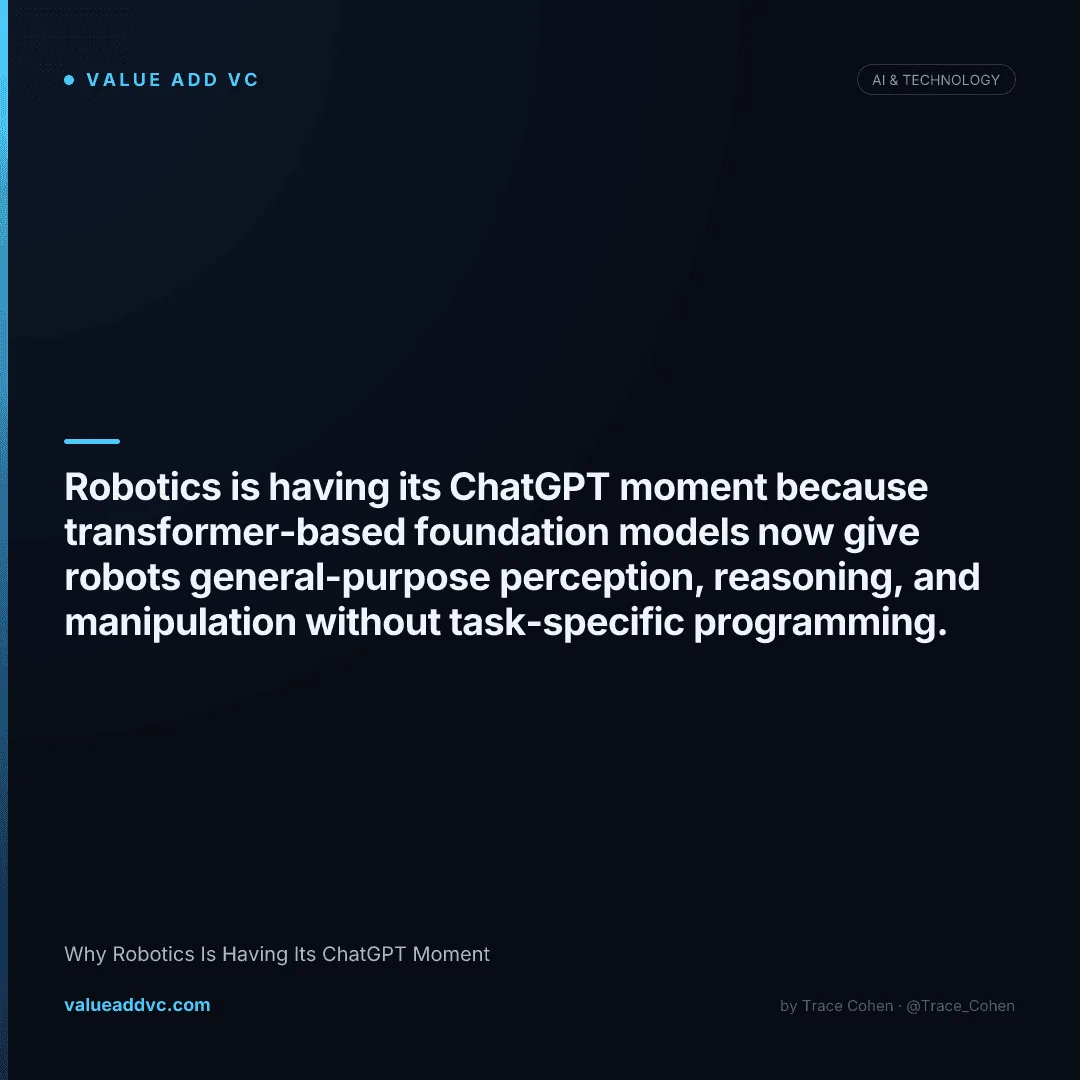
In November 2022, ChatGPT crossed 1 million users in five days. It didn't invent language — it collapsed the cost of using language intelligently. Robotics is at the exact same inflection point.
The technology didn't suddenly get better. The architecture did. Transformers, multimodal training, and foundation models have done to physical manipulation what GPT-3 did to text generation. The 20-year science project just became a product category.
The Funding Numbers Tell the Story
Capital follows conviction. In the past 18 months, robotics has attracted more serious venture money than the previous decade combined.
Partnership with BMW for factory deployment
$675M
$2.6B
Foundation model for general-purpose robot control
$400M
$2.1B
Backed by OpenAI; humanoid for warehouse ops
$100M
Undisclosed
NASA-heritage team; Apollo humanoid in testing
$350M
Undisclosed
Atlas and Spot in commercial deployment
Strategic
$1.1B (2021 deal)
Tesla's Optimus is an additional wildcard — internal deployment is already underway in Tesla factories, with external sales publicly targeted for 2026.
Why Now: The Architecture Shift Nobody Explains Correctly
Classic robotics required engineers to hand-code behavior trees for every single task. Pick up a box. Open a door. Navigate around an obstacle. Every scenario needed explicit programming. That approach hit a wall — the real world has infinite scenarios.
Physical Intelligence's π0 model changed the framing. Their foundation model — trained on diverse robot interaction data across manipulation tasks — generalizes to new tasks with minimal finetuning. It's the GPT-3 moment for robot control: one model, many applications.
I've watched enough AI waves to know when an architectural shift is real versus a rebranding exercise. This one is real. Diffusion policies, vision-language-action models, and transformer-based planners are producing robots that handle novel objects and unstructured environments — things that were effectively impossible three years ago.
The Market Pressure That Makes This Inevitable
Technology inflections don't happen in a vacuum. The labor economics make robotics deployment not just viable but urgent.
500,000+
Open manufacturing jobs in the US right now
$260B+
Global robotics market projected by 2030
750,000+
Amazon robots already operating in warehouses
3-5 years
Realistic timeline to mainstream humanoid deployment
US manufacturers are facing a structural labor shortage that automation is the only viable long-term answer to. The Bureau of Labor Statistics projects the skilled trades gap widens through 2030. Companies are not buying robots because they want to — they're buying them because the alternative is unfilled production lines.
What's Actually Investable vs What's Hype
Not everything in robotics deserves a Series A check. Here's how I think about separating signal from noise:
High conviction: Vertical-specific deployment
Warehouse picking, food manufacturing, construction trades. Narrow environments with high repetition and clear ROI. Boston Dynamics and Agility Robotics built real businesses here.
High conviction: Data flywheels
The moat in robotics is proprietary manipulation data, not hardware. Companies deploying at scale collect training data competitors can't buy. This is the network effect equivalent for embodied AI.
Speculative but real: General-purpose humanoids
Figure AI and 1X are betting the humanoid form factor wins because it fits the built world. The thesis is sound; the timeline is 3-5 years. This is a Series B/C bet, not seed.
Avoid: Hardware-first startups with no software moat
A company building a robot arm with no proprietary model, no data strategy, and no vertical focus is competing on cost with Asian manufacturers who will undercut on price every time.
The Real Bottleneck Is Data, Not Hardware
Language models trained on the internet. Vision models trained on ImageNet and web images. What do you train a robot manipulation model on? That's the unsolved problem.
Physical Intelligence is collecting real-world manipulation data at scale specifically because synthetic data and simulation don't transfer well to physical environments. The sim-to-real gap has been the graveyard of robotics companies for 15 years. The companies solving the data collection problem — not the hardware problem — will build the lasting moats.
In my experience watching AI companies scale, the companies that control the training data become the platform. Everyone else becomes a customer. In robotics, that means whoever is operating at sufficient scale to collect diverse manipulation data in the real world has a compounding advantage that a better-funded late entrant cannot easily overcome.
This is not a 10-year bet anymore.
Robotics has its foundation model moment. The companies collecting real-world manipulation data at scale today are building the moat that will define the next decade of physical AI.
Latest from the Pulse
Get VC data most people never see
— 100% free
Weekly benchmarks, valuations, and fund data. Join 5,000+ investors. No spam.