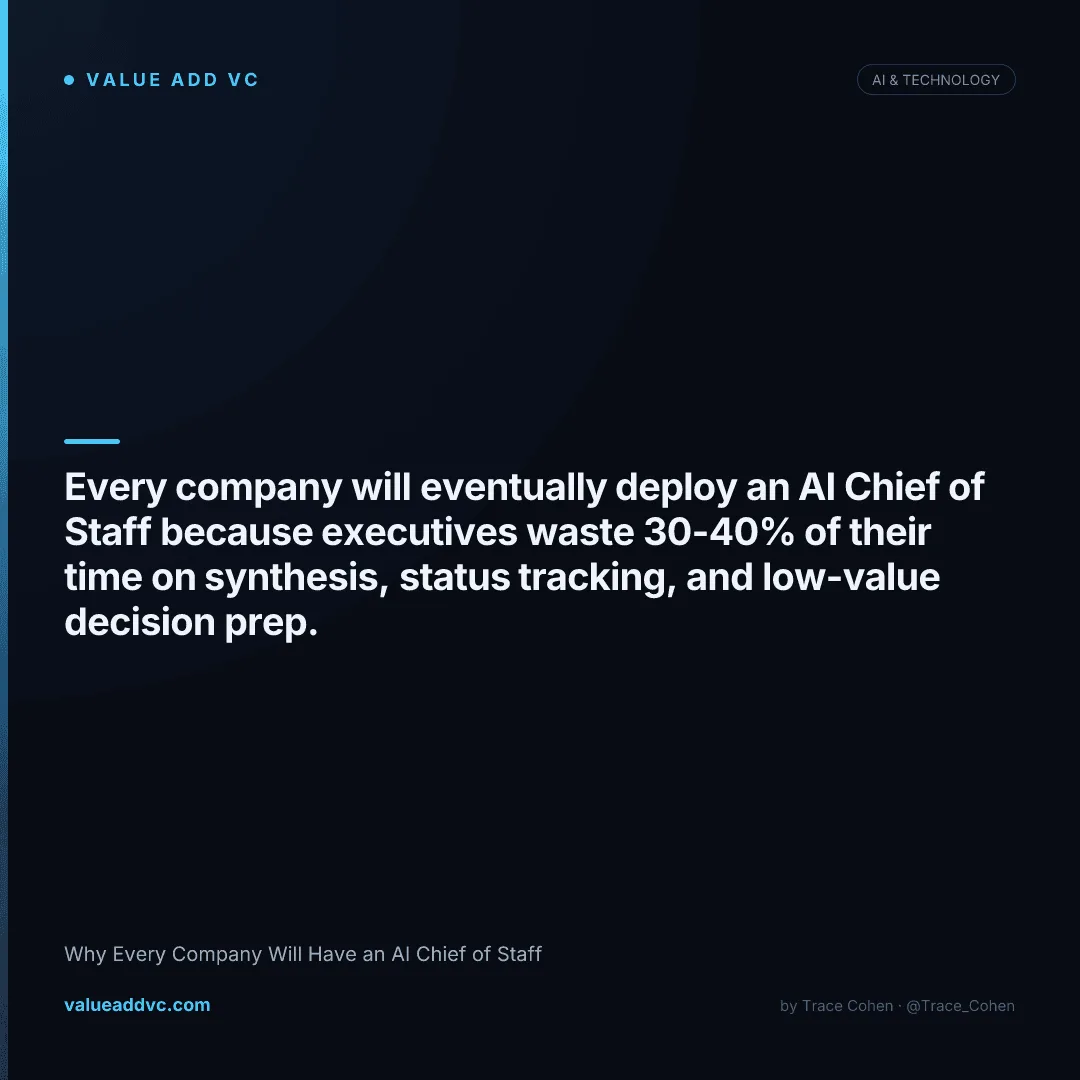
McKinsey estimates that executives spend 23 hours per week in meetings — and 67% of those meetings are rated unproductive by the people in them.
Add another 10 hours on email synthesis, status updates, and pre-meeting prep, and you have a picture of how most senior leaders actually spend their time. Not on strategy. Not on customers. On coordination. An AI Chief of Staff does not optimize that. It eliminates it.
What the AI Chief of Staff Actually Does
This is not a chatbot that answers questions. The AI Chief of Staff is an orchestration layer — an always-on system that monitors inputs across every tool in a company's stack and turns raw information into actionable intelligence. Specifically, it handles:
- →Meeting synthesis: Transcribes, summarizes, and extracts action items from every call — no human note-taker required. Decision log maintained automatically.
- →Cross-functional status aggregation: Pulls weekly updates from Jira, Linear, Salesforce, and Notion into a single executive briefing — automatically flagging blockers and dependencies.
- →Board and investor prep: Drafts board decks, investor updates, and OKR reviews from live data — the CEO reviews and edits, not builds from scratch.
- →Priority triage: Reads the full inbox and Slack history, surfaces the five things that actually need a human decision, and drafts responses to everything else.
- →Anomaly detection: Monitors KPI dashboards and sends real-time alerts when metrics deviate beyond defined thresholds — before the weekly review, not during it.
The Economics Are Unavoidable
A human Chief of Staff at a well-funded startup costs $180,000–$250,000 in total compensation, plus benefits, equity, and onboarding time. They work 50 hours a week, take vacation, and have a learning curve that runs 90 to 180 days before they are fully effective.
Human Chief of Staff (fully loaded)
$220K–$300K/year
Plus equity dilution, onboarding, and 3-6 month ramp
AI Chief of Staff (enterprise tier)
$30K–$60K/year
Live Day 1, zero ramp, 24/7 availability, no equity
Executive time recovered per week
12–20 hours
Based on pilots at 50+ companies using agentic workflow tools
ROI breakeven
Under 45 days
At a $500/hr executive opportunity cost assumption
Why Most Companies Are Getting This Wrong
The companies that fail at AI Chief of Staff implementation make the same three mistakes. First, they treat it as an add-on to existing workflows rather than a replacement for them — the AI gets bolted on, nobody changes their habits, and the tool sits unused inside six months.
Second, they start with the wrong use case. Summarizing emails is not a Chief of Staff function — it is a feature. The real unlock is cross-system synthesis: taking the Jira ticket, the Slack thread, the Salesforce note, and the Zoom recording and producing a single coherent picture of what is actually happening in the business. That requires integration work most teams are not willing to do upfront.
Third, they underinvest in the feedback loop. The AI Chief of Staff gets better the more you correct it — not through model fine-tuning, but through prompt refinement and process documentation. Companies that treat this as a set-and-forget deployment get 20% of the potential value. Companies that iterate weekly get 10x more.
Which Companies Will Move First
High-ROI Adopters
- ✓ Series B+ with 50+ employees and meeting-heavy culture
- ✓ Remote-first companies with distributed leadership
- ✓ Founder-CEOs drowning in operational overhead
- ✓ Any org where the exec team touches 10+ tools daily
- ✓ Companies raising or preparing for board-level governance
Slow or Resistant Adopters
- ✕ Heavily regulated industries with strict data residency rules
- ✕ Companies with fragmented, unmaintained tooling stacks
- ✕ Leadership teams that confuse busyness with productivity
- ✕ Orgs where the current CoS has strong political capital
The AI Chief of Staff is not replacing your executive team.
It is giving them back the 30% of their week that was spent becoming informed enough to make decisions.
Follow the evolution of AI in enterprise operations at Value Add VC. Originally published in the Trace Cohen newsletter.
Latest from the Pulse
Get VC data most people never see
— 100% free
Weekly benchmarks, valuations, and fund data. Join 5,000+ investors. No spam.