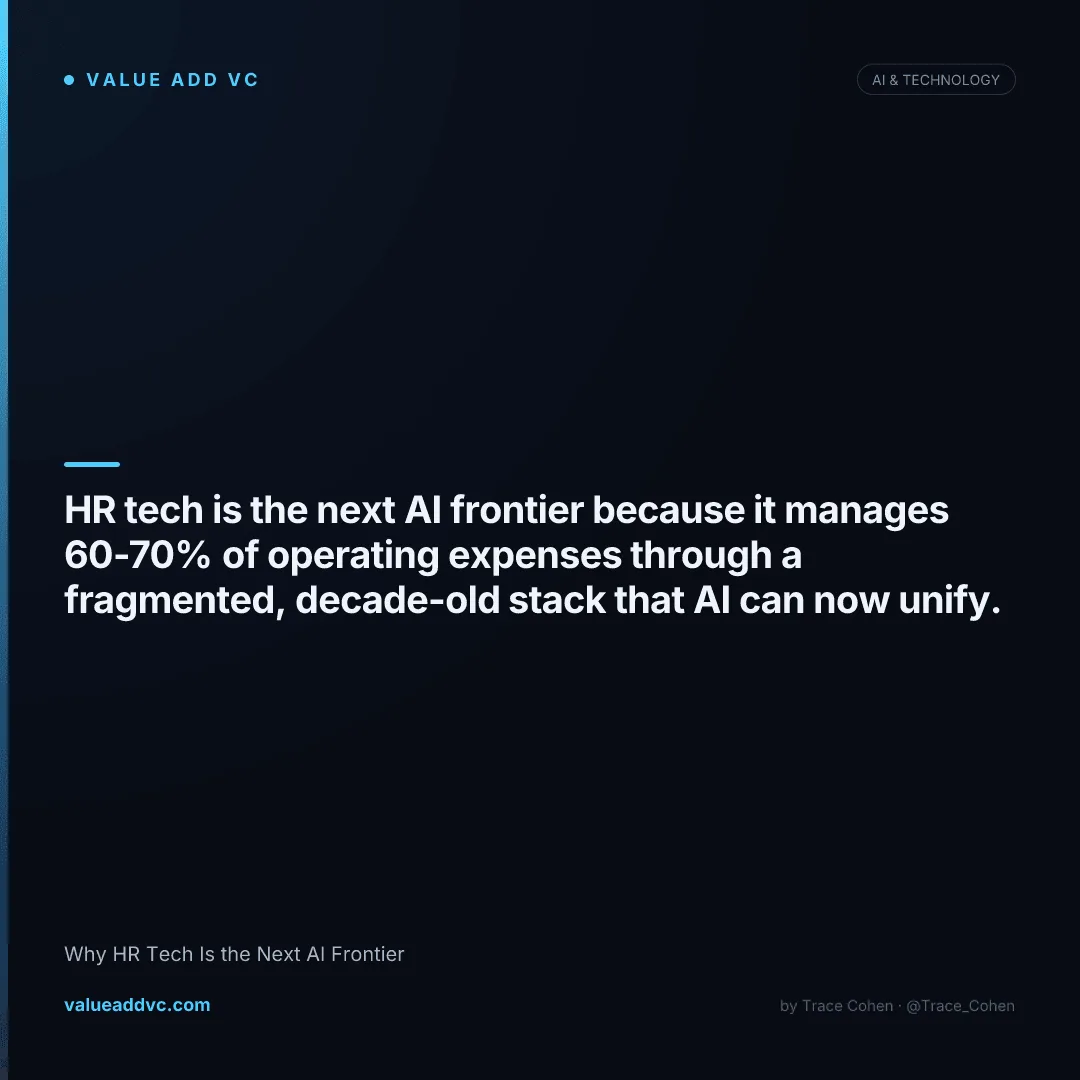
Labor is 60-70% of operating expenses for most companies. HR software is a $32B market. And yet, the average enterprise still manages their most expensive asset with a patchwork of 12+ tools, annual performance reviews, and spreadsheet-based headcount planning.
That is not a niche problem. That is the biggest unsolved operational challenge in enterprise software — and AI is finally mature enough to crack it.
The HR Stack Is Broken by Design
In 2026, the median enterprise uses Workday or SAP SuccessFactors for HRIS, LinkedIn for sourcing, an ATS like Greenhouse or Lever for recruiting, a separate tool for onboarding, another for performance management, and yet another for compensation benchmarking. None of these systems share data in real time. None of them generate actionable intelligence. They are expensive record-keeping systems masquerading as strategic infrastructure.
The numbers are damning. A 2025 Gartner survey found that 78% of HR leaders say their current tech stack does not meet their needs. Average time-to-hire sits at 44 days across industries — and that number has barely moved in a decade despite billions spent on recruiting software. Annual employee turnover costs U.S. employers an estimated $1 trillion per year, according to Gallup, with replacement costs running 50-200% of annual salary depending on seniority.
I've seen this firsthand across portfolio companies. The HR function is consistently the last to get modern tooling, and the first to get blamed when hiring slows or attrition spikes. The problem is structural, not cultural — the tooling has never given HR teams the data to be proactive.
Where AI Is Actually Breaking Through
- •Recruiting automation: AI screening reduces time-to-hire by 30-40% and cuts recruiter workload in half. Ashby, the AI-native ATS, crossed $25M ARR in under three years by building workflow intelligence on top of sourcing — not just applicant tracking.
- •Attrition prediction: Models trained on internal performance, compensation, tenure, and engagement data can identify flight risks 60-90 days out with 80-85% accuracy. The ROI is direct — retaining one senior engineer saves $150-300K in replacement costs.
- •Performance intelligence: AI-assisted continuous feedback is replacing the annual review cycle. Leapsome and Lattice now offer AI summaries of 360 feedback patterns, surfacing coaching opportunities managers would have missed in a 200-person org.
- •Compensation intelligence: Real-time market benchmarking is replacing stale salary surveys. Startups now have access to live comp data tied to role, stage, geography, and funding level — compressing the information asymmetry that has historically favored candidates over employers.
- •HR help desk deflection: Conversational AI is handling 60-70% of tier-1 HR queries (benefits questions, PTO calculations, policy lookups) that previously consumed 40% of HR team bandwidth. This is the category every legacy HRIS vendor is scrambling to add.
- •Onboarding acceleration: AI-guided onboarding sequences tied to role, team, and learning style are reducing time-to-productivity by 25-35%. In sales roles, this is worth an additional $50-100K per rep per year in accelerated ramp.
The Data Moat Nobody Is Mining
The most underappreciated dynamic in HR tech is the data moat. HR systems accumulate longitudinal, high-resolution workforce data — who was hired when, at what comp, under which manager, with what performance trajectory, and whether they stayed or left. This data, trained into AI models, becomes genuinely defensible.
Rippling understood this early. Their unified workforce data model — payroll, HRIS, IT, benefits, and equity on a single platform — means every action taken on the platform enriches the intelligence layer. Companies with five or more years of Rippling data have a structural advantage in workforce planning that competitors cannot easily replicate.
This is the AI flywheel the best HR tech companies are building: more users → more data → better predictions → more value → more users. The regulatory moat reinforces it. GDPR, CCPA, and HIPAA compliance in healthcare HR creates real barriers to entry for new entrants who cannot afford the legal infrastructure to handle employee data at scale.
Incumbents like Workday have the data but lack the AI architecture. Startups have the architecture but lack the data. The window to close that gap — by building AI-native on top of data networks fast enough to matter — is open right now, but it will not stay open forever. The winners in this cycle will be companies that acquire the data moat while the incumbents are still moving slowly.
The company that solves unified workforce intelligence will be worth more than Workday. We are in inning two of this transformation — and most of the best deals are still being made at the seed stage.
Stay current with VC and startup trends at Value Add VC. Originally published in the Trace Cohen newsletter.
Latest from the Pulse
Get VC data most people never see
— 100% free
Weekly benchmarks, valuations, and fund data. Join 5,000+ investors. No spam.