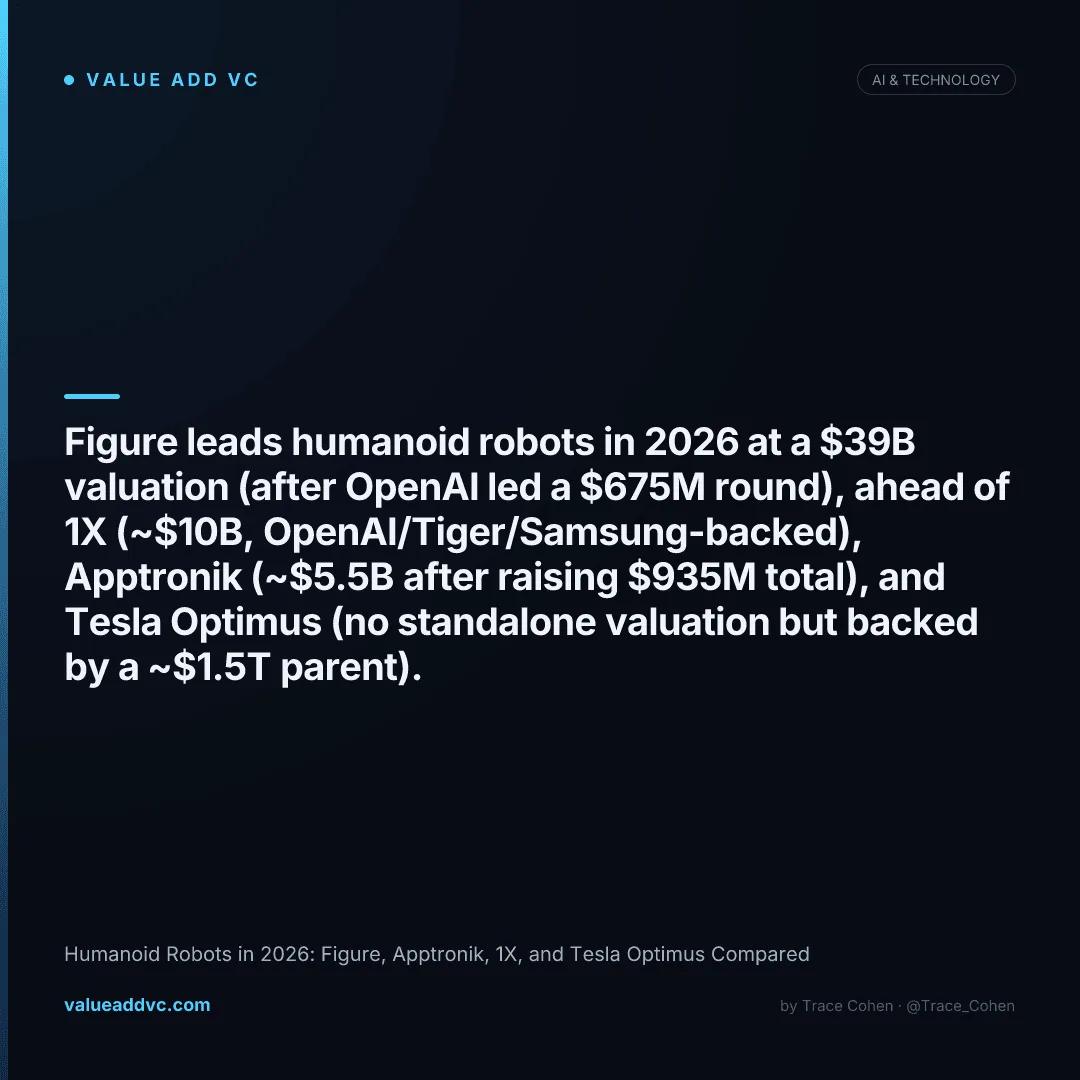
Figure leads the humanoid race in 2026 at a ~$39B valuation, ahead of 1X (~$10B), Apptronik (~$5.5B after raising $935M total), and Tesla Optimus, which has no standalone price but rides a ~$1.5T parent — while China's Unitree (~$1.3B) quietly outships all of them. Valuation and shipped units telling opposite stories is the tension to watch.
After more than $7B flowed into humanoid startups in 2025, four names have separated from the pack. None of them are shipping at scale yet — but each is betting on a different path to get there.
Humanoid Robots 2026 Comparison: The Four Leaders Side by Side
The humanoid robots 2026 comparison comes down to five companies: Figure, Apptronik, 1X, Tesla Optimus, and Unitree. Figure is the valuation leader at ~$39B and runs paid factory pilots; Apptronik (~$5.5B, $935M raised) targets logistics with Mercedes and GXO; 1X (~$10B) is going straight for the home at a $20,000 price; Tesla Optimus bets on manufacturing scale over a standalone raise; and Unitree (~$1.3B) is the volume and price leader out of China, having shipped 5,500+ humanoids in 2025.
| Attribute | Figure | Apptronik | 1X | Tesla Optimus | Unitree |
|---|---|---|---|---|---|
| Flagship robot | Figure 03 | Apollo | Neo | Optimus Gen 3 | G1 / H1 |
| Valuation (2026) | ~$39B | ~$5.5B | ~$10B | Part of ~$1.5T Tesla | ~$1.3B |
| Latest raise | $675M (OpenAI-led) | $935M total raised | $125M+ total | Internal funding | ByteDance/Alibaba/Tencent round |
| Target market | Factories / logistics | Logistics / manufacturing | The home | Tesla factories first | Research / industry / export |
| AI model | Helix (in-house VLA) | Apollo + partners | In-house + teleop | FSD-derived neural net | Open SDK + partners |
| Target price | RaaS (not listed) | RaaS (not listed) | ~$20,000 | $20,000–$30,000 | from ~$16,000 |
| Marquee customer | BMW | Mercedes-Benz, GXO | Consumers (preorder) | Tesla (internal) | 5,500+ units shipped (2025) |
Figures reflect publicly reported rounds and analyst estimates as of mid-2026; private valuations are approximate.
Figure: The Funding Leader Betting on Its Own AI
Figure is the clear capital leader in the 2026 humanoid market. A funding round led by OpenAI (a reported ~$675M raise) pushed its valuation to about $39B — a staggering ~15x jump from the ~$2.6B it was worth in early 2024. The thesis: humanoids are an AI problem as much as a hardware one, and Figure has leaned hard into building Helix, its own vision-language-action model, in-house — embodied AI as the moat rather than the actuators.
The Figure 03, unveiled in late 2025, is built for mass manufacturing with redundant actuators and tactile hands. Figure runs paid pilots at BMW's Spartanburg plant and has talked about deploying 100,000 robots over four years. The risk is obvious: a $39B valuation on a company with fleet sizes still measured in the hundreds is priced for a future that hasn't arrived. For a full breakdown of that valuation, the Series C investor list, and how the secondary market is now pricing the stock, see our Figure AI valuation deep dive. If Helix can generalize across tasks, the multiple looks cheap; if it can't, it looks like 2021 all over again.
Apptronik and 1X: The Logistics and Home Contenders
Apptronik closed a $403M Series A in 2025 — one of the largest A rounds in robotics history — then added a ~$520M extension to reach roughly $935M raised at a ~$5.5B valuation, with B Capital, Capital Factory, and Google among backers. Its Apollo robot, designed for 55 lb payloads, is in pilots with Mercedes-Benz and logistics giant GXO. Apptronik's edge is two decades of academic robotics IP out of the University of Texas and a deliberate focus on industrial reliability over flashy demos — and CEO Jeff Cardenas has framed the raise explicitly as a race to "beat Chinese humanoids to market."
1X Technologies, backed by OpenAI and EQT Ventures and valued near $10B, took the opposite bet: the home. Its Neo robot is priced around $20,000 — or a ~$500/month subscription — and 1X has been candid that early units rely on remote human teleoperation to handle edge cases while the AI learns. That honesty is refreshing in a sector full of staged videos, but it also underlines how far real autonomy still is from the marketing.
Tesla Optimus: Scale Over Valuation in the Humanoid Comparison
Tesla Optimus is the wildcard in any humanoid robots 2026 comparison because it doesn't play by startup rules. There's no Series anything and no standalone valuation — Optimus is funded off Tesla's balance sheet and a ~$1.5T market cap. Elon Musk has repeatedly claimed Optimus could eventually be worth more than the car business and floated production targets of 1M units per year by the late 2020s, with a long-run price of $20,000–$30,000.
Tesla's real advantages are manufacturing and AI reuse: it can amortize battery, motor, and inference work across millions of cars, and Optimus inherits the data engine behind Full Self-Driving. The weakness is deployment proof. As of mid-2026, Optimus is mostly working inside Tesla's own factories rather than in paying third-party plants, and Tesla's history of aggressive timelines means the production numbers deserve heavy discounting. Whoever wins, this is the kind of capex-heavy, AI-driven race we track on the AI Valuations dashboard.
Unitree: The China Volume Leader Reshaping the Race
The company most likely to be underestimated in any Western humanoid robots 2026 comparison is Unitree Robotics. The Hangzhou-based firm hit unicorn status at a ~$1.3B valuation in mid-2025 on a round backed by ByteDance, Alibaba, and Tencent, and priced its STAR Market IPO in August 2026 at a ~$6.2B valuation — the first public pure-play humanoid robotics stock. While Figure and Apptronik measure success in pilot programs, Unitree measures it in units: it shipped 5,500+ humanoids in 2025 and is targeting 10,000–20,000 in 2026 — more than every Western pure-play combined.
Its weapon is price. The Unitree G1 starts around $16,000 and the larger H1 sits in the low six figures — far below the robotics-as-a-service contracts Western players quote. That cost advantage is exactly why Apptronik raised nearly $1B explicitly to "beat Chinese humanoids to market," and why humanoids have become a national-security and supply-chain story as much as a venture one. We dig into that angle on the Defense Tech tracker and in Why Robotics Is Having Its ChatGPT Moment. For the broader embodied-AI thesis, see The Physical AI Opportunity.
Who Wins the Humanoid Robots 2026 Comparison?
There won't be one winner — the market is big enough to split by use case. My read after watching this sector and the broader embodied-AI thesis:
Best positioned
- ✓ Figure — most capital ($39B) + owns its AI stack
- ✓ Apptronik — deepest IP, real logistics pilots
- ✓ Tesla — unmatched manufacturing scale
- ✓ 1X — only serious play for the $20K home robot
- ✓ Unitree — volume and price leader, 5,500+ units shipped
Biggest risks
- ✕ Valuations priced years ahead of revenue
- ✕ Fleets still in the hundreds, not thousands
- ✕ Demo videos ≠ reliable 24/7 autonomy
- ✕ Teleoperation still propping up "autonomous" tasks
The hardware problem is mostly solved. The bottleneck is AI generalization and unit economics.
Whoever turns a $39B valuation into thousands of reliably deployed robots first wins the decade.
Track AI and robotics valuations on the AI Valuations Dashboard and the national-security angle on the Defense Tech tracker at Value Add VC. Originally published in the Trace Cohen newsletter.
Latest from the Pulse
Get VC data most people never see
— 100% free
Weekly benchmarks, valuations, and fund data. Join 5,000+ investors. No spam.