
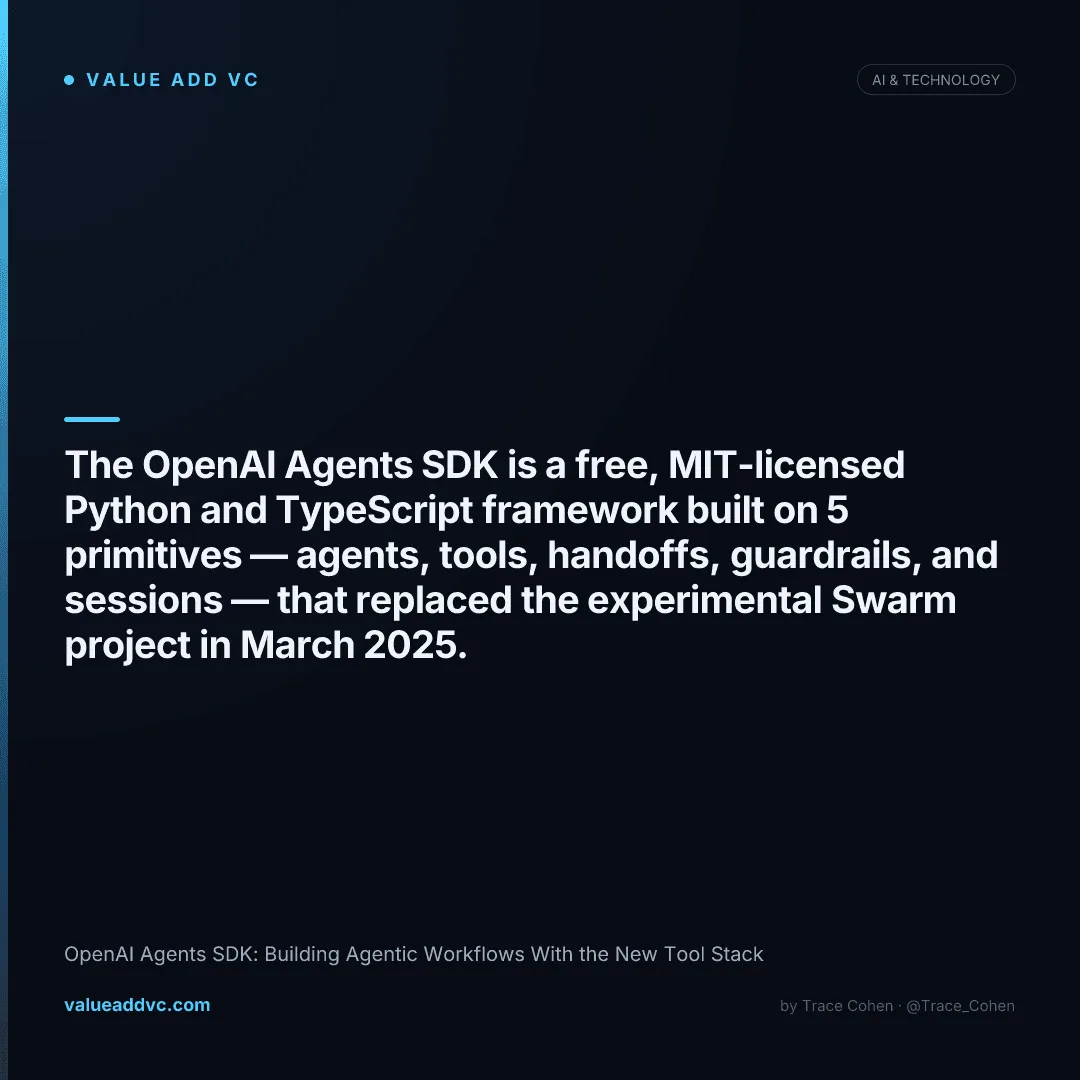
The OpenAI Agents SDK is a free, open-source framework built on exactly 5 primitives — agents, tools, handoffs, guardrails, and sessions — that turns a multi-agent workflow from 300+ lines of orchestration glue into roughly 30.
That's the short answer. The longer answer is more interesting — because the SDK is also a tell about where OpenAI thinks the value is moving: not the model, but the loop around it.
What the OpenAI Agents SDK Actually Is
The OpenAI Agents SDK is a lightweight Python and TypeScript framework for building agentic applications — programs where a language model autonomously decides which tools to call, hands work off to specialized sub-agents, and loops until a goal is reached. Released in March 2025 as the production successor to the experimental Swarm project, it is MIT-licensed, free of any platform fee, and built on just 5 core primitives, so a working multi-agent system fits in a single short file.
I've built three companies and made 65+ investments, and the pattern I keep seeing is that founders over-engineer the orchestration layer. The Agents SDK is OpenAI's argument that you shouldn't. It strips agent-building down to a handful of concepts and lets the model do the reasoning instead of forcing you to encode it in a sprawling state machine. The bet is volume: the easier agents are to ship, the more tokens get consumed — and tokens are the business.
The 5 Primitives in the OpenAI Agents SDK
Everything in the OpenAI Agents SDK reduces to five building blocks. Master these and you understand the entire framework — there is no hidden sixth layer of complexity waiting for you in production.
Layered on top is built-in tracing — every agent run, tool call, and handoff is automatically logged and viewable in the OpenAI dashboard, which removes the single biggest pain of debugging agentic systems: not knowing why the loop did what it did.
OpenAI Agents SDK vs LangChain vs CrewAI
The honest comparison: the Agents SDK wins on simplicity and OpenAI-native tooling, LangChain wins on breadth of integrations, and CrewAI wins on opinionated multi-agent role structure. Here is the side-by-side.
| Attribute | OpenAI Agents SDK | LangChain / LangGraph | CrewAI |
|---|---|---|---|
| Released | March 2025 | October 2022 | 2024 |
| Core concepts | 5 primitives | Dozens of modules | Crews, agents, tasks |
| License cost | $0 (MIT) | $0 (MIT) | $0 (MIT) |
| Languages | Python + TypeScript | Python + JS | Python only |
| Built-in tracing | Yes, native | Via LangSmith (paid tiers) | Limited |
| Model support | 100+ via compatible APIs | 100+ providers | Multi-provider |
| Learning curve | Low | Steep | Medium |
| Best fit | OpenAI-centric production agents | Complex stateful graphs | Role-based agent teams |
LangChain launched in October 2022 and now spans hundreds of integrations and a sprawling module surface — powerful, but it's easy to spend a week learning the framework before you ship anything. The Agents SDK's 5-concept footprint means a competent engineer is productive in an afternoon. That speed-to-first-agent gap is the whole pitch.
What Building Agentic Workflows With the SDK Costs
Building agentic workflows with the OpenAI Agents SDK has no framework cost — the SDK is MIT-licensed and free. Your only spend is the model tokens the agents consume, and because agents loop and call tools repeatedly, that token math matters far more than with a single-shot chatbot. Here is what the underlying models cost per million tokens.
| Model | Input / 1M tokens | Output / 1M tokens | Agent use case |
|---|---|---|---|
| GPT-4o | $2.50 | $10.00 | Complex reasoning loops |
| GPT-4o mini | $0.15 | $0.60 | High-volume cheap tools |
| o3 (reasoning) | ~$10.00 | ~$40.00 | Hard multi-step planning |
| Claude (via compatible API) | ~$3.00 | ~$15.00 | Long-context agents |
| Gemini Flash (via API) | ~$0.10 | ~$0.40 | Cheap classification |
| Local model (Ollama) | $0.00 | $0.00 | Privacy-sensitive workflows |
The trap founders fall into: an agent that calls 8 tools and reasons over the results can burn 50,000+ tokens for a single user request. At GPT-4o output pricing that's real money at scale, which is exactly why the SDK supports cheaper models like GPT-4o mini at $0.15 per million input tokens for the routine sub-tasks and reserves the expensive reasoning models for the hard steps. If you're tracking how this spend compounds across the industry, our AI Spending dashboard maps where the infrastructure dollars are going.
Why OpenAI Built the Agents SDK (The VC Read)
OpenAI doesn't ship free frameworks out of generosity. The Agents SDK is a distribution play. By making agents trivial to build, OpenAI increases the number of applications that consume its API — and agentic apps consume 5–10x the tokens of a simple chatbot because they loop, retry, and call tools. The framework is the on-ramp; the tokens are the toll road.
This matters for anyone investing in or building AI startups. If your entire company is "an orchestration layer on top of OpenAI," OpenAI just gave that layer away for free. The defensible value isn't the agent framework — it's the proprietary data, the vertical workflow, and the distribution. I've written before about how AI wrappers are dying while AI-native is winning, and the Agents SDK accelerates exactly that. The framework being commoditized pushes value to the edges: the data and the customer relationship.
Where Value Survives
- ✓ Proprietary data feeding the agent's tools
- ✓ Deep vertical workflows in regulated industries
- ✓ Distribution and customer trust
- ✓ Evals and reliability engineering at scale
Where Value Evaporates
- ✕ "We built an agent framework" as the moat
- ✕ Generic orchestration with no data edge
- ✕ Thin wrappers reselling raw model calls
- ✕ Prompt engineering as a defensible product
When to Choose the OpenAI Agents SDK
Choose the OpenAI Agents SDK when you want the shortest path from idea to a working agent, you're already OpenAI-centric, and you value native tracing over maximal flexibility. Reach for LangGraph or CrewAI when your needs push past what 5 primitives cleanly model.
Fast MVP, minimal abstraction
5 primitives means productive in an afternoon, not a week
OpenAI-native tracing and tools
Built-in run logs remove agentic debugging pain
Python and TypeScript parity
Ship the same agent logic on backend and edge
Multi-model flexibility later
100+ models via Chat Completions-compatible APIs
The framework is free. The model tokens are not.
OpenAI gave away the orchestration layer so it could sell the loop that runs on top of it — build on the data and workflow it can't commoditize.
Track AI model pricing and the agent infrastructure boom on the AI Valuations Dashboard at Value Add VC. Originally published in the Trace Cohen newsletter.
Latest from the Pulse
Get VC data most people never see
— free to subscribe
Trace's notes on venture, AI and startups, a few times a week. Join 5,000+ subscribers. No spam.
No spam, unsubscribe anytime. Sent via Substack · Privacy · or subscribe on Substack ↗