Every major Nvidia customer is building a chip to need Nvidia less. Nvidia's answer, announced today, is to buy $3.5 billion of the company helping them build it.
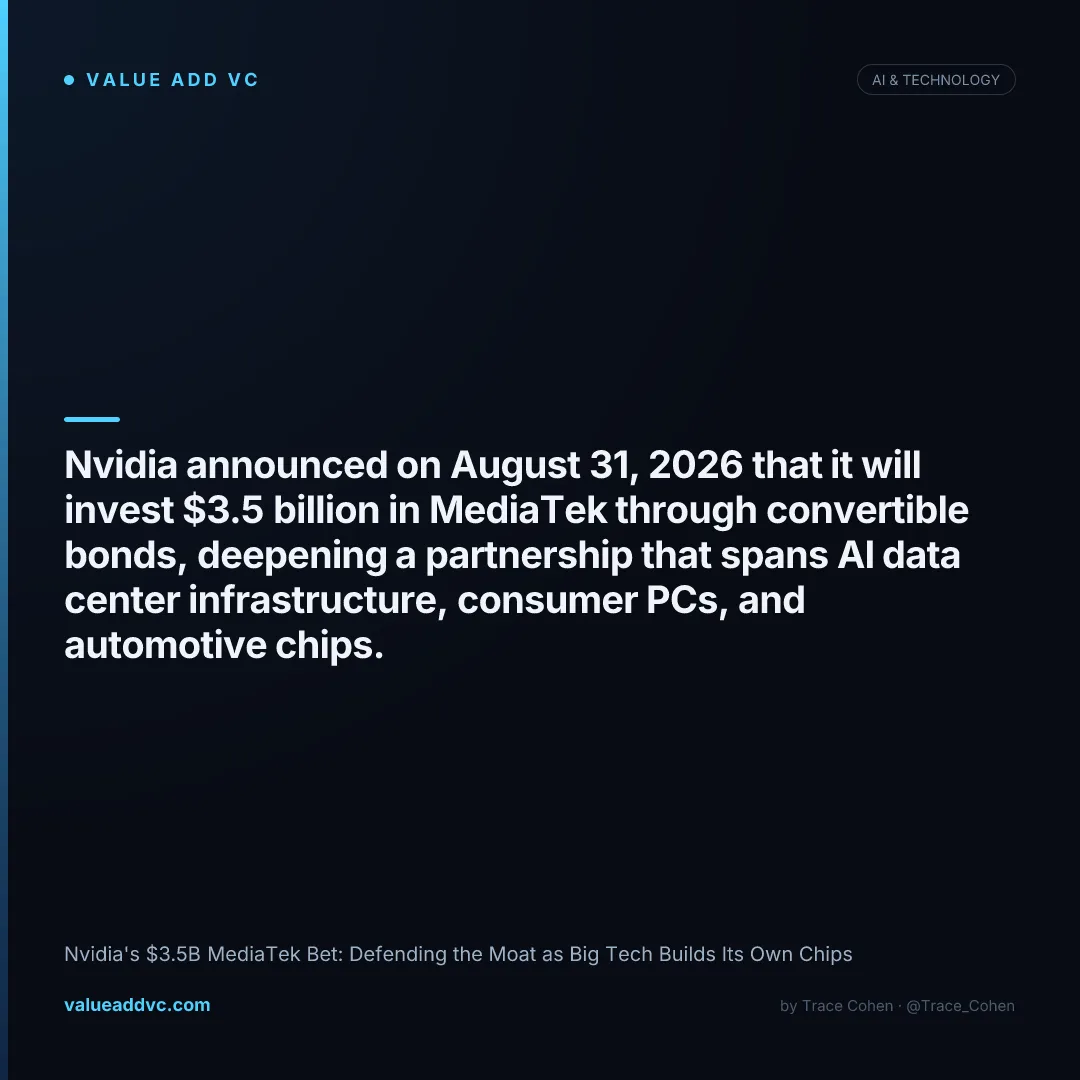
Nvidia said on August 31, 2026 that it will invest $3.5 billion in MediaTek through convertible bonds, deepening a partnership that already spans AI data center infrastructure, consumer PCs, and automotive chips. Alphabet joined the same offering, with the size of its stake undisclosed. In return, MediaTek is adopting Nvidia's NVLink Fusion platform — the interconnect standard that lets custom accelerator chips built by hyperscalers and cloud providers plug directly into Nvidia's rack-scale data center systems.

Figures per Nvidia, MediaTek, and Alphabet disclosures reported by Bloomberg, Nikkei Asia, and TechCrunch, August 31, 2026.
Why Nvidia is bankrolling the company building its rivals' chips
MediaTek is best known as a fabless designer of smartphone chips, but it's increasingly a contract designer for the custom AI silicon hyperscalers want — the kind of chip meant specifically to reduce how many Nvidia GPUs a company needs to buy. On paper, funding that business looks like Nvidia subsidizing its own disintermediation.
In practice, the $3.5 billion buys Nvidia something more durable than a single customer relationship: MediaTek's commitment to NVLink Fusion as the connective tissue for whatever it builds. A custom ASIC that still has to speak NVLink to reach rack scale is a custom ASIC that still runs on Nvidia's systems architecture — even if the compute silicon itself was never Nvidia's to sell.
The moat is moving from the chip to the rack
Nvidia's GPU business has always rested on two things: the best silicon and CUDA, the software layer that made switching costly. Custom silicon from Amazon's Trainium, Google's TPU, and Microsoft's Maia chips is chipping away at the first advantage for internal, well-defined workloads. NVLink Fusion is Nvidia's move to defend the second advantage at the systems level instead — by making its interconnect, not just its GPU, the thing a data center architect has to design around.
That reframes what counts as a win for Nvidia. It no longer needs every accelerator in a rack to be an Nvidia GPU — it needs every rack to be built on Nvidia's interconnect and reference architecture, whoever made the chip. Funding MediaTek's balance sheet to make that outcome more likely is a cheaper and faster way to lock in the standard than trying to out-design every hyperscaler's internal chip team.
Alphabet's presence in the round is the tell
Alphabet already runs one of the most mature custom-silicon programs in the industry with its TPU line, and it's precisely the kind of customer NVLink Fusion is designed to keep inside Nvidia's systems even as it builds chips outside Nvidia's GPU lineup. Its participation in the same bond offering — regardless of size — suggests hyperscalers see value in helping set the interconnect standard even while they diversify away from buying GPUs outright.
That's a more comfortable outcome for Nvidia than the alternative headline this deal could have generated: a hyperscaler-backed chip designer building a fully independent stack, interconnect included, with no Nvidia dependency left at all.
What it means for AI infra investors
For investors positioning around the GPU-versus-custom-ASIC divide, this deal is a reminder that the two aren't as separable as the framing suggests. Nvidia isn't fighting the shift to custom silicon — it's trying to own the rails that custom silicon has to run on, which means startups building interconnect, networking, or rack-scale infrastructure tooling now have to underwrite whether NVLink Fusion becomes the de facto standard or one of several competing ones.
It's also a signal for anyone underwriting MediaTek-adjacent or contract-chip-design startups: the more hyperscalers route their custom silicon ambitions through partners like MediaTek rather than fully vertical in-house teams, the more that middle layer of the stack becomes investable — and the more it becomes contested ground between Nvidia and the hyperscalers it's trying to keep close.
Bottom line: Nvidia's $3.5 billion MediaTek investment isn't a bet against the custom-silicon trend — it's a bet on staying relevant inside it. By getting NVLink Fusion adopted as the interconnect for MediaTek's AI accelerators, and pulling Alphabet into the same funding round, Nvidia is defending its moat one layer up from the chip itself. Expect more of these systems-level plays as Amazon, Google, Microsoft, OpenAI, and Anthropic keep building the silicon Nvidia can no longer assume it will sell them.
Latest from the Pulse
Get VC data most people never see
— free to subscribe
Trace's notes on venture, AI and startups, a few times a week. Join 5,000+ subscribers. No spam.
No spam, unsubscribe anytime. Sent via Substack · Privacy · or subscribe on Substack ↗