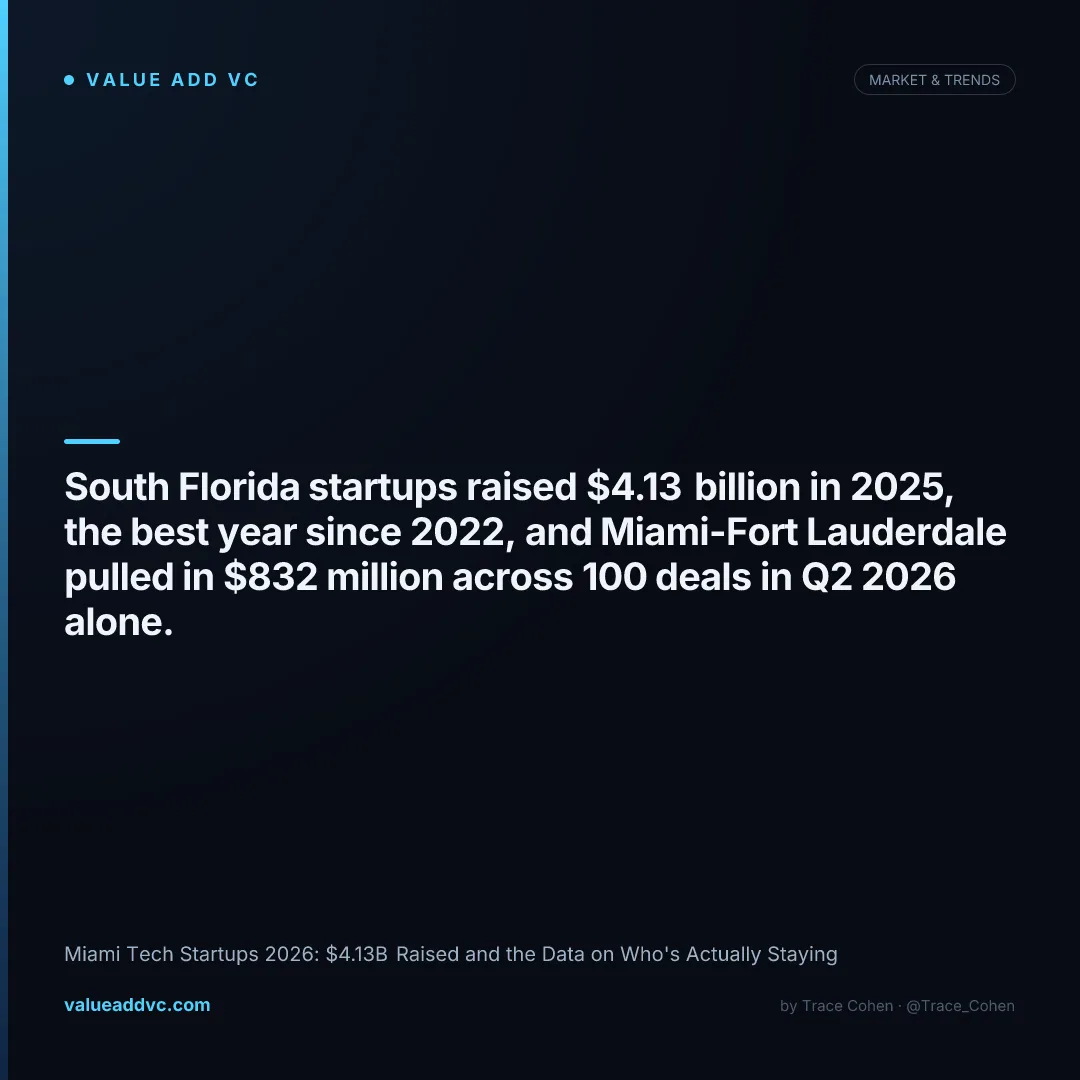
South Florida startups raised $4.13 billion in 2025 — the best year for the region since the 2022 record — and Miami-Fort Lauderdale alone pulled in $832 million across 100 deals in Q2 2026. That's the short answer. The longer answer is more interesting.
Every few months another headline asks whether the "Miami tech boom" was ever real, or whether it was just a 2021 Twitter moment that quietly reversed once founders realized SF and NYC still have deeper talent pools. The funding data says it didn't reverse. Three-plus years after the migration narrative peaked, capital and corporate relocations into South Florida are still climbing — even if the global rankings have cooled. Here's what the actual numbers show.
Figures from the eMerge Americas 2025 Florida Venture Capital Report, PitchBook data via Refresh Miami, and Startup Genome's 2026 ranking via Refresh Miami, checked September 26, 2026.
Miami Tech Startups 2026: The Funding Data
South Florida startups raised $4.13 billion across 376 deals in 2025, up 49% from 2024 and the strongest year for the region since the 2022 record, according to the eMerge Americas 2025 Florida Venture Capital Report (Refresh Miami summary). That momentum carried into 2026: the Miami-Fort Lauderdale metro pulled in $832 million across 100 deals in the second quarter, after a revised $1.1 billion in Q1, for nearly $2 billion in the first half, per PitchBook data reported by Refresh Miami. Track the region's ongoing deal flow on our own South Florida funding tracker.
Fintech has been the metro's strongest sector since at least 2021, and it led again in 2025 with $909 million across 85 deals, followed by healthcare at $821 million across 56 deals, per the eMerge report. Healthcare SaaS in particular is a growing category in South Florida — companies like Prosper Health's telehealth focus on adult autism care represent the clinical software segment absorbing capital regionally. See our ranking of Miami's largest companies by valuation for which individual names are absorbing that capital. In the first three quarters of 2025 alone, the metro raised $2.3 billion across 261 deals — in Q3 alone it ranked sixth nationally by deal count, even with Austin — and the region's largest 2025 round was $200 million (OpenEvidence), which suggests the total was broad-based rather than a single mega-round skewing the number.
The Quarter-by-Quarter Trend, and Why AI Is Now Driving It
Zooming into the metro level shows the growth wasn't a one-quarter spike. Miami-Fort Lauderdale pulled in $754 million across 92 deals in Q3 2025, up nearly 25% from a revised $608 million across 75 deals in Q2 2025, according to Refresh Miami's report on PitchBook's data. The metro's average deal size ticked up to roughly $8.2 million in that quarter, and the top rounds included a $150 million raise for maintenance-software company MaintainX and a $131.8 million round for Fort Lauderdale oncology biotech Syncromune.
AI is the specific sector driving that acceleration: AI-company investment in South Florida totaled $830 million in the first half of 2025 alone — 42% of the region's activity — per the same Refresh Miami report, and the full-year total for self-described AI startups (a category that overlaps fintech and healthcare) reached $1.22 billion, up from $897 million in 2024, per the eMerge report. That's a meaningfully different sector mix than the fintech-and-crypto story that defined Miami's 2021-2022 migration wave, and it tracks with the national AI-funding surge rather than a Miami-specific phenomenon.
Sources: 2022, 2023, and 2024-2025 eMerge Americas figures.
Miami Tech Startups vs. Austin and Denver: The City Comparison
The most useful comparison isn't Miami versus 2021 Miami — it's Miami versus the other cities founders are actually choosing between today. In full-year 2025, the Miami metro logged 376 deals worth $4.13 billion, essentially even with Austin's 372 deals on count but well behind Austin's $7.93 billion in dollars, while Denver raised $5.90 billion across only 234 deals, according to the metro rankings in the eMerge Americas report. Miami ranked 5th nationally by deal count but 9th by deal value — proof that Austin's and Denver's rounds skew much larger.
| Metro Area | Deal Count | Total Value | Avg. Deal Size |
|---|---|---|---|
| Austin (2025) | 372 | $7.93B | ~$21.3M |
| Denver (2025) | 234 | $5.90B | ~$25.2M |
| Miami / South Florida (2025) | 376 | $4.13B | ~$11.0M |
| Miami-Ft. Lauderdale (Q2 2026) | 100 | $832M | ~$8.3M |
| Miami-Ft. Lauderdale (Q3 2025) | 92 | $754M | ~$8.2M |
| Miami-Ft. Lauderdale (Q1-Q3 2025) | 261 | $2.3B | ~$8.8M |
Sources: eMerge Americas 2025 report (Austin and Denver totals are PitchBook-only; the South Florida total adds verified deals from Refresh Miami, CB Insights and Dealroom, so the comparison is close but not perfectly like-for-like); PitchBook quarterly data via Refresh Miami. Average deal size is total value divided by deal count.
Why the Miami Tech Startups 2026 Story Is Companies Arriving, Not Leaving
The clearest signal that Miami's tech shift stuck isn't the funding total — it's who is physically moving in. Varonis, a cybersecurity firm previously headquartered in New York, now lists 801 Brickell Avenue in Miami as its principal executive offices in SEC filings since 2025. Palantir moved its headquarters from Denver to Miami in February 2026; GFL Environmental relocated its headquarters to Miami Beach; D-Wave Quantum selected Boca Raton for its new corporate headquarters; and FC Barcelona moved its Americas commercial operations from New York to Downtown Miami. These are headquarters and headcount decisions, not short-term tax plays — though some, like Palantir's initial co-working footprint, are still early.
The global rankings are the counterweight. Miami placed No. 25 on Startup Genome's 2026 Global Startup Ecosystem ranking and 11th among U.S. ecosystems, down from No. 22 in 2025 and No. 16 in 2024, with fewer large exits cited as a key drag. Florida's lack of a state income tax remains one of the most concrete, non-narrative reasons founders cite for staying once they've relocated. You can track how this shift compares across regions on our VC & PE performance dashboard.
Miami vs. Austin, Full-Year 2025
eMerge Americas 2025 Florida Venture Capital Report (PitchBook data)
What Founders Actually Get Funded in Miami
Fintech and healthcare were the two sectors capturing the largest share of South Florida's $4.13 billion in 2025 funding, per the eMerge report, with AI-powered or AI-focused startups drawing $1.22 billion and crypto/blockchain companies $480 million across 38 rounds. On the check-writing side, Miami-based H.I.G. Capital reports $75 billion in assets under management, though its checks skew toward private equity and growth rather than early-stage. For founders raising seed and Series A rounds specifically, local early-stage funds and studios, such as Miami-based venture studio Atomic, are the more relevant first calls, and many of them underwrite differently than Bay Area funds.
That underwriting difference is the part most "is Miami real" takes miss: many Miami investors want to see a credible path to efficient growth, not a Bay Area-style burn-and-scale plan funded by an assumption of an always-open follow-on market. The region's average deal size was $11 million in 2025 across all stages, per the eMerge report. If you're building a South Florida fundraising plan, our fund directory breaks down which funds are actually writing checks by stage and sector.
That discipline also filters the founders who move to Miami for the wrong reasons. Founders coming down from the Bay Area who assume a Miami fund will underwrite the same runway-to-nowhere plan a Sand Hill Road seed fund might have signed off on in 2021 are often surprised by how quickly local partners ask for unit economics. That's arguably a healthier discipline than the pre-2022 default, and it tracks with the broader pullback in growth-at-all-costs financing nationally since 2022.
The Gap Miami Still Has to Close
None of this means Miami has caught up to the coasts, and pretending otherwise would undercut the actual case for the region. In 2025 Austin out-raised Miami by roughly $3.8 billion on about the same number of deals, and Denver out-raised it by roughly $1.8 billion with 142 fewer deals — average rounds of about $21 million and $25 million versus Miami's $11 million. Silicon Valley ($177 billion across 3,246 deals) and New York ($32.6 billion across 1,979 deals) operate at a different order of magnitude on both deals and dollars, per the same eMerge metro table.
The talent density gap is the harder problem than the funding gap. A founder in Miami can now raise a credible seed round and Series A locally, but hiring a fifth senior ML engineer or a VP of Sales who has already scaled a company through a $100 million ARR mark is still meaningfully easier in the Bay Area or New York. That's the honest version of "did the move stick": the capital stuck, the corporate headquarters commitments stuck, but the depth of specialized senior talent is still catching up — likely one reason Miami's average deal size trails Austin's and Denver's rather than leading them.
What's changed since the 2021 hype cycle is that Miami no longer needs the migration narrative to justify itself. $4.13 billion raised in 2025 and $832 million in a single quarter of 2026 are real, durable, boring metrics — the kind that build over years, not the kind a single viral tweet thread can manufacture. The slide to No. 25 on Startup Genome's ranking is the reminder that exits, not just inbound capital, are what the region still needs to prove.
Bottom line: the Miami tech move stuck. $4.13 billion raised in South Florida in 2025, $832 million in Miami-Fort Lauderdale in Q2 2026 alone, and headquarters moves by Varonis, Palantir and GFL Environmental, plus D-Wave's planned move to Boca Raton, are not the signature of a trend reverting to San Francisco and New York. Miami is now a top-five-by-deal-count U.S. hub running even with Austin on deal count — the story in 2026 isn't whether the migration was real, it's whether the region can close a dollar-volume gap that still trails Austin, Denver and the coasts, and produce the exits that global rankings reward.
Latest from the Pulse
Get VC data most people never see
— free to subscribe
Trace's notes on venture, AI and startups, a few times a week. Join 5,000+ subscribers. No spam.
No spam, unsubscribe anytime. Sent via Substack · Privacy · or subscribe on Substack ↗