
Instinct, a personal AI assistant built by 23-year-old founder Noah Shinn, is now valued at $10 billion after closing a $1 billion Series C on September 28, 2026 — 4x the $2.5 billion price its $250 million Series B set just a month earlier, and roughly five months after the company was registered. That's the headline number. The messier story: Instinct is still in invite-only early access with no disclosed revenue or user numbers, and the company says it has since rewritten the privacy policy TechCrunch criticized in August, when reporters found the assistant sent emails without asking and kept working on a user's inbox after access was revoked.
The newest development is distribution, not money. “Instinct opened its group-chat assistant to everyone on iMessage on October 27th, putting a shared AI agent inside conversations that can include people who do not have Instinct accounts,” RuntimeWire reported on October 29, citing Shinn's post on X. As of October 31, 2026, no new round or valuation has been reported since the Series C.
Instinct AI Key Numbers (as of October 31, 2026)
| Metric | Figure | Date | Source |
|---|---|---|---|
| Valuation (Series C) | $10B, 4x the $2.5B Series B a month earlier | Sep 28, 2026 | PYMNTS |
| Series C size and investors | $1B from Sequoia Capital, Benchmark, Coatue (no lead named) | Sep 28, 2026 | Business Wire |
| Disclosed priced-round funding | $1.325B+ ($75M A + $250M B + $1B C; our arithmetic) | Sep 28, 2026 | Business Wire |
| Revenue | None disclosed | Oct 31, 2026 | Value Add VC check |
| Transaction volume (not revenue) | Approaching $1B a year, about half travel (founder-stated) | Sep 30, 2026 | Fortune |
| Group chats on iMessage | Opened to everyone (early access since Oct 5) | Oct 27, 2026 | RuntimeWire |
| Flight help usage | 20%+ of users last month (founder-reported, unaudited) | Oct 2026 | AI PM Research newsletter |
| Personal Agent Protocol | Founding developer with Sierra, Meta, Shopify, Stripe, Walmart and others | Oct 6, 2026 | PYMNTS |
| Our own check | Value Add VC's Q3 2026 ranking lists Instinct at $1.0B Series C, $10.0B, Sep 28, 2026; no newer round reported | Oct 31, 2026 | Value Add VC |
Instinct has not disclosed users, retention or revenue. The 20% flight figure is a share of users, as stated by the founder, not a user count.
Updated Oct 31, 2026
Rechecked Oct 31, 2026: valuation, funding, revenue disclosure, the group-chat rollout, Personal Agent Protocol membership and peer valuations, against the sources linked on this page. The valuation is unchanged at $10 billion. Cognition's peer row now shows its September 2026 Series E at $48 billion instead of its May 2026 round.
Correction — September 29, 2026
Earlier versions of this article listed Perplexity at $23.0B (January 2026). That figure has no reputable source. Perplexity's last verifiable valuation is $20B (Sep 2025, reported by The Information via TechCrunch).
Sources: Instinct's Series C announcement (Business Wire), TechCrunch, Bloomberg, and PYMNTS, checked October 6, 2026.
Instinct AI Valuation: How Did It Hit $10 Billion So Fast?
Instinct's valuation is $10 billion as of September 28, 2026, set by a $1 billion Series C raised from Sequoia Capital, Benchmark and Coatue; neither the company's announcement nor TechCrunch named a lead investor. The company reached that number roughly five months after Noah Shinn registered Spear Street Technology, the entity behind the Instinct product, in April 2026 — one of the fastest climbs to a double-digit-billion price tag of any startup this year.
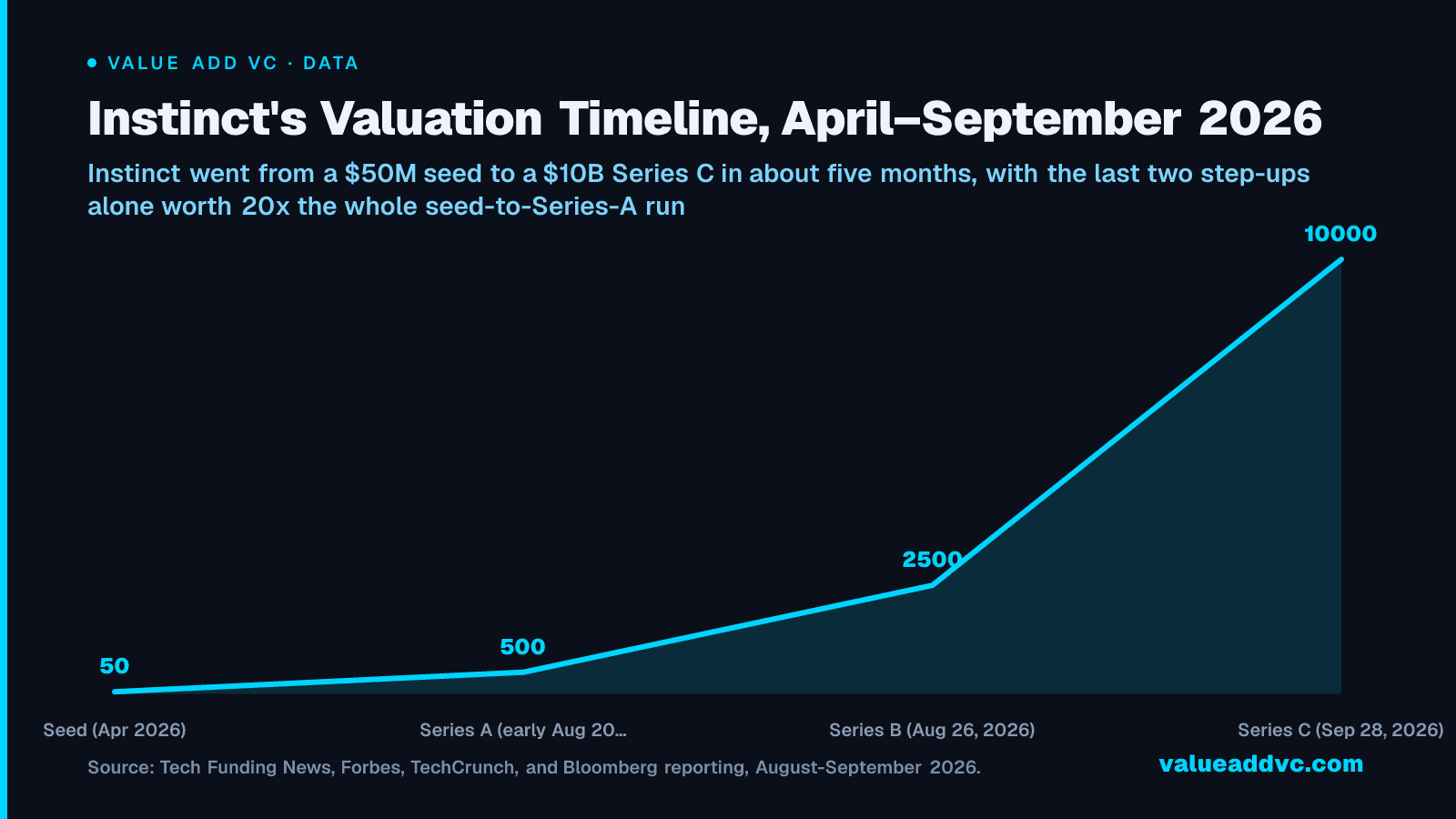
The speed is the story as much as the number. Instinct's seed round, backed by Conviction's Pranav Reddy and Greenoaks' Neil Mehta, valued the company at $50 million. By early August, a $75 million Series A led by Kleiner Perkins partner Mamoon Hamid put the price at $500 million. Three weeks later, a $250 million Series B co-led by Index Ventures and Benchmark put it at $2.5 billion. One month after that, the $1 billion Series C put it at $10 billion — a 4x step-up in about a month and a roughly 200x climb from seed in five months.
Instinct's Valuation Timeline, April–September 2026
Instinct went from a $50M seed to a $10B Series C in about five months, with the last two step-ups alone worth 20x the whole seed-to-Series-A run
Tech Funding News, Forbes, TechCrunch, and Bloomberg reporting, August-September 2026.
Data
| Item | Valuation ($M) |
|---|---|
| Seed (Apr 2026) | 50 |
| Series A (early Aug 2026) | 500 |
| Series B (Aug 26, 2026) | 2500 |
| Series C (Sep 28, 2026) | 10000 |
Who Are Instinct's Investors?
Instinct's cap table reads like a rotation through four different investor tiers in one summer. Conviction's Pranav Reddy and Greenoaks' Neil Mehta wrote the earliest checks at a $50 million valuation. Kleiner Perkins partner Mamoon Hamid then led the $75 million Series A at $500 million in early August 2026. Index Ventures and Benchmark co-led a $250 million Series B, bringing disclosed priced-round funding to $325 million against a $2.5 billion price, according to Tech Funding News. One month later, Sequoia Capital, Benchmark and Coatue backed a $1 billion Series C that pushed disclosed priced-round funding past $1.3 billion against the current $10 billion price, per TechCrunch.
What Does Instinct Actually Do?
Instinct is a proactive, always-on personal AI assistant that connects to a user's apps, email, and calendar and acts on their behalf rather than waiting to be asked. Early testers described using it to buy groceries, cancel recurring subscriptions, plan road trips, and organize a wedding, according to TechCrunch's reporting on the raise. Users text or call it, and Instinct "uses its own phone and computer to get it done," per its Series C announcement; there is no mobile app. The product remains in invite-only early access, is free to use, and Shinn has not committed to a broad launch date or a business model — the company has floated a paid subscription tier or advertising, but neither is priced or confirmed.
What Has Changed Since the Series C?
Instinct's Series C announcement listed several product updates: Instinct Concierge, a white-glove service for high-touch tasks such as phone calls and hard-to-book reservations; a Trusted Person Network that lets one user's Instinct coordinate plans with another user's; location sharing over iMessage; and security measures including isolated sandboxes, short-lived local credentials, identity-signed tool execution, and an "active detective system" meant to catch hallucinations before the agent responds or acts.
The one usage figure the company has offered publicly came from Shinn himself. On the Invest Like the Best podcast, he said Instinct is approaching $1 billion in annual transaction volume, about half of it travel, Fortune reported on September 30, 2026. That is money users spend through the assistant, not Instinct's revenue, and it is unaudited. Fortune also reported that each invite-only user gets five invites, that some users are reselling invites on eBay, and that Meta chief AI officer Alexandr Wang has mocked the startup on X as Meta pushes its own personal agent, Muse ("Muse absolutely crushes Insect," he wrote). Instinct declined to make Shinn available for interviews alongside the round, per TechCrunch.
Two product moves followed the round. Instinct began rolling out Instinct Selections, product recommendations Shinn says draw on picks curated by chefs, designers, architects and local guides, alongside a Shopify partnership; some users told Business Insider (October 5, 2026) the feature pushed products they never asked for, and Instinct has not said whether it earns commissions on those purchases. On October 5, Shinn said early-access users can now add Instinct to group chats, where a group-specific agent plans trips, splits costs and coordinates for several people at once, and friends in the chat don't need an account, Business Insider reported on October 6. As of October 31, 2026, no new funding round or valuation has been reported since the $10 billion Series C, and Instinct still has not disclosed revenue.
What's New in October 2026: Group Chats, Flights and a Protocol Seat
Group chats for everyone on iMessage (October 27). The group feature Shinn previewed for early-access users on October 5 is now open to everyone on iMessage. Per RuntimeWire, it puts a shared agent inside a group conversation, and people in that chat do not need Instinct accounts. That matters for growth: every group chat becomes a demo for people who have never signed up. It is not general availability of Instinct itself, which is still invite-only.
The first usage number (October 7-10). In posts on X summarized by the AI PM Research newsletter on October 10, Shinn said “more than 20% of Instinct's users had the agent help with flights last month, and the team just rebuilt that flight experience from scratch.” He also extended Instinct Concierge so the agent can make customer-service calls on a user's behalf, and introduced a new hotel booking experience built on the idea that “you shouldn't have to work around someone else's app or website to get something done.” The 20% is a share of users, founder-reported and unaudited. It still tells us something: travel is the core use, which fits Shinn's earlier remark to Fortune that about half of Instinct's near-$1 billion annual transaction volume is travel.
A seat at the standards table (October 6). Instinct is one of eight companies developing the Personal Agent Protocol, an open standard for how personal agents deal with businesses. “An open standard that defines how personal agents interact with businesses is being developed by Sierra, Meta, Genesys, Instinct, Rocket, Shopify, Stripe and Walmart,” PYMNTS reported, citing a blog post by Sierra co-founders Bret Taylor and Clay Bavor. A v0.1 specification was due by the end of October; we have not confirmed it was published. The group pairs Instinct with Sierra, Shinn's former employer, and with Meta, whose Muse agent competes with Instinct directly.
Instinct Bull Case vs. Bear Case
Bull. Instinct reached $10 billion about five months after it was registered, backed by Sequoia Capital, Benchmark and Coatue. The October 27 group-chat rollout is a distribution wedge that needs no signup, the founder-reported flight figure is the first real usage signal, and the Personal Agent Protocol seat puts Instinct next to Meta, Shopify, Stripe and Walmart while the rules for agent commerce are being written.
Bear. Instinct is pre-revenue and invite-only, with no disclosed user count or retention. TechCrunch's August reporting documented an assistant that sent email without asking and kept summarizing an inbox after access was revoked; the policy has since been updated, but the changes have not been detailed or independently checked. Meta's Muse is a direct competitor with far larger distribution, and there is still no pricing: a paid tier and advertising are both under consideration, neither confirmed.
Why Are Investors Moving This Fast on a Pre-Revenue Product?
Instinct's four-round run fits a pattern showing up across 2026 venture data: fewer deals overall, but far larger checks concentrated into companies investors believe are ahead in a specific category. Firmus Grid raised $2 billion at a $10.5 billion valuation the same month, Cognition raised $1 billion at a $26 billion valuation in May (and then over $2 billion at $48 billion in September, per PYMNTS), and Base Power's Series D tripled its price to $13 billion in ten months. Mega-rounds above $500 million, once reserved for late-stage companies with years of revenue history, are now landing on startups measured in months.
For Instinct specifically, the bet is narrower than "AI agents are hot." Kleiner Perkins' Mamoon Hamid and Index Ventures are both repeat backers of consumer software that won on distribution before it won on business model — the same logic that funded early rounds of several breakout consumer apps before those companies had settled on monetization. Shinn's Sierra pedigree adds a specific signal: Sierra proved that a genuinely proactive agent (one that acts instead of just answering) could command premium enterprise pricing, and investors are underwriting the idea that the same shift plays out in consumer software, where user acquisition is cheaper but trust and safety are harder to guarantee.
How Does Instinct's Valuation Compare to Other 2026 AI Agent Startups?
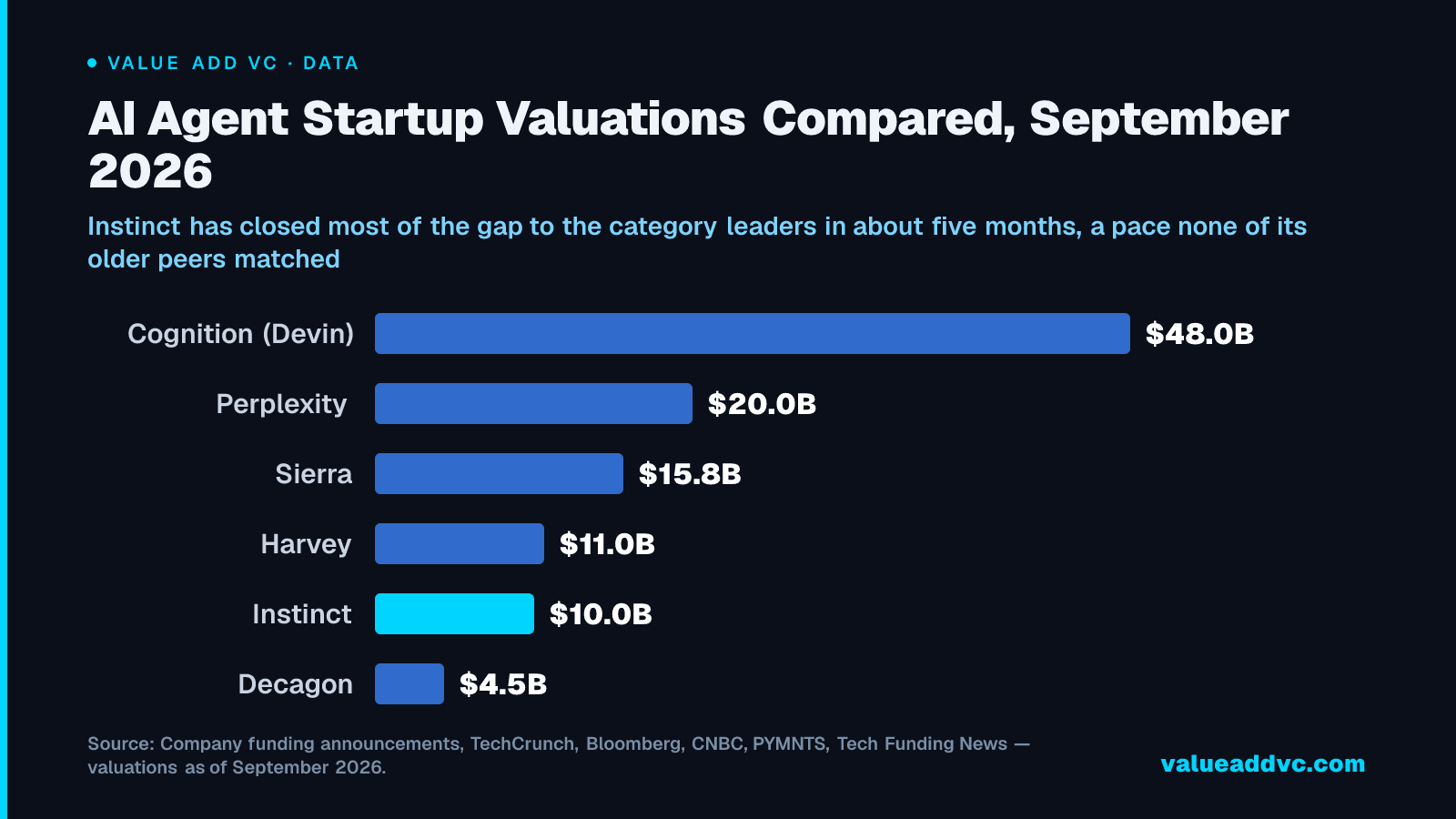
Instinct is the newest company in the current wave of AI-agent valuations, and it closed most of the gap to the category leaders faster than any of its peers below. Sierra — the enterprise customer-service agent company Shinn left to start Instinct — took about three years to reach a comparable multiple of its early valuation. The table below lines up six agent-focused AI startups by their latest disclosed valuation.
| Company | Category | Latest valuation | Date set | Total raised | Lead investors |
|---|---|---|---|---|---|
| Cognition (Devin) | AI coding agent | $48.0B | Sep 2026 | $2B+ in Series E alone | Andreessen Horowitz, Accel |
| Perplexity | AI search / answer engine | $20.0B | Sep 2025 | $1.72B | Nvidia, IVP, others |
| Sierra | Enterprise customer-service agents | $15.8B | May 2026 | $1.6B | Tiger Global, GV |
| Harvey | Legal AI agents | $11.0B | Mar 2026 | $1.0B+ | GIC, Sequoia |
| Instinct | Personal AI assistant | $10.0B | Sep 2026 | $1.325B+ | Sequoia, Benchmark, Coatue |
| Decagon | Enterprise customer-support AI | $4.5B | Jan 2026 | ~$500M | Coatue, Index Ventures |
Figures are September 2026 estimates from company funding announcements, TechCrunch, Bloomberg, CNBC, PYMNTS, and Tech Funding News; Cognition's row updated October 31, 2026 from its September 8 Series E (over $2 billion at $48 billion, co-led by Andreessen Horowitz and Accel, per PYMNTS). All are private-market valuations from the latest disclosed round; none of these companies has filed for an IPO.
AI Agent Startup Valuations Compared, September 2026
Instinct has closed most of the gap to the category leaders in about five months, a pace none of its older peers matched
Company funding announcements, TechCrunch, Bloomberg, CNBC, PYMNTS, Tech Funding News — valuations as of September 2026.
Data
| Item | Value |
|---|---|
| Cognition (Devin) | $48.0B |
| Perplexity | $20.0B |
| Sierra | $15.8B |
| Harvey | $11.0B |
| Instinct | $10.0B |
| Decagon | $4.5B |
Is Instinct Repeating the Humane and Rabbit Playbook?
Instinct isn't the first "your AI assistant handles everything" product to generate this kind of attention before shipping broadly. Humane's AI Pin launched in April 2024 to heavy press coverage, and by February 2025 the company had sold its software and patents to HP for $116 million — a fraction of the $750 million to $1 billion valuation Humane had reportedly sought less than a year earlier. Rabbit's R1 device drew similar hype at its January 2024 launch, then in June 2024 a hacking group called Rabbitude disclosed that it had found hardcoded API keys in Rabbit's codebase that could expose user data and let outsiders alter or read every device's responses. Both were hardware companies selling a physical device, which is a different capital structure than Instinct's software-only, subscription-or-ads model — but the underlying pattern is the same: a proactive-assistant pitch generates investor and press enthusiasm well ahead of the product proving it can be trusted with the access it asks for. Instinct's invite-only status means it hasn't yet had its Humane or Rabbit moment in front of a mass audience, and the privacy issues TechCrunch already documented in early access are the kind of problem that historically shows up at a larger, more damaging scale once a product ships broadly.
What the headline misses
Instinct's $10 billion price tag was set on a product still in invite-only early access with no disclosed revenue, no confirmed pricing model, and — per TechCrunch's August 24, 2026 reporting — real, documented security gaps at the time: terms of service that reportedly granted the company a perpetual, irrevocable license to reuse user materials for AI training, an assistant testers found could be phished relatively easily, emails stored in plain text, and at least one case of the assistant sending an email on a user's behalf without asking first, plus reports it kept summarizing a user's Gmail account for hours after that user revoked its access. Union Square Ventures general partner Michael Mignano told TechCrunch at the time that products like Instinct are going to "change modern security norms for consumers" as people hand over credentials to third-party apps without fully understanding what gets stored. Alongside the Series C, TechCrunch reported that the policy "has since been updated," and Instinct's announcement listed security measures such as isolated sandboxes and short-lived credentials, but neither has detailed what changed in the policy itself. None of the original concerns slowed the round — the $10 billion price is still a bet on the product Instinct could become, and on a privacy fix that hasn't been independently verified, not a company with a public track record to point to yet.
Is Instinct's $10 Billion Valuation Justified?
Instinct's valuation is closer to a bet on Noah Shinn and the category than on any current business metric, since the company has not disclosed revenue, users, or retention. One read on this: investors are pricing in the same trade Sierra proved out at the enterprise level — that a genuinely proactive AI agent, not a chatbot that waits to be asked, is worth a premium — and betting Shinn can repeat that shift in consumer software, where user trust and data access are harder to control than in an enterprise sales contract. Whether that bet pays off likely comes down to whether Instinct's claimed privacy fix actually holds up before a bigger, more damaging incident tests it in public.
The bottom line:
Instinct is worth $10B on a $1B Series C from Sequoia Capital, Benchmark and Coatue — but it is still a pre-revenue, invite-only product, and its claimed privacy fix hasn't been independently verified.
The October 27 group-chat rollout and the first usage figure are real product progress. The $10B is still a bet on the category and on Shinn, not on disclosed business metrics.
Track how private AI valuations are moving across the market on our AI Valuations dashboard, and see how the broader private AI market is being priced in our roundup of the highest-valued private AI companies at Value Add VC. Originally published in the Trace Cohen newsletter.
Latest from the Pulse
Get VC data most people never see
— free to subscribe
Trace's notes on venture, AI and startups, a few times a week. Join 5,000+ subscribers. No spam.
No spam, unsubscribe anytime. Sent via Substack · Privacy · or subscribe on Substack ↗