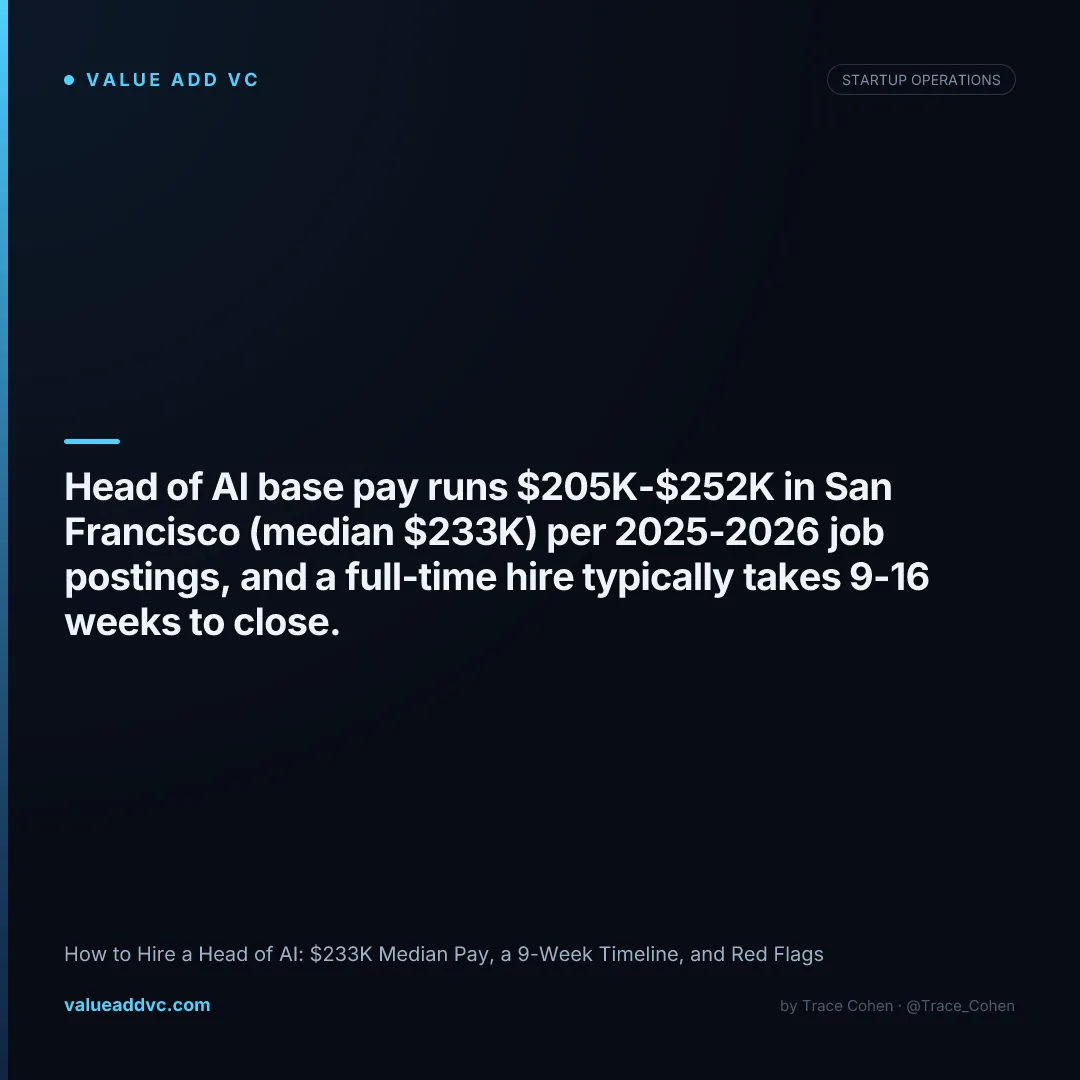
$233K is the median San Francisco base salary for a Head of AI in 2025-2026, and the role typically takes 9-16 weeks to fill. Why the role is so hard to fill well is the part worth understanding before you post the job.
Every founder I talk to right now is convinced they need a Head of AI. Most of them are wrong about why. They've watched competitors slap "AI-powered" on a landing page and panicked into posting a job req without deciding what the person will actually own — model strategy, a product roadmap, data infrastructure, or just vibes and a Slack channel full of ChatGPT screenshots. That vagueness is exactly why so many of these hires fail inside six months. Here's the actual job description, the comp data, the interview loop, and the red flags that separate a real AI leader from someone who's good at demoing.
Figures are 2025-2026 estimates blended from Recruiting From Scratch SF job postings, PwC's 2025 AI wage premium analysis, and KORE1's Chief AI Officer salary guide.
How to Hire a Head of AI: What the Role Actually Needs to Own
To hire a Head of AI, founders need to define ownership of four things before writing the job post: the build-vs-buy-vs-fine-tune model strategy, a production deployment track record (not pilots), data infrastructure decisions, and a direct reporting line — ideally to the CEO. Recruiting firms tracking 2025-2026 searches report that companies rescoping a vague "AI thought leadership" req into a narrow, budgeted, CEO-reporting role cut their own time-to-hire roughly in half.
The single biggest scoping mistake is hiring a Head of AI who reports into an existing VP Engineering. It signals to the market — and to the candidate — that the role is a staff-augmentation hire, not a strategy hire, and it filters out exactly the senior operators you're trying to attract. If AI is core to the product, the role needs a real budget and a seat at the leadership table from day one.
Head of AI Salary in 2026: What the Market Actually Pays
| Title | Base Pay Range | Typical Equity | Typical Stage |
|---|---|---|---|
| Head of AI (national avg.) | $150K-$250K | 0.25-1% | Seed-Series B |
| Head of AI (San Francisco median) | $205K-$252K (median $233K) | 0.25-1% | Seed-Series C |
| VP AI/Machine Learning (avg.) | $322K avg., $242K-$436K range | 0.5-1.5% | Series B+ |
| Chief AI Officer (startup, Series B-D) | $200K-$300K | 0.5-2% | Series B-D |
| Chief AI Officer (mid-market, $100M-$1B rev.) | $280K-$380K + 15-30% bonus | RSUs | Growth/mid-market |
| Chief AI Officer (enterprise) | $350K-$450K + 25-40% bonus | Significant grants | Enterprise |
Figures are 2025-2026 estimates blended from Recruiting From Scratch, Glassdoor, ZipRecruiter, Payscale, and KORE1 salary guide data. Ranges reflect posted job listings, not offer-accept data, and will run lower than total comp once signing bonuses and RSU refreshers are included.
Head of AI vs. Chief AI Officer: Which Title Does Your Startup Need?
Head of AI is typically a director/VP-level operating role — shipping features, managing a small technical team, and owning model selection — while Chief AI Officer is a C-suite title carrying company-wide strategy authority and, per KORE1's 2026 guide, a median salary near $380K once bonus and equity are included. Most startups under 100 employees are better served by a Head of AI; the CAIO title mostly shows up at $100M+ revenue companies formalizing AI governance for a board or regulators, not startups shipping their first AI feature.
Head of AI vs. Chief AI Officer: Median Base Pay and Team Size
Recruiting From Scratch, KORE1, industry job posting data, 2025-2026
How Long Does It Take to Hire a Head of AI?
Full-time AI leadership searches take 9-16 weeks on average, though one documented case filled a Head of AI role in 9 weeks after the founders re-scoped it — narrower charter, a real budget, and a direct line to the CEO. Mid-level AI engineering roles move faster, closing in 4-8 weeks, while broad or poorly scoped executive searches routinely stretch past 16 weeks because candidates keep asking the same clarifying question the job post should have answered: what will I actually own?
Speed matters more in AI hiring than in most functional searches. Top AI leadership candidates report accepting competing offers within 2-3 weeks of a first conversation, and 92% growth in AI job postings year-over-year means every serious candidate is fielding multiple offers simultaneously. If your process has more than three interview rounds, you will lose candidates to a faster-moving competitor — see how other startups are restructuring headcount around AI on our hiring dashboard.
The Head of AI Interview Process: What to Actually Test For
A tight Head of AI interview loop runs four stages: a 30-minute screen for background, motivation, and communication; a 90-minute technical deep-dive on a real problem pulled from your own product, not a generic take-home; a build-vs-buy strategy session where the candidate defends a specific model or vendor decision with real tradeoffs; and a reference check that specifically asks past colleagues what broke in production and how the candidate responded. Skip any of these four and you're hiring on vibes.
The technical deep-dive matters most and gets rushed most often. AI leadership hiring needs deeper validation than a standard engineering-manager loop — not just coding ability, but model architecture judgment, data strategy awareness, and production deployment experience under real constraints like latency, cost per inference, and hallucination rates. A candidate who's only worked on demos and internal pilots will struggle with all three.
Red Flags When Hiring a Head of AI
| Red Flag | Why It Matters | What to Ask Instead |
|---|---|---|
| Resume is all pilots, zero production ships | Pilots don't surface the real cost, latency, and reliability tradeoffs a shipped product forces | "Walk me through the last model you shipped to production and what broke in week one." |
| Can't defend a specific build-vs-buy call | Everyone can describe the options; few can explain why they picked one under real constraints | "Tell me about a time you chose to buy/fine-tune instead of build, and what you gave up." |
| No opinion on evaluation methodology | Without eval infrastructure, model quality claims are unfalsifiable | "How did you know your model got better after the last change you shipped?" |
| Vague on data infrastructure ownership | Model quality is usually a data problem wearing a model costume | "What did your data pipeline look like, and who owned data quality?" |
| Only talks in industry-wide trends, not specifics | Thought-leadership fluency is not the same as operating experience | "What's the one AI trend everyone's excited about that you think is overrated, and why?" |
| Refuses to give a cost-per-inference estimate | Anyone who's actually run a model in production tracks unit economics reflexively | "Roughly what did it cost you per 1,000 requests at your last company?" |
Framework synthesized from Samson Rose, HSG, and Syndesus 2025-2026 AI hiring research, adapted for early-stage interview loops.
Why AI Leadership Pay Commands Such a Steep Premium
PwC's 2025 wage analysis found roles requiring AI skills carry a 56% wage premium over comparable non-AI positions — up sharply from a 25% premium just a year earlier. That premium compounds at the leadership level: a Head of AI at $233K median already sits well above a comparable VP Engineering hire, and the jump to Chief AI Officer at a $380K median reflects real scarcity, not just title inflation. AI made up 64% of all US venture capital dollars invested in 2025 per PitchBook, which means the pool of companies competing for the same small set of proven AI operators keeps growing faster than the talent pool does.
For founders, the practical takeaway is that underpaying this hire relative to market doesn't just slow the search — it actively signals the company isn't serious about AI, which is disqualifying to the exact caliber of candidate you need. Track how AI-native company valuations and hiring plans are moving together on our AI valuations dashboard.
Bottom line: A Head of AI costs roughly $233K in base pay at the median and takes 9-16 weeks to hire — but the number that actually predicts success isn't comp, it's scope. Rescoping the role to a narrow, budgeted, CEO-reporting mandate cut one company's search to 9 weeks; leaving it vague as "AI thought leadership" is what stretches searches past 16 weeks and produces hires who can demo but can't ship. Write the job description around what the person will own, test for production experience over pilot experience in the interview loop, and pay the 56% AI-skills premium the market is already charging — because your competitors are.
Latest from the Pulse
Get VC data most people never see
— free to subscribe
Trace's notes on venture, AI and startups, a few times a week. Join 5,000+ subscribers. No spam.
No spam, unsubscribe anytime. Sent via Substack · Privacy · or subscribe on Substack ↗