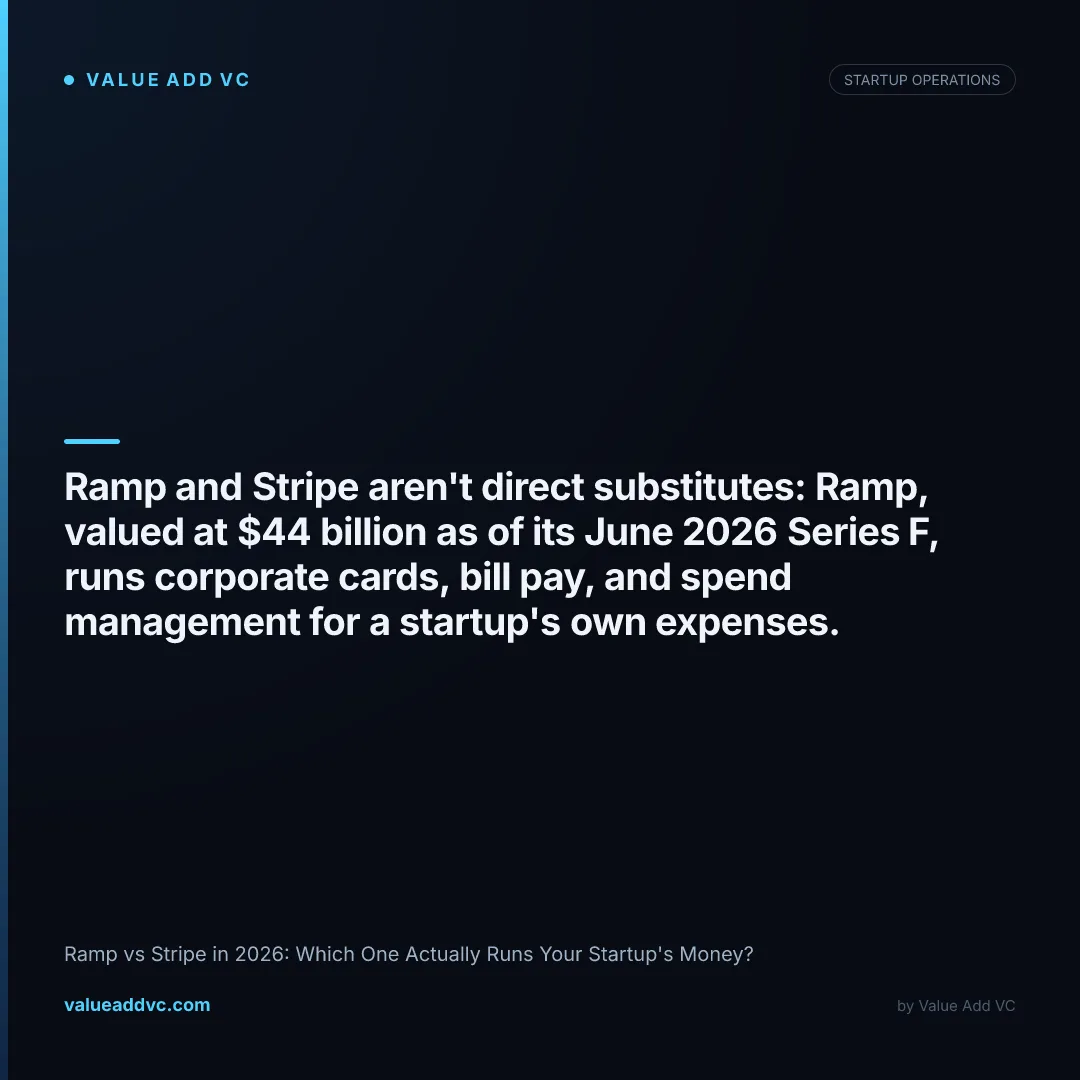
Ramp is valued at $44 billion and runs corporate cards and spend management. Stripe is valued at $159 billion and runs payment processing and treasury infrastructure. They're not really competing for the same dollar — most startups end up using both.
Ramp closed a $750 million Series F in June 2026 at a $44 billion valuation, led by ICONIQ, GIC, and Ontario Teachers' Pension Plan — and Bloomberg reported in September 2026 that it was in early talks for a roughly $60 billion valuation on a new raise, though that figure is unconfirmed. Stripe was valued at $159 billion in a February 24, 2026 employee tender offer, according to The Block, up 49% from the roughly $106.7 billion it was valued at the prior September. Both are private companies — despite some low-quality aggregator sites claiming Stripe listed on Nasdaq in 2026, no SEC filing or exchange listing confirms that, and The Block's reporting describes Stripe as still private as of its February tender offer.
Ramp: FinTech Futures / Bloomberg reporting on its June 2026 Series F. Stripe: The Block, reporting on its February 2026 annual letter.
Two Different Jobs: Spending Your Money vs. Moving Customer Money
Ramp's core product is managing a company's own spend: a corporate charge card, automated expense reports, bill pay, and procurement, with a free tier that includes unlimited physical and virtual cards and a $15-per-month-per-user Plus tier that adds AI-driven expense review and accounting-system integrations, according to Ramp's pricing page. Ramp says it serves over 50,000 customers and handled more than $100 billion in annual purchase volume as of June 2026, with total payment volume growing about 170% year-over-year in March, per Bloomberg-sourced reporting.
Stripe's core product is the opposite side of the ledger: accepting payments from customers. Its standard pricing is 2.9% plus 30 cents per successful US card transaction, with surcharges for international cards and currency conversion, per Stripe's pricing page. Stripe processes more than $1 trillion in payments annually across 195 countries, and its business customers moved $1.9 trillion in total volume in 2025, up 34% year-over-year, according to The Block's reporting on Stripe's annual letter.
Where They Actually Overlap: Cards and Treasury
The genuine overlap is narrower than the valuations suggest. Stripe Issuing lets platforms issue virtual cards for $0.10 each and physical cards for $3.50 each, per Stripe's pricing page — infrastructure a company could use to build its own card program, but not a ready-made corporate-card product the way Ramp sells one directly. And Stripe Treasury, Stripe's banking-as-a-service layer, is built primarily for platforms that want to embed bank accounts for their own end customers, not as a place for a startup to park its own operating cash.
That's a meaningful distinction for a founder comparing the two: Ramp's banking features — a 2% APY checking account (through its bank partner, First Internet Bank of Indiana) and an investment account advertising a 4.63% yield net of up to a 0.15% advisory fee — are aimed directly at a startup managing its own treasury. Stripe doesn't compete there in the same way; its treasury tools are for companies building financial products for their own customers, which is a different buyer than a startup just trying to earn yield on its runway.
Ramp vs Stripe: Valuation and Scale
FinTech Futures / Bloomberg (Ramp); The Block (Stripe), 2026.
Stripe's valuation is roughly 3.6x Ramp's, reflecting its far larger payment-volume base and longer operating history.
Ramp vs Stripe: Side by Side
| Dimension | Ramp | Stripe | Source |
|---|---|---|---|
| Primary job | Spend management (cards, bills, procurement) | Payment processing + treasury infra | Company pricing pages |
| Valuation | $44B (Jun 2026) | $159B (Feb 2026) | Bloomberg; The Block |
| Lead backers (latest round) | ICONIQ, GIC, Ontario Teachers' | Thrive, Coatue, a16z | Bloomberg; The Block |
| Revenue / ARR | $1.5B+ ARR (Jun 2026) | ~$5.1B net revenue (2024, JPMorgan est.) | Bloomberg; The Block |
| Scale metric | $100B+ annual purchase volume, 50K+ customers | $1.9T 2025 business volume, 195 countries | Bloomberg; The Block |
| Core card fee | Free tier $0/user; Plus $15/user/mo | Issuing: $0.10 virtual / $3.50 physical card | Ramp.com; Stripe.com pricing |
| Payment processing fee | Not a core product | 2.9% + 30¢ per US card transaction | Stripe.com pricing |
| Cash/treasury yield | 2% APY checking; 4.63% investment account | Treasury is embedded banking infra, not a yield product for the company itself | Ramp.com pricing |
How we counted: figures from each company's own pricing pages and the cited news reports; as of October 2026.
Which One Should You Actually Pick?
If you're managing how your startup spends money — corporate cards, expense reports, vendor bills, procurement approvals — Ramp is the direct answer; that's its whole product, and its free tier covers most early-stage needs. If you're building a product that needs to accept payments from your own customers, or you need global payment-processing infrastructure, Stripe is the direct answer; Ramp doesn't compete there at all.
For parking idle cash and earning yield on your own treasury, Ramp's banking product is built for that use case directly; Stripe's Treasury product is built for companies embedding banking into their own platforms for their end users, not for managing your own startup's runway. In practice, most growth-stage startups run both: Ramp (or a close substitute like Brex) for internal spend, and Stripe for revenue collection — this is a "which one for which job" decision, not an either-or.
Where we could be wrong
Ramp's reported $60 billion valuation talks are unconfirmed — Bloomberg's own sourcing said the details could change, and the company hasn't commented. Stripe's profitability claim rests on its own annual letter plus JPMorgan analyst estimates for 2024, not an audited public filing, since Stripe doesn't publish financial statements the way a public company would. And framing this as "spend vs. payments" undersells real competitive pressure at the edges: Ramp's expansion into bill pay and banking, and Stripe's expansion into Issuing and Treasury, mean the two companies' product surfaces are converging even if their primary businesses haven't collided yet.
Bottom line: Ramp ($44 billion valuation) and Stripe ($159 billion valuation) aren't head-to-head competitors for most startups — Ramp runs how you spend money, Stripe runs how you collect it. The real overlap is narrow (card issuing, treasury infrastructure), and most companies end up paying both, not choosing one over the other.
See Value Add VC's coverage of Ramp's $44 billion Series F and how Ramp actually makes money.
Latest from the Pulse
Get VC data most people never see
— free to subscribe
Trace's notes on venture, AI and startups, a few times a week. Join 5,000+ subscribers. No spam.
No spam, unsubscribe anytime. Sent via Substack · Privacy · or subscribe on Substack ↗