
A $44B valuation. A 3× step-up in a year. $1B ARR with positive cash flow. And the pitch isn't cards anymore.
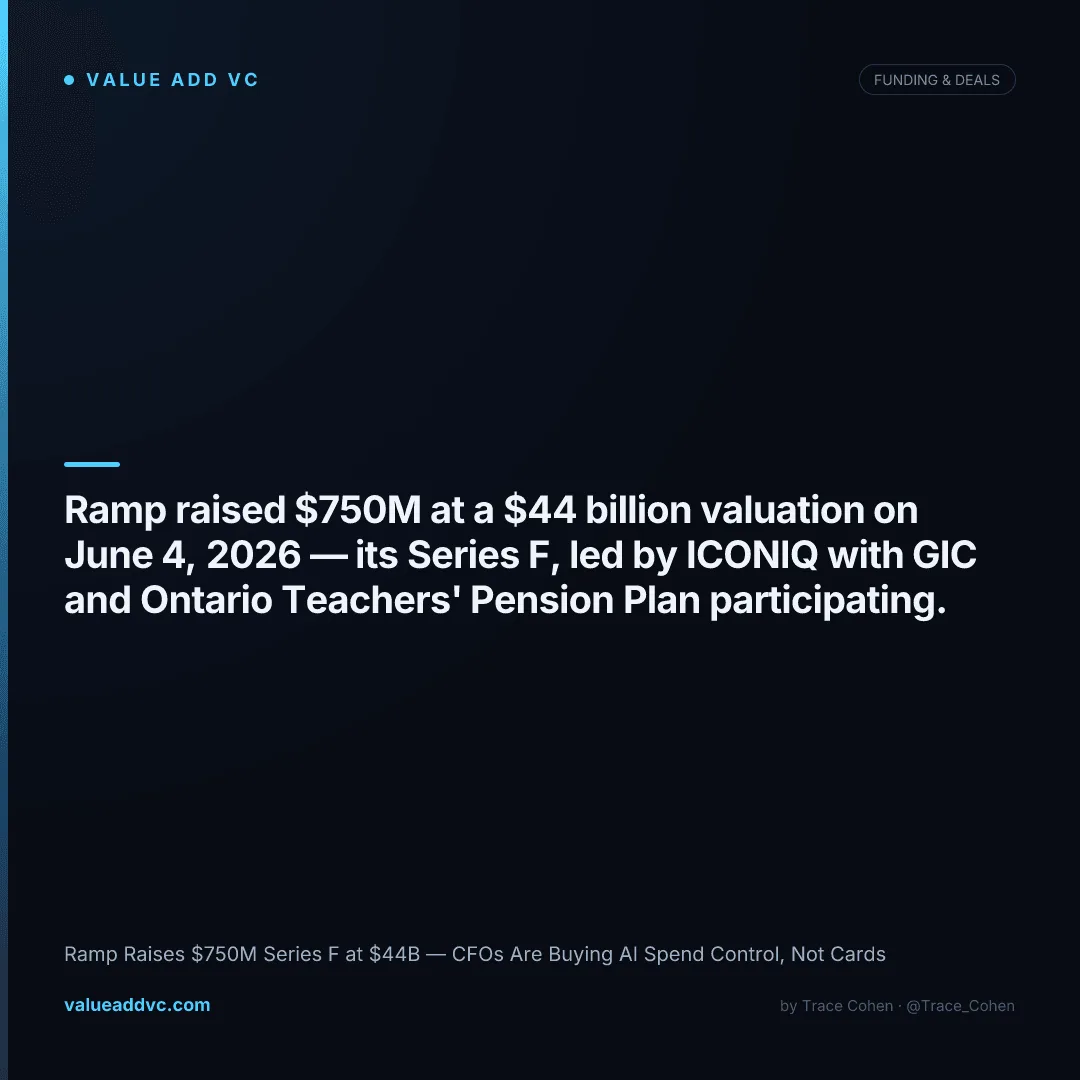
On June 4, 2026, Ramp announced a $750 million Series F at a $44 billion post-money valuation — led by ICONIQ with GIC and Ontario Teachers' Pension Plan participating. CEO Eric Glyman confirmed that annualized revenue crossed $1 billion with positive free cash flow, and that March 2026 total payment volume was tracking ~170% year-over-year growth.
A year ago, Ramp was valued at roughly $16 billion. Six months ago, the company was reportedly raising at $32 billion. Today: $44 billion. The reason isn't the corporate card. It's what the corporate card has been quietly turned into — spend management, bill pay, and banking, pushing Ramp's product surface closer to (though still distinct from) payments infrastructure players like Stripe. The round also makes Ramp New York's single most valuable startup, ahead of every other NYC unicorn on the list.
The Numbers Behind the Valuation
$44B
Post-money Series F valuation
Up from $32B in late 2025 and ~$16B in mid-2025
$1B+
Annualized revenue
With positive free cash flow — rare at this scale
~170%
TPV YoY growth (March 2026)
Total payment volume on the platform
$750M
Series F round size
ICONIQ led; GIC and OTPP participated
Why Investors Tripled the Valuation in a Year
The 2024 Ramp story was "Brex but better, with sharper UX and faster card-to-close." The 2026 story is different. Ramp is selling CFOs an operating system: cards, bill pay, procurement, accounting AI, travel, and — newest and loudest — AI spend control. Each module compounds the others. Once finance teams plug in Ramp for cards, the procurement product lands without a sales cycle.
The AI spend wedge is what changed the growth slope in the last six months. CFOs built 2025 budgets without a line item for model inference. By Q4, the line item existed, and it was bigger than expected. By Q1 2026, finance teams were buying tools to control it. Ramp built one. Brex did not lead here. It's the same underlying cost pressure that's funding startups on the supply side too — Multiverse Computing's $570M round is a bet that shrinking the models themselves, not just tracking the bill, is where the next round of savings comes from.
AI token spend grew faster than any other SaaS line item for mid-market companies in 2025 — and CFOs had no native controls
Ramp's Stack accounting AI agent automates reconciliation, vendor reviews, and close — pulling the company from card-issuer to finance-team OS
Procurement attached to spend management is a >$10B TAM by itself — Coupa is a public benchmark, but Coupa was built for enterprise, not startups and mid-market
Cross-sell into existing card customers is the highest-margin growth Ramp has — and it shows up in the operating leverage that produced positive free cash flow
Round Details and Investor Signals
| Investor | Type | Signal |
|---|---|---|
| ICONIQ | Lead / Growth | Late-stage fintech specialist — typically leads when an IPO window is 18–24 months out |
| GIC (Singapore SWF) | Sovereign Wealth | Pre-IPO positioning — GIC favors profitable category leaders with durable moats |
| Ontario Teachers' Pension Plan | Pension / Crossover | OTPP underwrites for liquidity within fund lifecycle — strong signal on IPO timing |
| Existing cap table | Insiders doubling down | Founders Fund, Stripe, Sequoia historically anchor — no signal of insider selling at this mark |
The Multiple: Is $44B on $1B ARR Defensible?
Ramp is trading at roughly 44× annualized revenue. That is high for fintech, but the comp set isn't pure fintech. Public payments and spend-management companies — Bill.com, Toast, even Coupa pre-take-private — historically trade in the 8–15× forward revenue range. Ramp's multiple lives in the AI-infrastructure neighborhood, not the fintech neighborhood.
Investors are paying for three things at once: a card-and-spend business that already prints cash, an AI-finance OS that is recategorizing the company as software-plus-fintech, and a procurement attach that hasn't fully shown up in revenue yet. If procurement and AI spend control hit even half their 2027 plan, the implied forward multiple is closer to 20× — defensible for a profitable category leader.
The risk is the same risk every fintech faces: rate cuts compress interchange and float revenue, and macro slowdowns hit TPV. ICONIQ, GIC, and OTPP are underwriting the operating system thesis, not the card-issuer thesis. If they're right, Ramp doesn't derate when rates move. If they're wrong, this is the priciest paper in fintech.
What This Means for the Brex–Ramp Battle
Brex and Ramp have been the two-horse race in startup and mid-market spend for five years. Brex pivoted toward enterprise and embedded finance; Ramp built deeper into the CFO toolset. The AI spend management wedge is the first product category where Ramp is meaningfully ahead in market perception, not just feature velocity.
Brex's last reported valuation was $12.3 billion in a 2022 round, and Capital One has since acquired Brex outright for $5.15 billion in a deal that closed in April 2026 — see how that plays out for founders comparing Mercury vs Brex in 2026. The valuation gap is now real and structural. For founders evaluating which platform to standardize on, the $44B mark is a hiring signal — Ramp has the capital and the cycle to keep shipping AI features faster than Brex can match.
What to Watch Next
IPO timeline
ICONIQ + GIC + OTPP is a textbook pre-IPO investor mix. Combined with $1B+ ARR and positive FCF, Ramp is on a 2027 IPO track. Watch for an S-1 in late 2026 or H1 2027.
AI spend product GA
The AI token spend management product is the differentiating product line. Watch for a public general-availability announcement and customer case studies — those are the leading indicators of attach rate.
Procurement attach
Procurement is the next big revenue line. Coupa generated $1B+ at scale in this category. If Ramp shows procurement TPV growing materially in 2026, the $44B multiple looks cheap.
Interchange and rate exposure
Ramp's core card revenue still depends on interchange and float. If the Fed cuts in H2 2026, expect margin compression in the cards business — and pressure on Ramp to show that the software lines compensate.
For more on the 2026 fintech and AI spend cycle, see Supabase's $500M Series F and AI Startup Valuation Multiples in 2026. Track late-stage fundraises on the VC Fundraises 2026 tracker at Value Add VC.
Latest from the Pulse
Get VC data most people never see
— free to subscribe
Trace's notes on venture, AI and startups, a few times a week. Join 5,000+ subscribers. No spam.
No spam, unsubscribe anytime. Sent via Substack · Privacy · or subscribe on Substack ↗