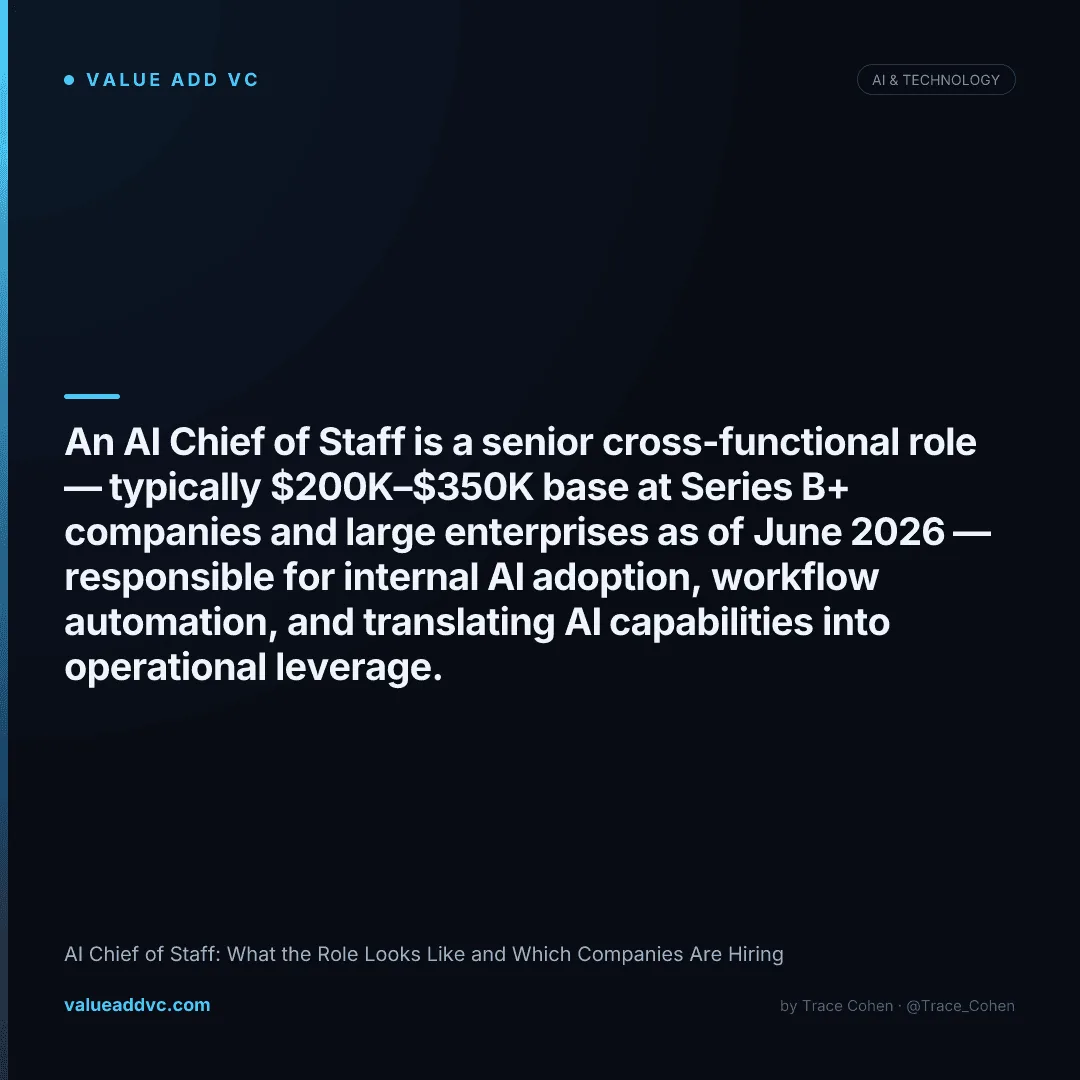
The AI Chief of Staff is the fastest-growing executive title in tech right now — and most companies still don't know exactly what they're hiring for.
That ambiguity is the point. The role emerged because a gap opened between the AI capabilities companies now have access to and the operational reality of how those capabilities actually get deployed internally. Someone needs to own that gap. Someone operationally credible, who can move fast, has direct access to the CEO, and can run change management across an entire organization simultaneously.
The AI Chief of Staff is that person. And based on the job postings, comp data, and conversations I'm having with founders and CEOs, this role is about to become as standard as Head of Finance.
What the AI Chief of Staff Role Actually Owns
This is not a VP of AI. This is not a CTO. The confusion comes from conflating the technology strategy layer with the operational execution layer. Let me be precise:
| Role | Primary Question | Owns |
|---|---|---|
| CTO | What AI should we build? | Technology architecture and model strategy |
| VP of AI / Head of AI | How do we develop AI products? | AI product roadmap and engineering team |
| AI Chief of Staff | How do we actually use AI to run better? | Internal adoption, workflow automation, operational ROI |
| Traditional CoS | How do we run the CEO efficiently? | Executive leverage, cross-functional coordination, OKRs |
The AI Chief of Staff sits in a unique operational lane that existing titles don't cover.
Core Responsibilities of an AI Chief of Staff
Internal AI Rollout
Leads tool evaluation, pilot programs, and org-wide deployment of AI systems across functions — finance, sales, legal, HR, engineering
Workflow Automation
Maps existing processes, identifies automation leverage points, and manages implementation with teams. Targets 20–40% efficiency gains per department
AI Tool Stack Management
Owns vendor relationships with AI providers, manages API costs, evaluates new tools, and maintains the internal AI capability inventory
Change Management & Training
Runs AI literacy programs, creates playbooks, and drives adoption metrics. A common KPI: getting 70%+ of employees using at least one AI tool daily within 6 months
AI ROI Measurement
Tracks hours saved, cost reductions, quality improvements, and speed gains across AI initiatives. Builds the business case for continued investment
Executive AI Leverage
Acts as the CEO's operator for AI: synthesizes information faster, prepares AI-augmented briefings, and ensures the executive team is maximally productive
AI Chief of Staff Salary: The Real Numbers
Compensation has moved fast as demand has outpaced supply. Here's what the market actually pays across company stages:
Series A / Early Stage (10–50 employees)
Often combined with Chief of Staff duties
$150K–$200K
0.25%–0.75%
Series B–C / Growth Stage (50–300 employees)
Dedicated AI focus, reports to CEO
$200K–$280K
0.1%–0.3%
Late Stage / Pre-IPO (300–2,000 employees)
Full org-wide AI transformation mandate
$250K–$350K
0.05%–0.15%
Large Enterprise / Fortune 500
Often titled Director or VP of AI Operations
$280K–$400K total comp
RSUs only
Source: Levels.fyi, LinkedIn job postings, and direct comp data from portfolio company hiring. Updated Q2 2026.
Which Companies Are Hiring for AI Chief of Staff Roles
As of mid-2026, demand is concentrated in three buckets: hyperscalers and large tech companies formalizing internal AI transformation programs, growth-stage SaaS companies racing to embed AI across every workflow, and professional services firms (consulting, legal, finance) where knowledge-work leverage is enormous.
Big Tech & Hyperscalers
- • Microsoft (multiple divisions)
- • Salesforce
- • IBM
- • ServiceNow
- • Workday
Often titled 'Director of AI Transformation' or 'VP of AI Operations'
AI-Native Companies
- • OpenAI
- • Anthropic
- • Scale AI
- • Cohere
- • Mistral
Internal AI ops role critical for eating their own cooking at scale
Professional Services
- • McKinsey (QuantumBlack)
- • Accenture (AI unit)
- • Deloitte AI
- • KPMG Ignition
Client-facing AI transformation lead with internal adoption mandate
Beyond these buckets, almost every Series B+ startup I talk to is either hiring for this role explicitly or has someone informally playing it. The title is new. The need is not.
You can track AI hiring trends and the broader landscape at the Hiring Dashboard and AI Landscape Dashboard on Value Add VC.
What Makes a Great AI Chief of Staff
I've seen this hire done well and done poorly. The ones who fail are usually brilliant engineers with no operational instinct, or operationally excellent people who are afraid to actually use AI tools hands-on. The best candidates have three things in common:
Operator-first mindset
They've run something — a team, a product, a process — and they know how to get things done inside an organization. They understand that adoption is a change management problem, not a technology problem.
Deep AI fluency without engineering identity
They use LLMs, agents, and automation tools daily. They can evaluate model capabilities honestly, write good prompts, and assess build vs. buy decisions. But they don't need to write the code — they need to know what the code should do.
Executive proximity and political capital
This role only works with CEO-level sponsorship. The best AI Chiefs of Staff are people the CEO trusts completely — they've either worked together before or have earned credibility in an adjacent role. Without that sponsorship, the role becomes internal consulting with no teeth.
The companies winning on AI aren't the ones with the best models.
They're the ones with someone who got 300 people to actually use them.
That's the AI Chief of Staff job description in one sentence.
Track AI company hiring trends and valuations on the AI Landscape Dashboard and Hiring Dashboard at Value Add VC. Published in the Trace Cohen newsletter.
Latest from the Pulse
Get VC data most people never see
— 100% free
Weekly benchmarks, valuations, and fund data. Join 5,000+ investors. No spam.