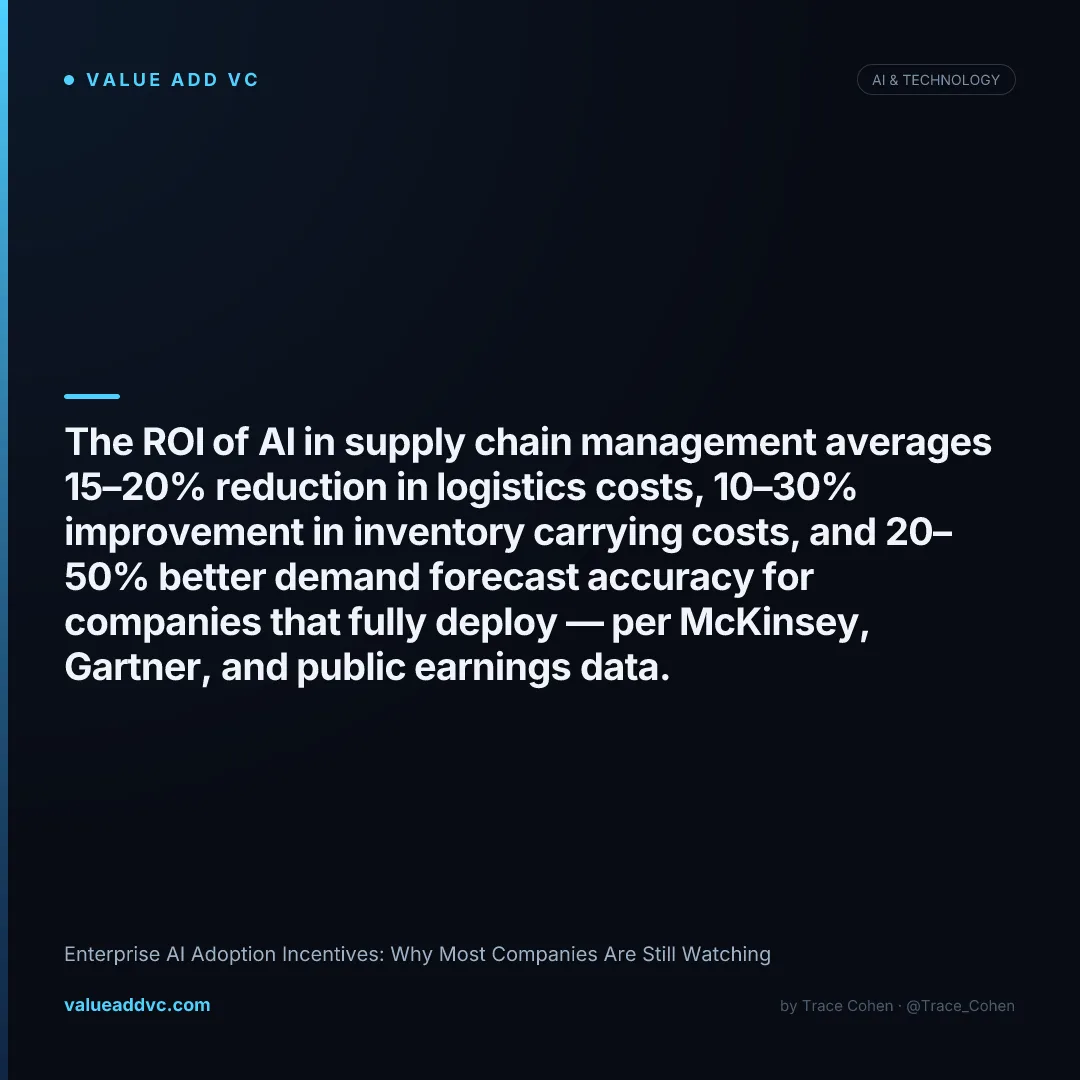
Supply chain AI delivers some of the most documented, largest ROIs in enterprise technology. The numbers are not subtle: 15–20% logistics cost reductions, 10–30% inventory savings, 20–50% better demand forecasting.
And yet only 24% of companies report widespread AI adoption in their supply chains as of McKinsey's 2024 survey. The bottleneck is not technology. It's organizational math — and most enterprises are still getting it wrong.
The ROI of AI in Supply Chain: What the Data Shows
The case for supply chain AI is not theoretical. Here are documented results from companies that moved past pilot:
| Use Case | Documented ROI | Payback Period | Example |
|---|---|---|---|
| Route optimization | 10–25% fuel/labor savings | 12–18 months | UPS ORION: $400M/yr |
| Demand forecasting | 20–50% MAPE improvement | 18–30 months | Walmart: 15% stockout reduction |
| Inventory optimization | 10–30% carrying cost reduction | 18–36 months | Amazon: 25% less overstock |
| Supplier risk AI | 5–15% avoided disruption costs | 24–48 months | Apple: dual-source AI alerting |
| Autonomous procurement | 6–12% unit cost reduction | 6–12 months | Siemens spot-buy AI |
| Warehouse robotics + AI | 25–40% labor cost reduction | 24–36 months | Ocado: 5x throughput vs manual |
Sources: McKinsey Global Institute, Gartner Supply Chain Research, company earnings disclosures
Why 76% of Enterprises Are Still Watching
Sixty percent of AI pilots never reach production. Gartner has been saying this since 2019 and it remains true. I've seen it in portfolio companies across fintech, industrials, and retail. The failure modes cluster around three root causes:
The data quality trap
Supply chain AI models are hungry for clean, consistent historical data — typically 2–3 years of high-fidelity SKU-level demand, inventory position, and lead time signals. Most enterprise ERPs are fragmented across 4–8 systems after acquisitions. Getting a unified data layer ready takes 12–18 months before model training can even begin. Companies that skip this step train on garbage and get garbage forecasts that are immediately distrusted by planners.
Optimizing the wrong metric
The classic pilot failure: a team shows the CFO that their demand AI reduced forecast MAPE (mean absolute percentage error) from 32% to 19%. Sounds great. Doesn't move the needle on inventory turns or service levels because the AI was optimized against the wrong objective. Procurement, finance, and supply chain planning each have different KPIs — and most vendor demos only optimize against one.
Change management is the real product
A demand planner who has been using Excel and gut instinct for 15 years will not trust an AI forecast until it has demonstrably beaten them on their own terms — usually after 3–6 months of shadow mode. Most implementations don't budget for this. They install the software, hold a training session, and wonder why adoption is zero. Per Deloitte, 72% of failed AI supply chain projects cite "lack of trust in AI outputs by end users" as the primary cause.
What Separates Leaders From Laggards
McKinsey's supply chain AI leaders — the top quartile — share three structural characteristics that explain their outsized returns:
1 unified data layer
Leaders built a supply chain data lakehouse before deploying any AI. Laggards deployed point solutions that created more fragmentation.
AI + human in the loop
Top performers don't automate decisions — they automate recommendations with explainability. Planners approve AI suggestions and see the reasoning. Trust builds faster.
P&L owner accountability
Successful deployments have a CFO or COO with a specific inventory or service-level target tied to the AI project. Pilots owned only by IT rarely survive the next budget cycle.
The Enterprise AI Supply Chain Market in 2025
The market infrastructure is now mature enough to reduce implementation risk significantly. Here's where the money is moving:
- ▸Supply chain AI software spend hit $10.4B in 2024 (IDC) and is projected to reach $30B by 2027 — a 3x in 3 years.
- ▸75% of supply chain software vendors now embed AI features (Gartner 2024), up from 35% in 2022. The default has flipped.
- ▸The fastest-growing segment is AI-powered supply chain control towers — unified dashboards that give real-time visibility and trigger alerts. Gartner projects 50% of large enterprises will use them by 2027.
- ▸Hyperscalers are consolidating: Google Supply Chain, AWS Supply Chain, and Microsoft's Dynamics 365 Copilot now compete directly with point-solution vendors like o9 Solutions, Kinaxis, and Blue Yonder.
- ▸The winning architecture is not a replacement — it's an intelligence layer that sits on top of existing ERP (SAP, Oracle) and reads from existing WMS, TMS, and planning tools without requiring a full rip-and-replace.
My Take: The Incentive Problem Is Real
The deeper issue isn't technology or data — it's incentive misalignment. Supply chain AI's biggest ROI usually comes from inventory reduction. But in most enterprises, the inventory manager is measured on service levels, not inventory turns. A supply chain AI that recommends carrying 20% less safety stock looks like a threat to their job security metric, not an improvement.
Until the CFO explicitly changes the metric from “avoid stockouts” to “optimize working capital while maintaining X% service levels,” the planner rationally ignores or overrides the AI. I've seen this exact dynamic kill three pilots at otherwise sophisticated companies.
This is also why supply chain AI vendors are increasingly packaging behavioral change management as a core product — not a consulting add-on. The companies getting it right (o9, Kinaxis, Blue Yonder's newer implementations) are selling outcomes, not software. That's the right model.
The ROI of AI in supply chain is not in doubt.
The question is whether your organization is structurally willing to capture it — or whether the incentive stack protects the status quo.
Track enterprise AI adoption trends on the Enterprise AI Adoption Dashboard and AI Valuations tracker at Value Add VC. Originally published in the Trace Cohen newsletter.
Latest from the Pulse
Get VC data most people never see
— 100% free
Weekly benchmarks, valuations, and fund data. Join 5,000+ investors. No spam.