
Updated Nov 4, 2026: added Q3 2026 results (reported Nov 2) — revenue hit $2.313B (+96% YoY), total commercial revenue ($1.168B) overtook total government revenue ($1.146B) for the first time, and the market cap fell to about $423.7B as the stock dropped on a broader AI-trade selloff despite the beat.
Palantir generated $2.313 billion in revenue in Q3 2026, up 96% year-over-year, with U.S. commercial revenue growing 148% to $984 million on the back of its AI Platform (AIP) — and total commercial revenue edged past total government revenue for the first time. Behind those numbers is a two-decade-old government contractor that quietly became one of the fastest-growing, highest-margin software companies on the planet.
Palantir spent its first 15 years as a company most people associated almost entirely with classified government work — the Army, the CIA, immigration enforcement. As of November 4, 2026, its market cap is about $423.7 billion, down from roughly $447 billion in late September after the stock fell on a broader AI-trade selloff despite beating guidance, and its commercial business ($1.168 billion) has now overtaken government ($1.146 billion) in Q3 2026. Here's exactly how the money moves, and why investors are paying such an extreme premium for it.
Figures from Palantir's Q3 2026 earnings release (November 2, 2026) and Q3 2026 Form 10-Q, segment note; market cap and trailing P/E from stockanalysis.com (November 4, 2026, 10:30 AM ET).
How Does Palantir Make Money?
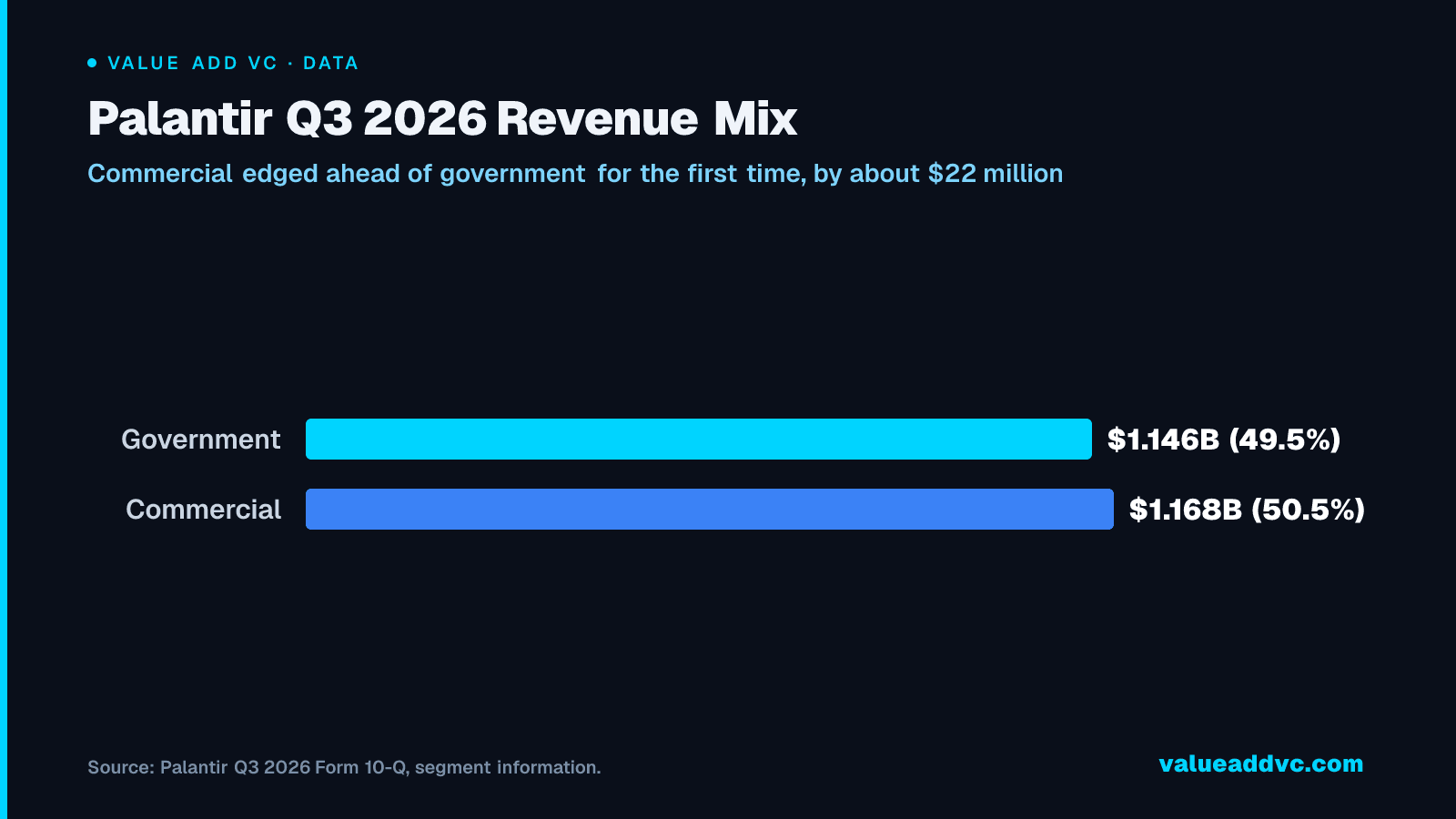
Palantir makes money selling three software platforms — Gotham (government and defense intelligence), Foundry (commercial data integration), and the Artificial Intelligence Platform, or AIP, layered across both — through multi-year subscription and licensing contracts. In Q3 2026, that combination produced $2.313 billion in total revenue, up 96% year-over-year and 20% sequentially (the highest sequential growth rate in company history), with private enterprises ($1.168 billion) now slightly ahead of government agencies ($1.146 billion).
What makes Palantir unusual is that it sells essentially the same underlying data-ontology technology to both buyers. The Army uses it to fuse battlefield sensor feeds; an airline or bank uses the same core platform, rebranded as Foundry, to fuse supply-chain or fraud data. AIP, launched in 2023, is the layer that lets both sets of customers plug large language models into that existing data infrastructure — and it's the single biggest reason commercial revenue has grown more than twice as fast as government revenue over the past year.
What Changed in Palantir's Q3 2026 Results?
Palantir reported Q3 2026 on November 2, 2026, and again raised its full-year outlook — but the stock still fell. U.S. revenue grew 119% to $1.937 billion, split between U.S. commercial ($984 million, up 148%) and U.S. government ($953 million, up 96%), per the earnings release. The company closed $2.918 billion of total contract value, up just 6% year-over-year — a sharp deceleration from Q2's 49% TCV growth — including $1.463 billion of U.S. commercial contract value, up 11%. GAAP net income reached $1.128 billion, a 49% margin, and adjusted and GAAP earnings per share both came in at 44 cents, versus 21 cents adjusted and 18 cents GAAP a year earlier, according to Fortune's reporting. CEO Alex Karp called the results "extraordinary," saying: "The Sovereign AI movement is imposing the most dramatic dichotomy between haves and have nots that I have witnessed in 30 years of business."
Full-year 2026 revenue guidance now sits at $8.530 to $8.534 billion, about 91% growth, with U.S. commercial revenue guided above $3.559 billion (at least 143% growth), adjusted operating income of $5.245 to $5.249 billion, and adjusted free cash flow of $4.8 to $5.0 billion. For Q4 2026, Palantir guided revenue of $2.649 to $2.653 billion, implying about 88% growth — deceleration the company itself is forecasting. Despite beating already-elevated Street expectations on every headline metric, the stock initially rose about 1.5% in after-hours trading before reversing to a roughly 3.6% decline, which Fortune attributed to a broader AI-trade selloff rather than anything specific to Palantir's quarter.
What Are Gotham, Foundry, and AIP?
Gotham is Palantir's oldest product, built for intelligence and defense agencies to fuse classified data sources — satellite imagery, signals intercepts, logistics feeds — into a single operational picture. Foundry is the commercial mirror of that same underlying "ontology" architecture, sold to airlines, banks, manufacturers, and hospitals to unify messy internal data (supply chains, claims, sensor readouts) that would otherwise sit in disconnected systems.
AIP, launched in April 2023, doesn't replace Gotham or Foundry — it sits on top of both, letting customers plug large language models directly into data that's already been structured and permissioned inside the platform. That's the practical reason AIP adoption shows up as commercial and government revenue growth rather than as its own line item: it's sold as an upgrade to existing Gotham and Foundry deployments, not a standalone product, which is also why Palantir doesn't break out AIP revenue separately in its filings.
How Much Does Palantir's Government Business Actually Generate?
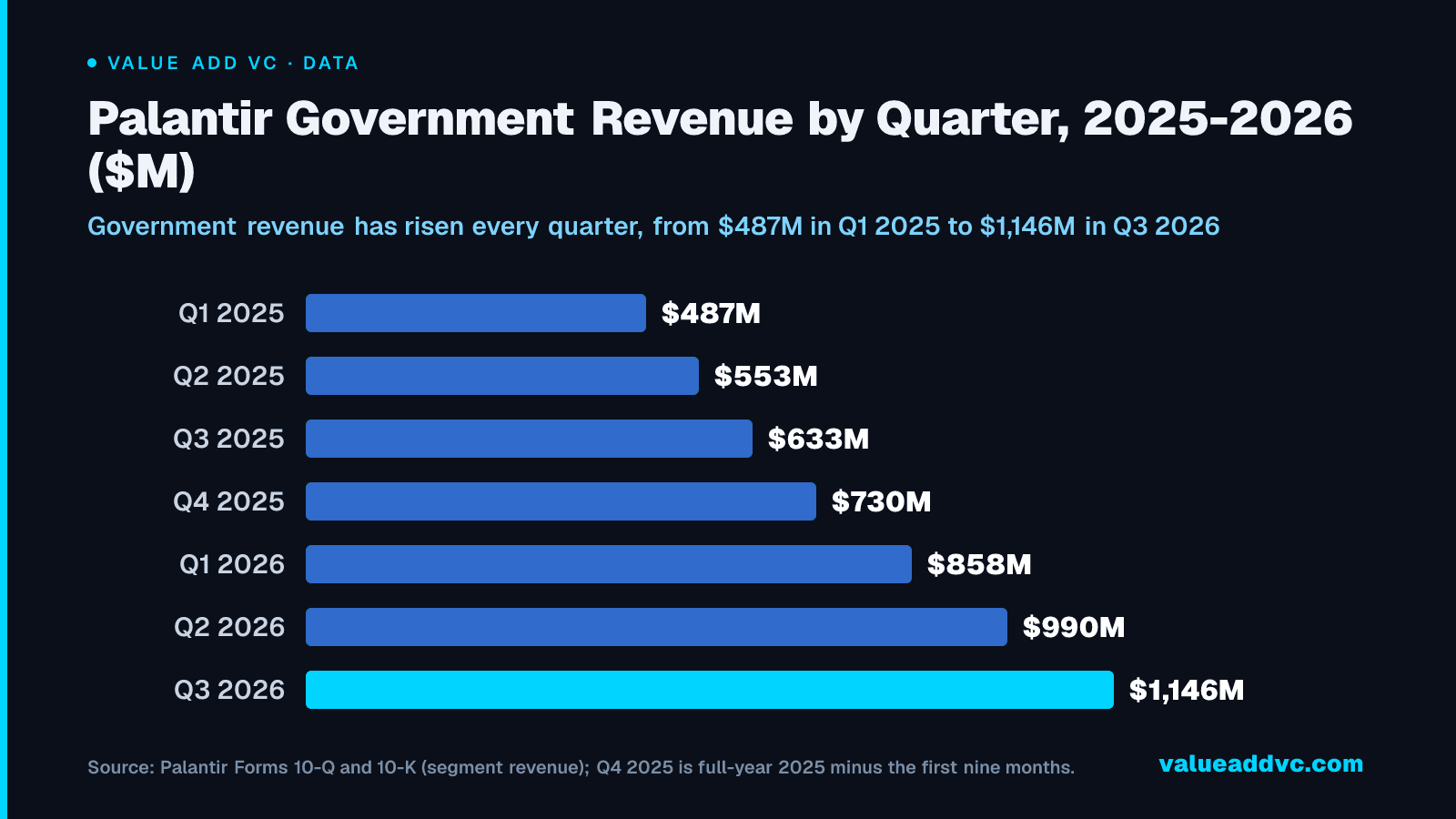
Government revenue reached $1.146 billion in Q3 2026, up 81% year-over-year, and U.S. government revenue alone grew 96% to $953 million. For the first time, government is no longer Palantir's largest customer category in absolute dollars — commercial revenue edged ahead of it this quarter. Palantir does not guide government revenue separately; its raised 2026 outlook covers total revenue and U.S. commercial revenue only.
Palantir Government Revenue by Quarter, 2025-2026 ($M)
Government revenue has risen every quarter, from $487M in Q1 2025 to $1,146M in Q3 2026
Palantir Forms 10-Q and 10-K (segment revenue); Q4 2025 is full-year 2025 minus the first nine months.
Data
| Item | Value |
|---|---|
| Q1 2025 | $487M |
| Q2 2025 | $553M |
| Q3 2025 | $633M |
| Q4 2025 | $730M |
| Q1 2026 | $858M |
| Q2 2026 | $990M |
| Q3 2026 | $1,146M |
How Is Palantir's AIP Commercial Business Growing?
U.S. Commercial revenue — the segment most directly attributable to AIP adoption — hit $984 million in Q3 2026, up 148% year-over-year (from $764 million and 149% growth in Q2), and Palantir raised its full-year 2026 guidance for that segment to more than $3.559 billion, implying at least 143% growth. Total commercial revenue (U.S. plus international) reached $1.168 billion in the quarter, up 113%, now ahead of the $1.146 billion from government.
Palantir Revenue by Segment, Q1 2025-Q3 2026 ($ Millions)
Commercial revenue grew from $397M to $1,168M in seven quarters and overtook government in Q3 2026
Palantir Forms 10-Q and 10-K segment disclosures; Q4 2025 is full-year 2025 minus the first nine months.
Data
| Item | Government Revenue | Commercial Revenue |
|---|---|---|
| Q1 2025 | 487 | 397 |
| Q2 2025 | 553 | 451 |
| Q3 2025 | 633 | 548 |
| Q4 2025 | 730 | 677 |
| Q1 2026 | 858 | 774 |
| Q2 2026 | 990 | 945 |
| Q3 2026 | 1146 | 1168 |
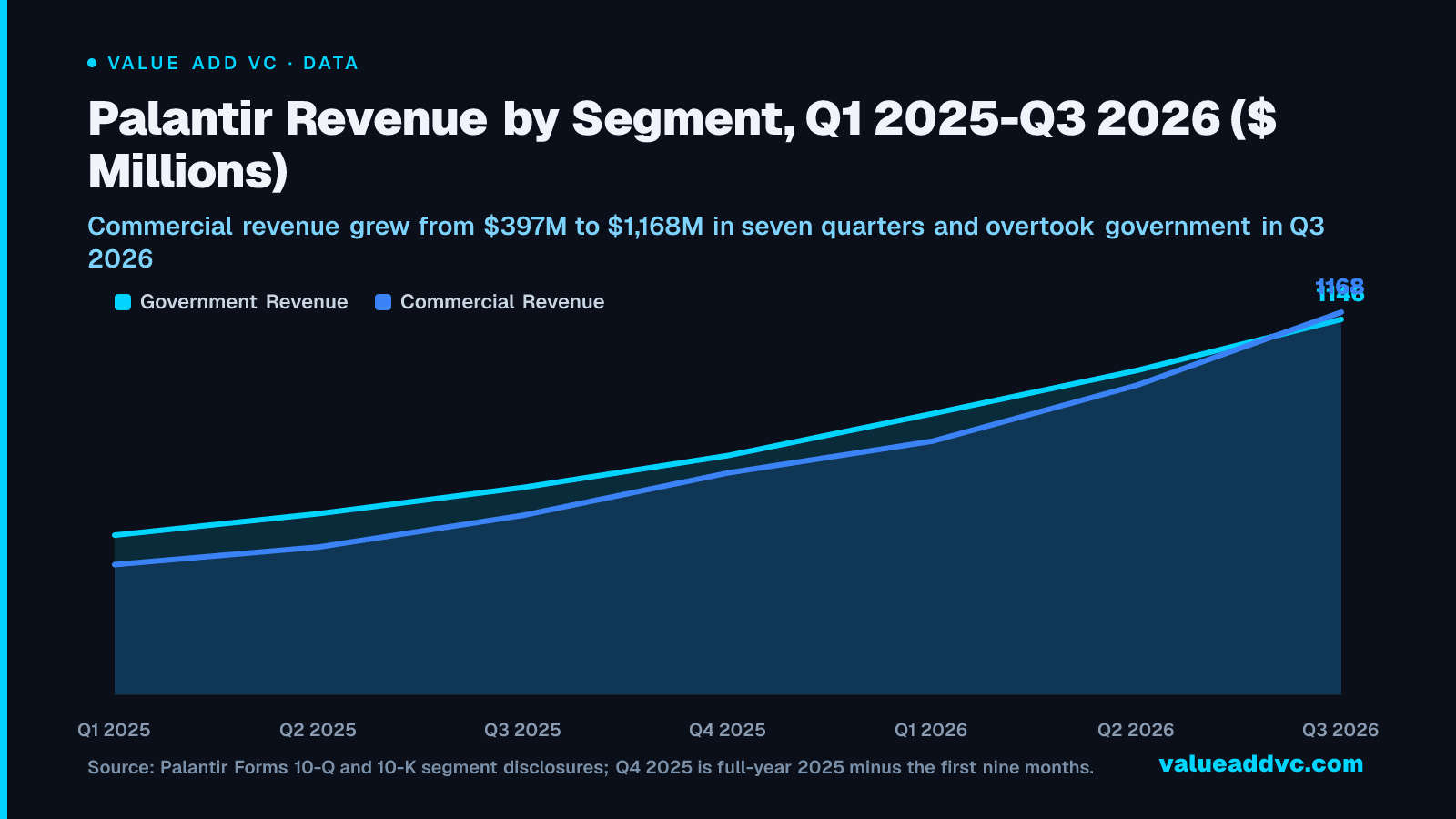
Commercial's share of total revenue rose from 45% in Q1 2025 to just over 50% in Q3 2026 — the first quarter it has outright exceeded government. That's a meaningful re-rating for a company that spent its first decade known almost exclusively as a defense and intelligence contractor. We track how this kind of enterprise AI adoption compares across sectors on the AI Valuations Dashboard.
Government vs. Commercial: Palantir's Revenue Mix
| Period | Government Revenue | Commercial Revenue | Total Revenue | YoY Growth | Commercial % of Total |
|---|---|---|---|---|---|
| Q1 2024 | $335M | $299M | $634M | 21% | 47% |
| Q1 2025 | $487M | $397M | $884M | 39% | 45% |
| Q1 2026 | $858M | $774M | $1.633B | 85% | 47% |
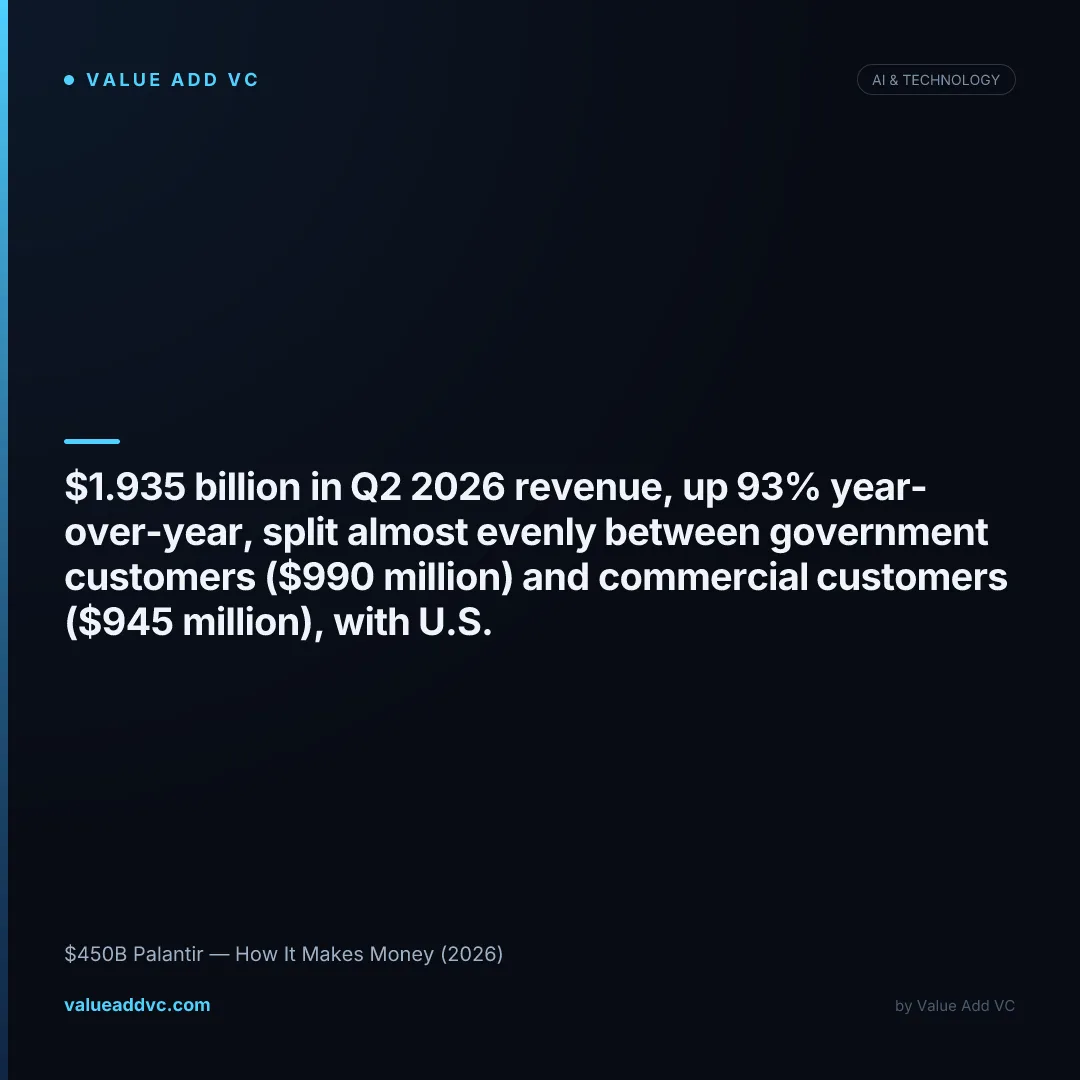
| Q2 2026 | $990M | $945M | $1.935B | 93% | 49% |
| Q3 2026 | $1.146B | $1.168B | $2.313B | 96% | 50.5% |
| FY2025 (Actual) | $2.402B | $2.073B | $4.475B | 56% | 46% |
| FY2026 (Guidance) | Not guided | Not guided | $8.530-8.534B | ~91% | — |
Figures from Palantir's Forms 10-Q and 10-K and its Q3 2026 earnings release (reported November 2, 2026). Palantir guides total and U.S. commercial revenue only, not the government/commercial split. Shares are rounded.
Palantir Q3 2026 Revenue Mix
Commercial edged ahead of government for the first time, by about $22 million
Palantir Q3 2026 Form 10-Q, segment information.
Data
| Item | Value |
|---|---|
| Government | $1.146B (49.5%) |
| Commercial | $1.168B (50.5%) |
What Is Palantir's Rule of 40 Score, and Why Does It Matter?
The Rule of 40 adds a software company's revenue growth rate to its profit margin — a score above 40% is generally considered healthy, since it means a company is either growing fast, profitable, or both. Palantir's Rule of 40 score hit 158% in Q3 2026, combining 96% revenue growth with a 62% adjusted operating margin, up from 155% in Q2 2026 and 145% in Q1 2026.
A score that high, sustained over multiple quarters, is genuinely rare for a company now guiding to more than $8.5 billion in annual revenue — most software companies see growth decelerate sharply as they scale past a few billion dollars. Palantir's own Q4 guidance already calls for growth to slow to 88%, so whether the score stays anywhere near 158% is the central question hanging over its valuation.
How Does Palantir Compare to Anduril, Snowflake, and Other Data/Defense Companies?
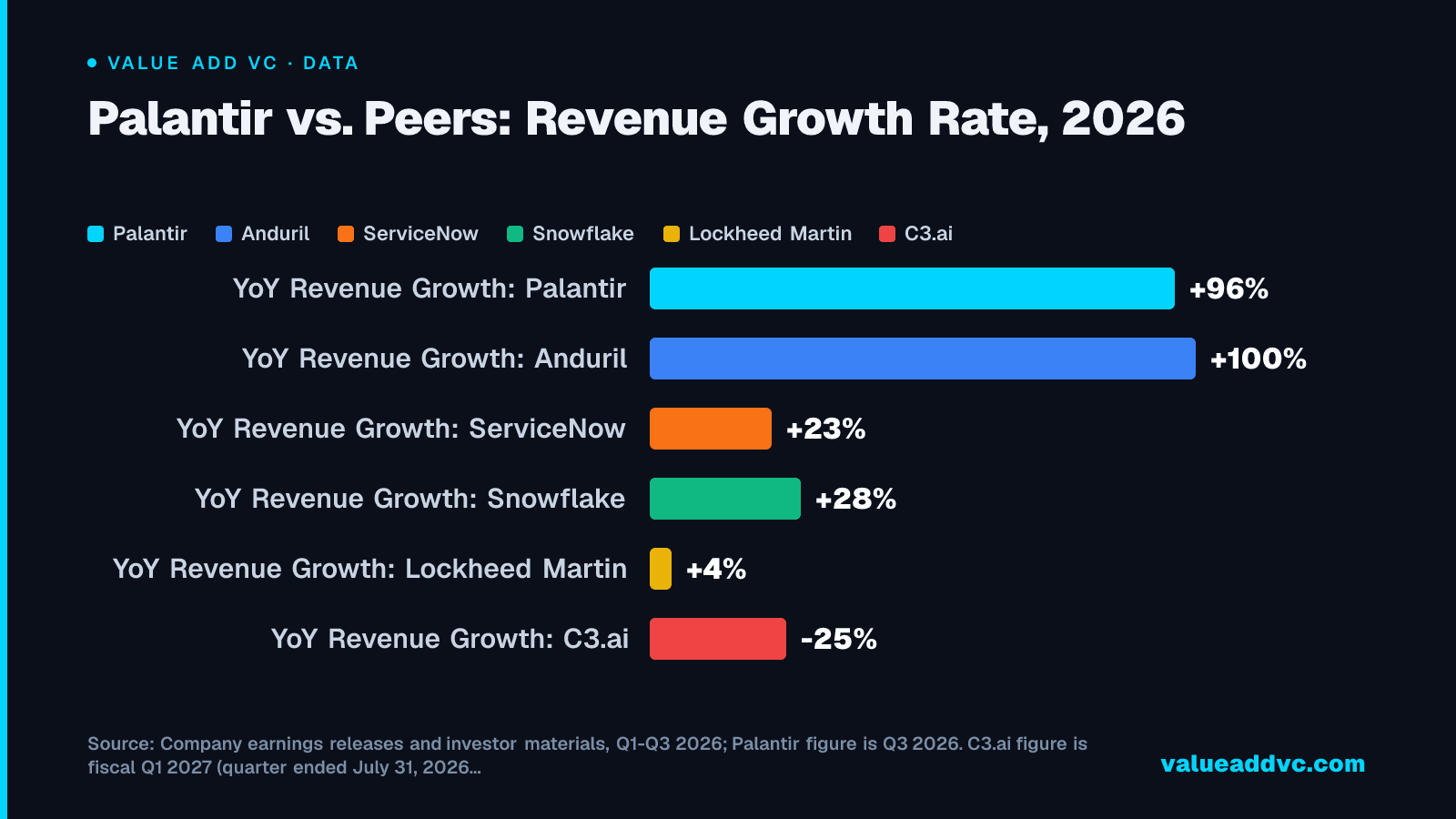
Palantir's growth rate and margins put it in a different league than most of its software peers, and its valuation multiple reflects that. Snowflake guided FY2026 product revenue to $4.45 billion, up about 28%, with a 9% non-GAAP operating margin target — solid, but nowhere near Palantir's combination of growth and profitability. C3.ai, by contrast, is shrinking: revenue fell 25% year-over-year to $52.4 million in its most recent quarter (fiscal Q1 2027, ended July 31, 2026), after a 52.5% drop to $51.6 million in fiscal Q4 2026 (ended April 30, 2026), and full fiscal-2026 revenue fell 36% to $250.3 million, per C3.ai's September 2, 2026 and June 3, 2026 earnings releases. Anduril, the closest defense-tech comparable, is privately held at a $61 billion valuation on roughly $2.2 billion of 2025 revenue — a fraction of Palantir's multiple, though Anduril sells hardware and munitions, not pure software. A smaller public-safety-focused comparable, Peregrine Technologies, was last valued at $6.8 billion in June 2026 on a platform that unifies police and emergency-management data for local and state agencies — a narrower slice of the government-data market than Palantir's Gotham.
Palantir vs. Peers: Revenue Growth Rate, 2026
Company earnings releases and investor materials, Q1-Q3 2026; Palantir figure is Q3 2026. C3.ai figure is fiscal Q1 2027 (quarter ended July 31, 2026) vs. the year-earlier quarter, per its September 2, 2026 earnings release. Anduril figure is 2025 full-year revenue growth (privately held, does not report quarterly).
Data
| Company | 2026 Revenue (Est./Guide) | YoY Growth | Valuation | Forward P/S | Public / Private |
|---|---|---|---|---|---|
| Palantir | $8.53-8.53B | ~91% | ~$423.7B | ~50x | Public (PLTR) |
| Anduril | N/A (private) | ~100% | $61B | N/A | Private |
| Snowflake | $4.45B | 28% | ~$70B | ~13x | Public (SNOW) |
| ServiceNow | ~$13.5B | 23% | ~$200B | ~11x | Public (NOW) |
| Lockheed Martin | ~$74B | 4% | ~$115B | 1.6x | Public (LMT) |
| C3.ai | $210-240M (FY to Apr. 2027, guide) | -25% (fiscal Q1 2027) | ~$1.7B | ~7x | Public (AI) |
Palantir row: 2026 guidance from its Q3 2026 earnings release, market cap as of November 4, 2026 (stockanalysis.com), forward P/S is our arithmetic (market cap divided by the midpoint of 2026 revenue guidance). C3.ai row: fiscal 2027 revenue guidance (year ending April 30, 2027) and fiscal Q1 2027 growth from its September 2, 2026 earnings release; market cap is our arithmetic (160.8 million Class A and B shares outstanding on August 31, 2026, per its fiscal Q1 2027 Form 10-Q, times the $10.34 closing price on September 29, 2026), and forward P/S divides that by the guidance midpoint. Other rows blended from company earnings releases, S&P Global, TradingKey, and Augment Market as of Q2 2026. Anduril and other private company figures are estimates from press disclosures, not audited financials.
Palantir wins that comparison on the metric investors actually reward: the combination of scale, growth, and profitability. No peer on this list matches its Rule of 40 score, which is exactly why the market has assigned Palantir a forward P/S multiple several times Snowflake's and many times Lockheed Martin's. We track how these premiums compare across the broader AI sector on the SaaS Valuations Dashboard.
Is Palantir Overvalued?
Palantir trades at a trailing P/E of roughly 124x and about 50 times its 2026 revenue guidance as of November 4, 2026, per stockanalysis.com — still extreme by traditional software standards, where a 4-8x P/S ratio is typical, though down from roughly 160x trailing earnings and a $447 billion market cap in late September. The stock fell on its Q3 2026 earnings day even though revenue growth accelerated to 96% and guidance was raised again, which Fortune attributed to a broader market reassessment of AI-linked valuations rather than anything in Palantir's own numbers. Bulls point to the 158% Rule of 40 score and commercial revenue now exceeding government as justification; bears note that even a modest deceleration in growth, paired with a multiple compression toward historical software norms, could cut the stock price by half or more without any change in the underlying business.
The most useful lens isn't whether Palantir "deserves" a premium in the abstract — every high-growth, high-margin software company trades at a premium — it's whether 96% growth and a 62% adjusted operating margin can survive the transition from an $8.5 billion revenue base to far larger ones. Government contracts are sticky and multi-year, often running three to five years with renewal options built in; AIP commercial deals are newer, shorter-tenured, and less proven over a full economic downturn, which is exactly the scenario that would test whether enterprises keep expanding AI software budgets or cut them first.
There's also a concentration risk worth flagging: a meaningful share of Palantir's fastest growth is concentrated in U.S. Commercial, a segment that didn't exist in its current form five years ago and that management itself has guided at 143%+ growth for 2026 — a rate that, by definition, cannot compound indefinitely off an ever-larger base. Total contract value growth already slowed sharply, from 49% in Q2 to just 6% in Q3, a signal worth watching even though booked revenue hasn't decelerated yet. Investors underwriting the current multiple are effectively betting that AIP adoption is still in its early innings across both government and enterprise customers, not a one-time bump from a single product cycle.
Palantir spent 15 years known almost entirely as a government contractor.
In Q3 2026, its commercial business overtook government revenue for the first time.
The Bottom Line: How Does Palantir Actually Make Money?
Palantir makes money selling Gotham, Foundry, and AIP — data-integration and AI software sold on multi-year contracts to governments and enterprises alike — and in Q3 2026 that generated $2.313 billion in revenue, up 96% year-over-year, with a 62% adjusted operating margin. Commercial revenue overtook government for the first time ($1.168 billion versus $1.146 billion), powered largely by AIP adoption.
That combination of growth and profitability pushed Palantir's Rule of 40 score to 158%, yet its market cap fell to about $423.7 billion by November 4, 2026 — down from roughly $447 billion in late September — as the stock dropped on a broader AI-trade selloff despite the beat-and-raise quarter. Whether that premium holds depends entirely on whether Palantir can keep compounding at anywhere near its current pace as its revenue base roughly doubles again, especially with the company's own guidance already calling for growth to slow to 88% next quarter.
Track AI and defense-tech company revenue, valuations, and funding on the AI Valuations Dashboard and Defense Tech Tracker at Value Add VC. Reach out at t@nyvp.com or @Trace_Cohen.
Latest from the Pulse
Get VC data most people never see
— free to subscribe
Trace's notes on venture, AI and startups, a few times a week. Join 5,000+ subscribers. No spam.
No spam, unsubscribe anytime. Sent via Substack · Privacy · or subscribe on Substack ↗