
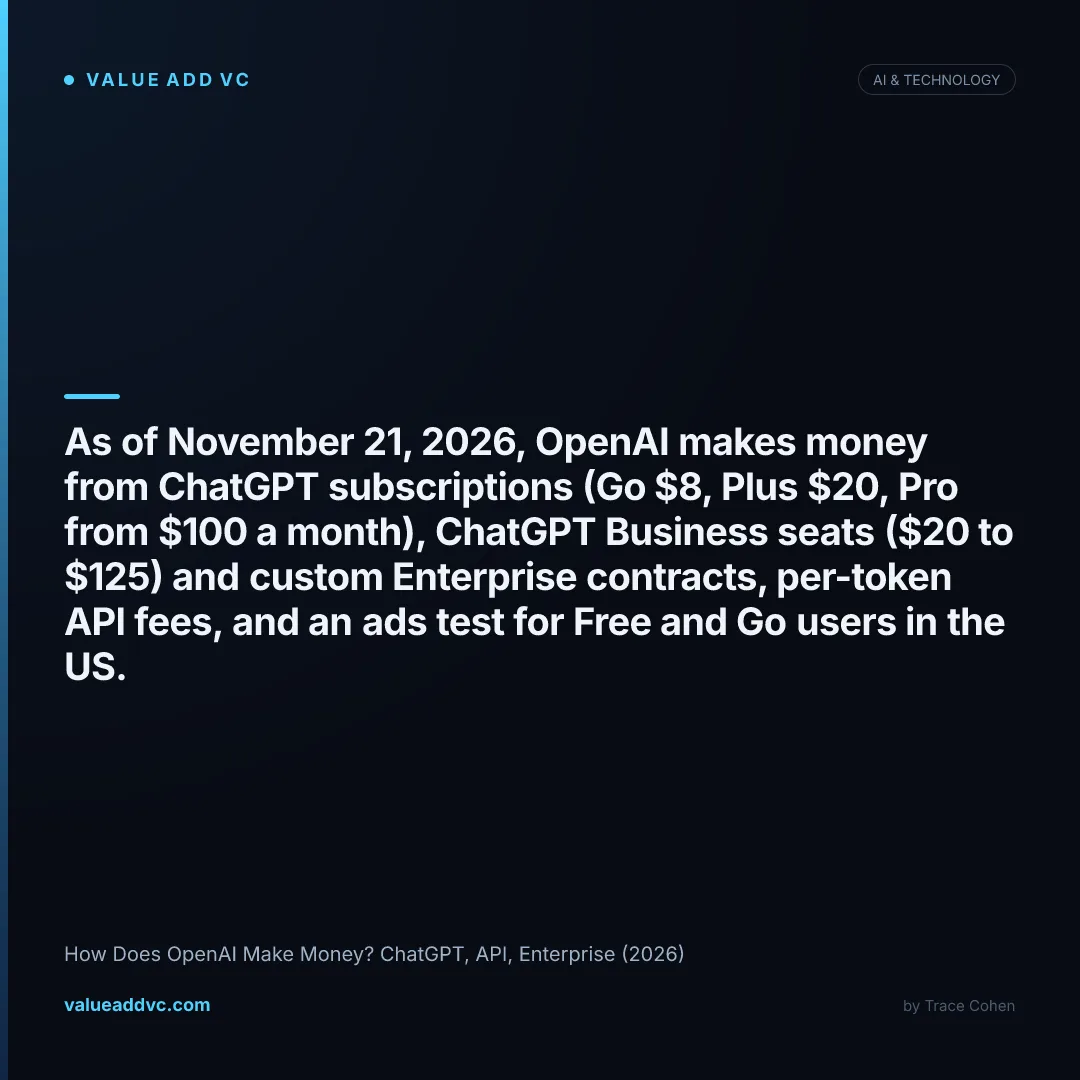
OpenAI makes money four ways: it charges consumers $8 to $100-plus a month for ChatGPT, sells ChatGPT seats and custom Enterprise contracts to employers, bills developers per token for its API, and, since February 2026, tests ads for Free and Go users in the US. As of November 21, 2026, OpenAI is private and unprofitable; reported 2025 revenue was $13.07 billion.
This page covers how the money is made: the revenue lines, what each one charges, who pays, and what OpenAI actually discloses. Prices come from OpenAI's own pricing pages. For the reported run-rate history and the losses in detail, see our OpenAI revenue and path-to-profitability page; for the employer business, see OpenAI enterprise revenue; for listing status, see the OpenAI IPO page.
Prices from OpenAI's help center, Business pricing page and API pricing page, checked November 21, 2026. Revenue as reported by Ed Zitron and Gizmodo.
How does OpenAI make money?
OpenAI sells access to its AI models. Everything it charges for falls into one of four lines, and each has a different buyer and a different pricing unit.
| Revenue line | Who pays | How it's priced (as of Nov 21, 2026) |
|---|---|---|
| ChatGPT consumer plans | Individuals | Flat monthly fee: Free $0, Go $8 (US), Plus $20, Pro from $100 |
| ChatGPT Business and Enterprise | Employers | Per seat per month: Standard $20 to $25, Premium $100 to $125; Enterprise custom |
| OpenAI API | Developers and companies building on OpenAI models | Per million tokens, by model and service tier |
| Ads in ChatGPT (test) | Advertisers | Shown only to Free and Go users in the US; no ads on paid tiers above Go |
OpenAI does not disclose how much revenue each line produces, so no revenue split is shown here. Any split you see elsewhere is an estimate.
Revenue line 1: ChatGPT subscriptions
The consumer business is a classic freemium ladder. ChatGPT is free to use, and paid plans add more messages, uploads, image generation, voice, deep research and access to stronger reasoning models. OpenAI's pricing page lists four individual plans: Free, Go, Plus and Pro, and notes on the Go plan that it "may include ads."
- Free: $0. The top of the funnel and the audience for the ads test.
- Go: $8 a month in the US. TechCrunch described it as "a low-cost subscription at $8 per month in the U.S." (February 9, 2026). Go users can see ads.
- Plus: $20 a month. OpenAI's help center describes Plus as a plan "for $20/month." No ads.
- Pro: from $100 a month. OpenAI's pricing page lists Pro "From $100 / month" with a choice of three usage tiers. No ads.
The economics are simple to state: every subscriber pays a flat fee regardless of how much compute they use, so heavy users cost more to serve than light ones. That is why the higher tiers are sold on usage limits rather than features alone. OpenAI does not disclose subscriber counts by tier or subscription revenue on its own.
Revenue line 2: ChatGPT Business and Enterprise
The employer line sells ChatGPT to companies by the seat. OpenAI's Business pricing page lists, as of November 21, 2026:
- Standard seat: "$20/month if billed annually. $25/month if billed monthly."
- Premium seat: "$100/month if billed annually. $125/month if billed monthly."
- Enterprise: "Custom pricing. Contact our sales team to discuss enterprise pricing."
Business is sold "for teams of 2–200 employees," and each workspace gets "up to $500 per month in API credits," per the same page. That credit is a deliberate bridge: it pulls a company that starts with chat seats toward building on the API, the second way OpenAI bills the same customer.
Enterprise is where the large contracts sit, negotiated per customer with custom terms, so there is no public price to quote. For what has been reported about enterprise contract sizes and seat counts, see our OpenAI enterprise revenue page.
Revenue line 3: the OpenAI API
Developers pay per token, with separate rates for input, cached input and output, and no subscription fee for API access itself. Standard-tier rates per million tokens on OpenAI's API pricing page (short context, up to 272K input tokens), checked November 21, 2026:
| Model | Input | Cached input | Output |
|---|---|---|---|
| GPT-6 Astra | $10.00 | $1.00 | $50.00 |
| GPT-6.1 Sol | $2.00 | $0.10 | $10.00 |
| GPT-6.1 Terra | $1.00 | $0.05 | $5.00 |
| GPT-6 Luna | $0.10 | $0.01 | $0.50 |
Astra's input rate is 100 times Luna's (our arithmetic), which is how OpenAI prices for very different jobs: Luna for high-volume, low-stakes tasks, Astra for the hardest reasoning work. Batch requests cost half the Standard rate, and some background requests on the smaller models get further discounts for slower completion windows, per the same page. Those discounts let OpenAI fill spare capacity at a lower price instead of leaving it idle.
API prices change often and vary by tier, context length and region, so check the live page before relying on any rate. OpenAI does not report API revenue separately from its other lines. For older-model API prices and a developer cost comparison, see our OpenAI API pricing breakdown.
Revenue line 4: ads in ChatGPT (a test)
Advertising is the newest line and is still labelled a test. TechCrunch reported on February 9, 2026: "OpenAI on Monday announced it's beginning to test ads in the U.S. for users on its Free and Go subscription tiers" (TechCrunch). Paid subscribers on Plus, Pro, Business, Enterprise and Education plans "will not see ads," the company said, per the same report.
The scope is company-stated: US only, Free and Go only. OpenAI has not disclosed advertising revenue, and we do not repeat the estimates that circulate, because we could not confirm any of them with two independent sources. The strategic logic is visible without a number: ads let OpenAI earn from the users who will never pay, while every paid tier above Go doubles as the ad-free upgrade.
What it costs OpenAI to make that money
The cost side explains why revenue growth has not produced profit. Every ChatGPT answer and every API call consumes compute, and training new models consumes more. Flat-fee subscriptions cap what OpenAI earns from a heavy user, while the compute that user consumes is not capped.
Audited 2025 statements first reported by Ed Zitron, who wrote that they were "independently verified by the Financial Times," put 2025 revenue at $13.07 billion (Where's Your Ed At, June 15, 2026; Gizmodo, June 16, 2026). The same documents show costs well above that revenue. Published loss figures differ by measure, operating versus net and with or without large non-cash charges tied to OpenAI's restructuring, so we do not print one here; our OpenAI revenue page walks through the reported loss and burn figures with their caveats.
Is OpenAI profitable?
No. On every reported basis, OpenAI spent more than it earned in 2025. It is a private company, so none of its financials come from a public filing: the revenue figure on this page is reported from leaked statements that OpenAI declined to comment on, per Gizmodo. Plan and API prices, by contrast, are company-stated on OpenAI's own pages.
What OpenAI discloses vs. what is reported
Company-stated (OpenAI's own pages)
ChatGPT plan prices; Business seat prices and the $500 monthly API credit; Enterprise is custom-priced; API rates per million tokens; the ads test covers Free and Go users in the US and not paid tiers above Go.
Reported, not disclosed
2025 revenue of $13.07 billion (leaked audited statements). Revenue by line, subscriber counts by tier, ads revenue and API revenue are not disclosed, and this page does not estimate them.
Bottom line: OpenAI's business is four meters on the same models: a flat monthly fee for consumers, a per-seat fee for employers, a per-token fee for developers, and ads for the free audience. Each line is priced on OpenAI's own pages as of November 21, 2026; how much each one earns is not disclosed. Reported 2025 revenue of $13.07 billion did not cover costs, which is why the run-rate and profitability story on our OpenAI revenue page and the listing questions on our OpenAI IPO page matter as much as the price list.
Latest from the Pulse
Get VC data most people never see
— free to subscribe
Trace's notes on venture, AI and startups, a few times a week. Join 5,000+ subscribers. No spam.
No spam, unsubscribe anytime. Sent via Substack · Privacy · or subscribe on Substack ↗