
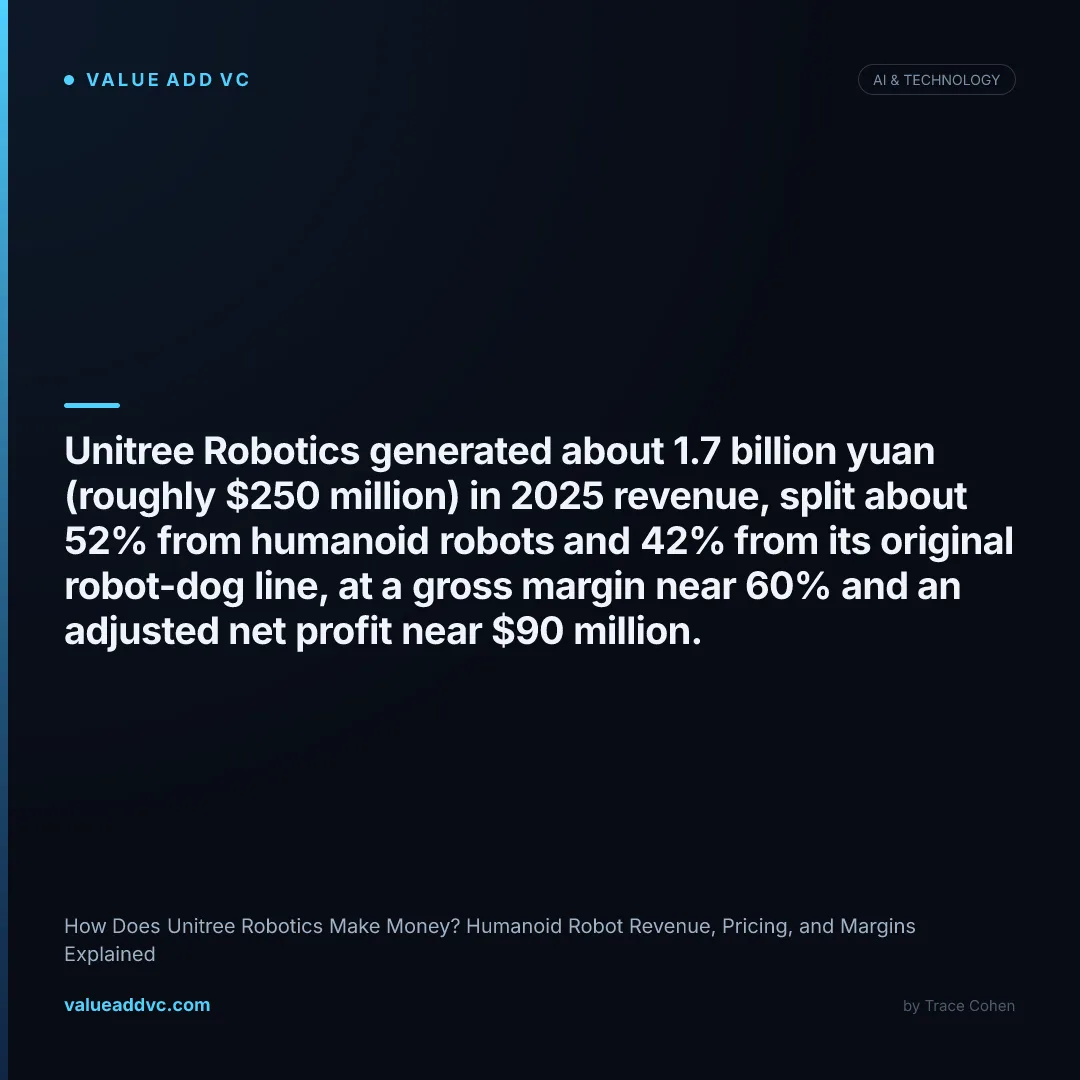
Unitree Robotics generated about 1.7 billion yuan (roughly $250 million) in 2025 revenue, split almost evenly between humanoid robots and its original robot-dog line, at a 60% gross margin and an adjusted net profit near $90 million.
That makes Unitree one of the rare profitable companies in humanoid robotics, a sector where most venture-backed competitors are still selling single-digit-million-dollar volumes against triple-digit-million-dollar losses. We covered the Unitree IPO's valuation swings in full here; this post is about the business underneath the stock price — exactly how Unitree prices its hardware, who's buying it, and why.
Figures from Unitree's STAR Market IPO prospectus, as reported by The Robot Report (Sept. 9, 2026) and eWeek (Apr. 1, 2026).
How Does Unitree Robotics Make Money?
Unitree sells hardware outright rather than leasing it. The company builds and sells two product lines — humanoid robots (its G1 and H1 series) and quadruped "robot dog" units that were its original business — plus a smaller stream of robotic components, per The Robot Report's review of Unitree's IPO filing. That's a different model from most of its humanoid-robotics peers: competitors like Agility Robotics typically lease hardware under multi-year robots-as-a-service contracts and book revenue over time, while Unitree recognizes revenue at the point of sale.
Humanoid robots overtook the quadruped business for the first time in 2025, reaching about 51.5%-52% of revenue against roughly 42.3% for quadrupeds, with components and other sales making up the remainder, eWeek reported from the same filing. Back in 2023, humanoids were just 1.9% of Unitree's business — the mix shift happened almost entirely in the past two years.
Unitree Robotics: 2025 Revenue Mix by Product Line
Humanoid robots passed Unitree's original robot-dog business in 2025, two years after they were under 2% of revenue.
Unitree STAR Market IPO prospectus, via The Robot Report and eWeek, 2026
Data
| Item | Value |
|---|---|
| Humanoid robots | 52% |
| Quadruped robot dogs | 42% |
| Components & other | 6% |
Who Is Actually Buying Unitree's Robots?
Mostly research labs and schools, not factories. In the first nine months of 2025, research and education customers accounted for about 73.6% of humanoid-robot revenue, commercial display and demonstration use made up 17.4%, and industrial applications — the use case most investors associate with humanoid robots replacing factory labor — were just 9.01%, per Unitree's filing. Geographically, about 60.8% of revenue in that period came from mainland China, up from under half in prior years, with overseas sales making up the rest.
Pricing has fallen fast as volume has scaled. Unitree's average humanoid selling price dropped from roughly $85,000 (593,400 yuan) in 2023 to about $25,000 (167,600 yuan) in the first nine months of 2025, even as companywide gross margin held near 60%, per the same filing. In full-year 2025, Unitree said it delivered more than 5,500 humanoid robots to customers out of more than 6,500 produced, per Jiemian's report on Unitree's own January 22, 2026 shipment disclosure — about 30% ahead of the roughly 4,200 units analyst firm Omdia had forecast.
| Breakdown | Category | Share | Period |
|---|---|---|---|
| By product | Humanoid robots | ~51.5%-52% | FY2025 / 9M2025 |
| By product | Quadruped robot dogs | ~42.3% | 9M2025 |
| By product | Components & other | ~6% | 9M2025 (implied) |
| Humanoid revenue by customer | Research & education | 73.6% | 9M2025 |
| Humanoid revenue by customer | Commercial display/demo | 17.4% | 9M2025 |
| Humanoid revenue by customer | Industrial applications | 9.01% | 9M2025 |
| By region | Mainland China | 60.8% | 9M2025 |
| By region | Overseas | ~39.2% | 9M2025 |
How we counted: shares of revenue as disclosed in Unitree's STAR Market IPO prospectus; 9M2025 = first nine months of 2025; as reported by The Robot Report and eWeek, 2026.
Revenue Growth, 2023-2025 — and the 2026 Slowdown
Unitree's revenue climbed from about 159 million yuan (~$22M) in 2023 to roughly 393 million yuan (~$54M) in 2024 to 1.70 billion yuan (~$250M) in 2025 — a 335% year-over-year jump in the final year, per The Robot Report's September 9, 2026 analysis of the IPO filing. R&D spending fell as a share of revenue over the same stretch, from about 31.4% of revenue in 2023 to roughly 7.7% in the first nine months of 2025, even as absolute R&D dollars rose from about $6.9 million to $12.5 million.
That growth rate has since cooled sharply. First-half 2026 revenue grew only about 40% year-over-year, down from 335% the prior year — a sign that demand is normalizing off 2025's unusually small base, not necessarily that the business is struggling. Unitree's own targets imply it's still betting on scale: the company has said it aims to reach 75,000 humanoid robots and 115,000 quadruped robots a year within five years, and brought a second production base in Wuxi online in the second quarter of 2025 with annual quadruped capacity of 50,000 units.
Unitree Robotics Revenue, 2023-2025
Revenue grew more than 10x in two years as humanoid robots scaled from under 2% to roughly half of sales.
Unitree STAR Market IPO prospectus, via The Robot Report, 2026
Data
| Item | Value |
|---|---|
| 2023 | ¥159M (~$22M) |
| 2024 | ¥393M (~$54M) |
| 2025 | ¥1.70B (~$250M) |
Unitree vs. Agility Robotics: Two Very Different Humanoid Robot Businesses
The contrast with Western humanoid robotics startups is stark. Agility Robotics, heading to Nasdaq through a $2.5 billion SPAC merger, reported just $1.8 million in 2025 net sales against a $140 million operating loss, per its merger filing reviewed by The Robot Report. Unitree, selling at far lower price points and far higher volume, turned roughly $250 million of 2025 revenue into an estimated $90 million of adjusted profit. The difference isn't product ambition — it's that Unitree has already found paying customers (even if mostly researchers, not factories) at a price point and volume Western humanoid makers haven't reached yet.
Unitree Robotics vs. Agility Robotics: 2025 Financials
Unitree STAR Market IPO prospectus (via The Robot Report, eWeek); Agility Robotics SPAC S-4 filing (via The Robot Report), 2026
Unitree's lower-priced, higher-volume model produced real profit in 2025; Agility's RaaS model is still almost entirely pre-revenue relative to its $2.5B valuation.
Where this could be wrong
Unitree's profitability rests on a customer base that's still mostly research and education (73.6% of humanoid revenue) rather than the industrial deployments (9.01%) that would prove humanoid robots can do paid factory work at scale — and the average humanoid selling price has already fallen more than 70% in two years, from about $85,000 to about $25,000, a trend that could keep compressing margins even as volume grows. Revenue growth has also decelerated sharply, from 335% in 2025 to roughly 40% in the first half of 2026. And at a roughly $30 billion valuation as of September 9, 2026 — about 125 times 2025 revenue, per The Robot Report — the stock is pricing in a humanoid-robotics future that's still mostly a research-lab product today, not the industrial one the valuation implies.
Bottom line: Unitree makes money the old-fashioned way — selling hardware at a profit — generating about $250 million in 2025 revenue and roughly $90 million of adjusted profit at a 60% gross margin, split almost evenly between humanoid robots and its original robot-dog line. That puts it well ahead of Western humanoid competitors on actual revenue and profit today, even though its buyers are still mostly researchers and its 2026 growth rate has cooled sharply from 2025's pace.
For the IPO itself — pricing, the 460% debut-day pop, and the pullback since — see our full Unitree IPO breakdown. For how other humanoid makers price their hardware, see how Agility Robotics makes money, and track every public and private robotics valuation on Unicorns.
Latest from the Pulse
Get VC data most people never see
— free to subscribe
Trace's notes on venture, AI and startups, a few times a week. Join 5,000+ subscribers. No spam.
No spam, unsubscribe anytime. Sent via Substack · Privacy · or subscribe on Substack ↗