

$300 million in annualized recurring revenue is what Harvey AI generated as of May 2026, up from $195 million at the end of 2025 — nearly all of it from per-seat subscription licenses sold to law firms and corporate legal departments. Per-seat pricing in a market AI is supposed to shrink is the tension worth examining.
Harvey doesn't sell an API and doesn't have a self-serve consumer product. Every dollar of its revenue runs through negotiated, seat-based enterprise contracts with law firms, in-house legal teams, and a smaller cohort of asset managers — a business model that looks more like Workday selling into HR departments than like OpenAI selling tokens. That structure is exactly why Harvey has been able to command an $11 billion valuation on relatively modest revenue: legal services spending is enormous, sticky, and price-insensitive relative to most SaaS categories, and Harvey has positioned itself as the default AI layer inside that spend before rivals could get there.
How Does Harvey AI Make Money: The Per-Seat Licensing Model
Harvey makes money almost entirely through per-seat subscription licenses sold directly to law firms and corporate legal departments, not through a metered API or a consumer app. Each licensed attorney or legal professional gets a seat, priced on an annual or monthly basis with contract minimums that typically require 20 to 50 seats and 12-month terms. Enterprise deals then add custom-model fine-tuning, workflow integrations, and dedicated support fees on top of the base per-seat price, which is how a single AmLaw 100 contract can scale into seven figures even at a lower effective per-user rate.
Harvey AI's Revenue Growth: From $100M to $300M ARR in Nine Months
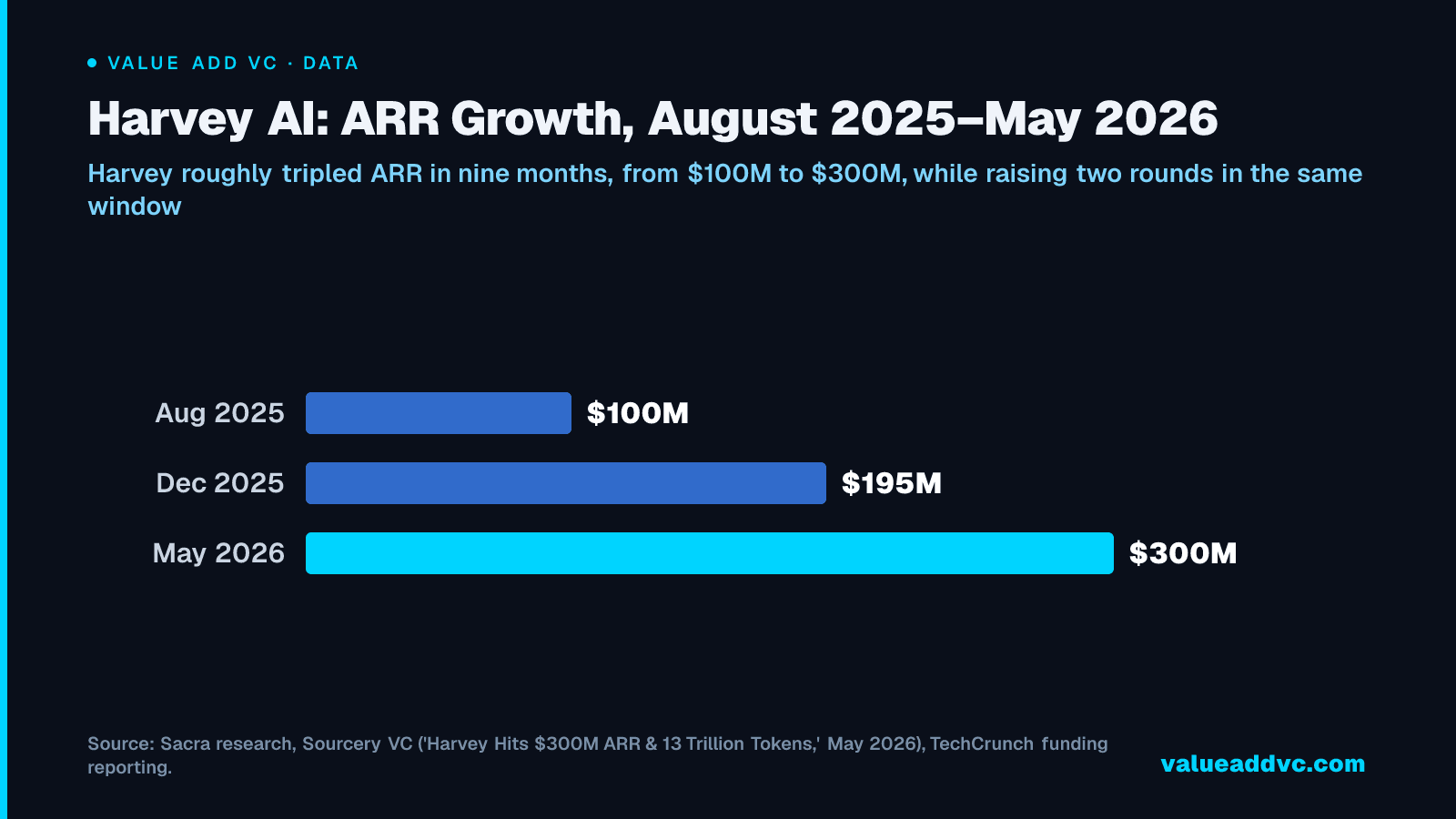
Harvey crossed $100 million in ARR in August 2025, roughly three years after founding. It nearly doubled to $195 million by the end of 2025, then jumped again to approximately $300 million by May 2026 — a 54% increase in about five months and a 3x increase over nine months. That growth curve tracks almost exactly with Harvey's funding cadence: the company raised $160 million at an $8 billion valuation in December 2025, then $200 million at $11 billion in March 2026, a roughly 38% valuation step-up in three months, co-led by GIC and Sequoia Capital with participation from a16z, Coatue, Conviction, Elad Gil, and Kleiner Perkins.
Harvey AI: ARR Growth, August 2025–May 2026
Harvey roughly tripled ARR in nine months, from $100M to $300M, while raising two rounds in the same window
Sacra research, Sourcery VC ('Harvey Hits $300M ARR & 13 Trillion Tokens,' May 2026), TechCrunch funding reporting.
Data
| Item | Value |
|---|---|
| Aug 2025 | $100M |
| Dec 2025 | $195M |
| May 2026 | $300M |
Harvey AI Pricing: What Law Firms and Legal Departments Actually Pay
Harvey has never published an official price sheet, but third-party pricing breakdowns and reported deal terms give a reasonably consistent picture. Smaller law firm deployments run roughly $1,200 per attorney per month with around 20-seat minimums and 12-month commitments. Mid-market firms with 50-200 attorneys typically land in the $1,000-$2,000 per-seat-per-month range. Large AmLaw 100 enterprise contracts, by contrast, reportedly scale down to $100-$200 per user per month — the classic enterprise SaaS pattern where volume buys a steep discount, and where a 3,500-seat deal at $150/month still generates over $6 million in annual contract value. Annual contracts overall commonly range from $50,000 to $300,000-plus, with renewal uplifts of 10-25% reported as firms expand usage.
| Customer segment | Typical seat price | Seat minimum | Contract term |
|---|---|---|---|
| Small law firms | ~$1,200/mo | 20 seats | 12 months |
| Mid-market firms (50-200 attorneys) | $1,000-$2,000/mo | 25-50 seats | 12 months |
| AmLaw 100 enterprise | $100-$200/mo | 500+ seats | 12-24 months |
| Corporate legal departments | Custom enterprise | Varies | 12-24 months |
| Asset managers | Custom enterprise | Varies | 12 months |
| Renewal uplift (existing accounts) | +10-25% ACV | — | Annual |
Figures are 2026 estimates blended from eesel AI pricing analysis, thelegalprompts.com deal-term reporting, and Sacra research. Harvey has not published official pricing; these are third-party and reported-deal estimates, not confirmed company figures.
Harvey AI's Customer Base: Law Firms vs. Corporate Legal Departments
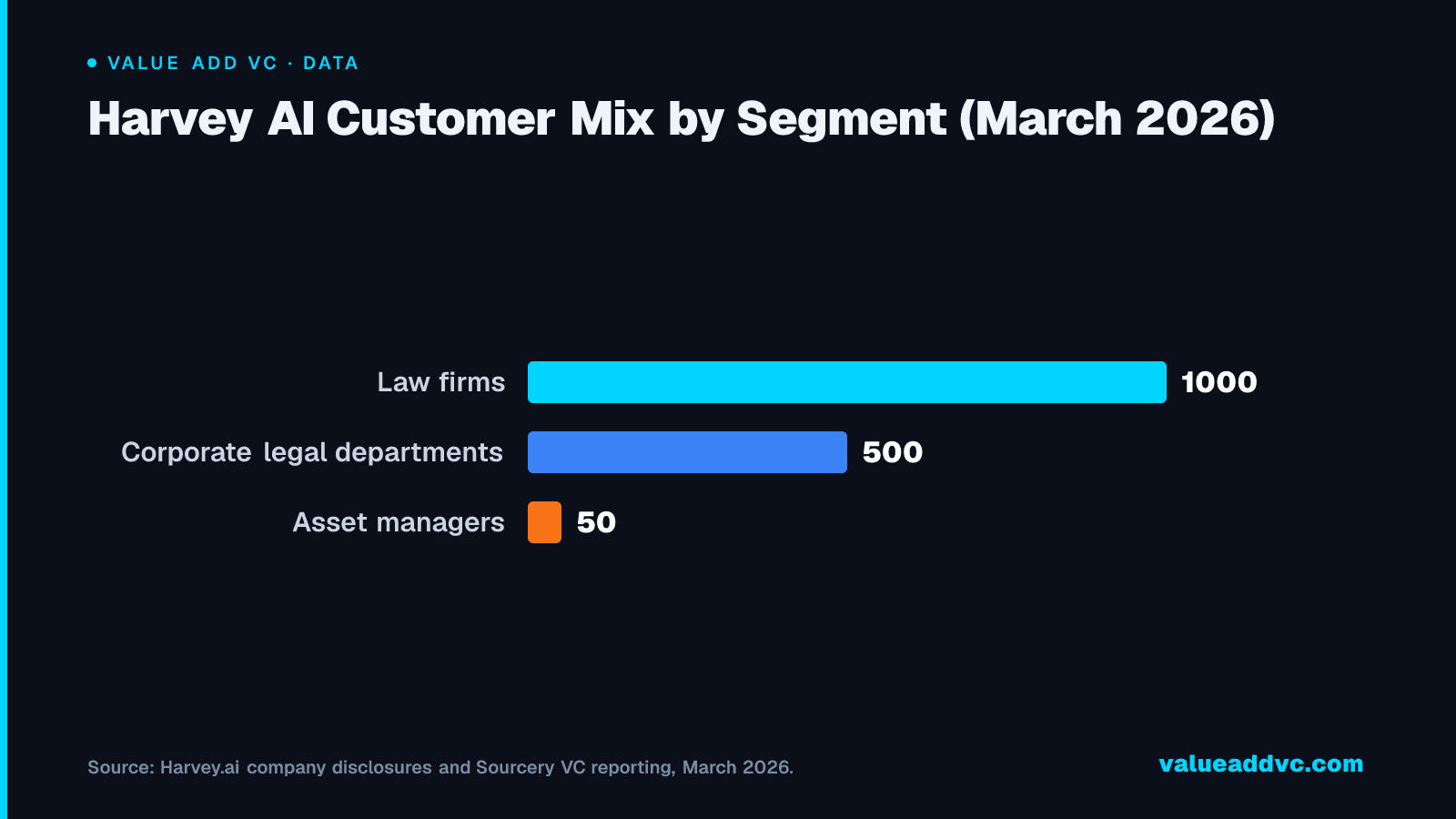
Harvey's customer base splits into three main segments: law firms, in-house corporate legal departments, and asset managers. As of March 2026, Harvey counted 1,500+ customers across 60+ countries, made up of roughly 1,000 law firms, 500+ corporate legal departments, and 50 asset managers, with 142,000+ individual lawyers on the platform and coverage across roughly half of the Am Law 100. Named customers include Allen & Overy (Harvey's first major client, signed in February 2023 and now merged into A&O Shearman), PwC, Cleary Gottlieb, Macfarlanes, and Reed Smith — a mix that shows Harvey landed both elite corporate law firms and Big Four professional services early, then expanded into general counsel offices as the product matured.
Harvey AI Customer Mix by Segment (March 2026)
Harvey.ai company disclosures and Sourcery VC reporting, March 2026.
Data
| Item | Value |
|---|---|
| Law firms | 1000 |
| Corporate legal departments | 500 |
| Asset managers | 50 |
How Harvey AI's Business Model Compares to Legal AI Competitors
Harvey's closest direct competitor, Legora, runs a similar per-seat SaaS model focused on law firms, but has grown its valuation faster than its revenue disclosed to date — jumping from a $1.8 billion Series C in October 2025 to a reported $5.55-$5.6 billion in early 2026, roughly a 3x step-up in a few months, without matching Harvey's disclosed $300 million ARR. Thomson Reuters' CoCounsel competes from a different position entirely: it's built on Thomson Reuters' $650 million Casetext acquisition and bundled into existing Westlaw and Practical Law distribution, giving it an incumbent's reach without needing venture-style growth capital. Smaller players like Spellbook, focused on contract drafting for smaller firms, have raised far less — around $11 million in an early round plus a reported $40 million debt facility — and haven't disclosed a recent valuation.
Harvey vs. Legora: Valuation and Growth Trajectory
TechCrunch, PYMNTS, and Sacra reporting on Harvey and Legora funding rounds, as of 2026.
Data
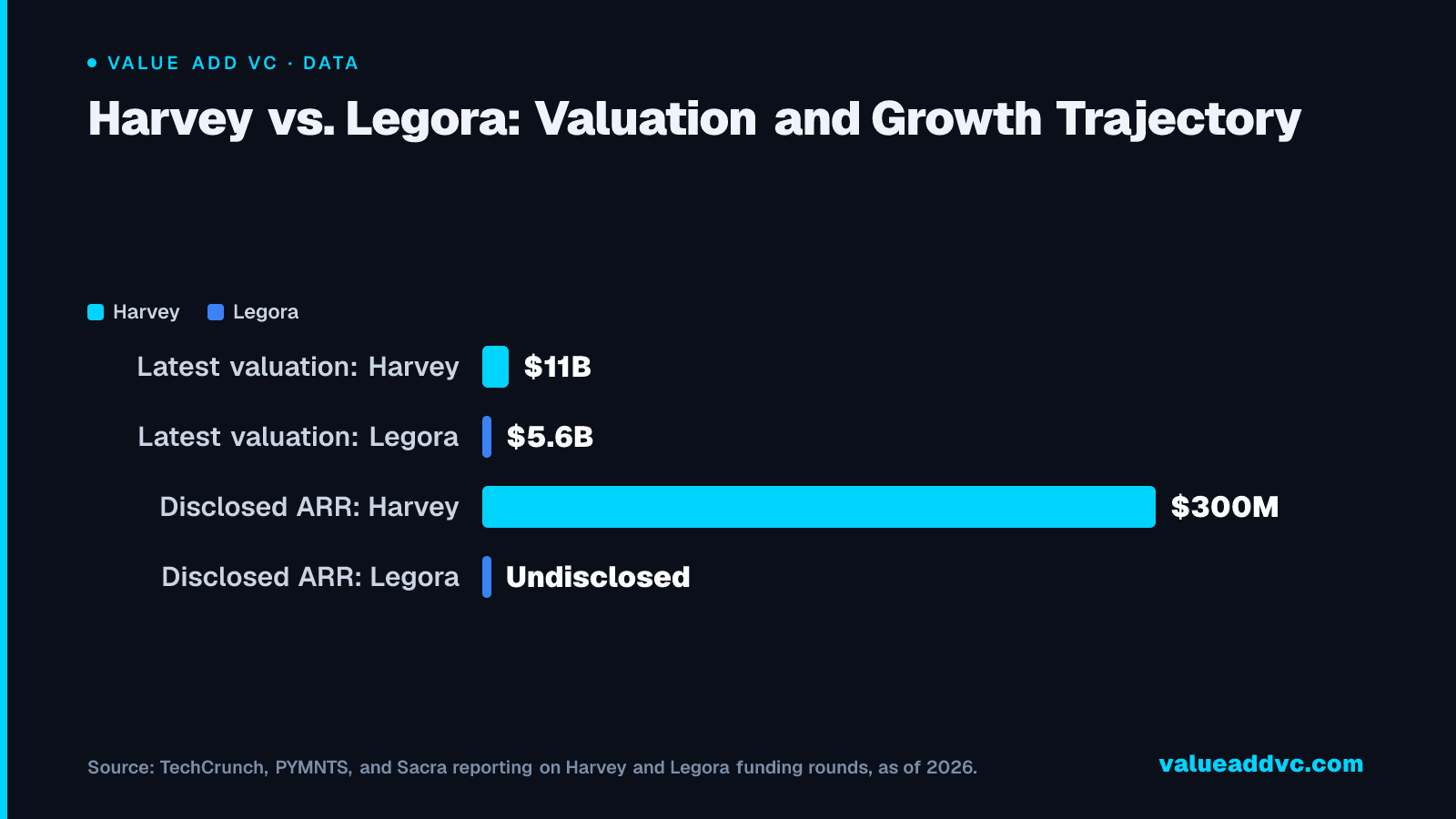
Legora has not publicly disclosed an ARR figure comparable to Harvey's $300M mark as of this writing.
Founders, Headcount, and the Team Behind the Revenue
Harvey was founded in 2022 by Winston Weinberg, a former litigator at O'Melveny & Myers, and Gabriel Pereyra, a former DeepMind and Meta AI researcher — a founding pair that combined legal-domain credibility with frontier-model research experience, which likely helped Harvey land its first major law firm client faster than a pure-technology team could have. Headcount grew from roughly 82 employees in early 2025 to an estimated 250 by early 2026, meaning Harvey's $300 million ARR works out to roughly $1.2 million of revenue per employee — an efficient ratio for an enterprise software company still scaling this fast, though the company has not disclosed burn rate, gross margin, or profitability status. That's worth flagging explicitly: unlike API-based AI companies whose compute costs scale directly with usage, Harvey's cost structure and margins remain a black box, which matters for anyone trying to underwrite whether $11 billion is the right price for $300 million of revenue.
Why Harvey's Per-Seat Model Works Better in Legal Than Elsewhere
Per-seat pricing has struggled in some enterprise AI categories because the value delivered per user varies wildly, but legal services happen to be an unusually good fit for it. Law firms already bill clients by the hour at rates commonly running $500-$1,500+ per partner hour, so a tool priced at $100-$2,000 per attorney per month only needs to save a handful of billable hours a month to pay for itself many times over — the ROI math essentially sells itself to a General Counsel or managing partner without Harvey needing to prove a complicated productivity metric. That's structurally different from, say, a coding assistant competing against a developer's existing free tools, or a customer-support agent that has to prove it reduces headcount before a CFO will sign off. Legal buyers are also unusually willing to pay for compliance and risk reduction on top of pure time savings, which is part of why Harvey's average contract value has scaled even as per-seat pricing at the largest accounts has compressed toward $100-$200/month.
That said, the model isn't without risk. Seat-based pricing caps revenue growth once a firm's headcount stops growing, which is why Harvey's next leg of ARR growth likely depends less on adding new law firm logos — most of the AmLaw 100 has already run a pilot — and more on expanding usage-based add-ons, deeper corporate legal department penetration, and international expansion into the 60+ countries it already touches but hasn't fully saturated. Corporate legal departments in particular represent a larger long-term opportunity than law firms alone: general counsel offices control legal spend directly and can redirect outside-counsel budget toward in-house AI tooling, a dynamic that could eventually make corporate contracts a larger share of Harvey's revenue mix than the roughly one-third they represent today (500 of 1,500+ total customers). For how Harvey stacks up against Legora, CoCounsel, and five other vendors on price and capability, see our ranking of the best AI tools for legal teams in 2026.
The Bottom Line
Harvey makes money the old-fashioned enterprise SaaS way — per-seat licenses sold to law firms and legal departments, not API usage or consumer subscriptions — and that model has scaled from $100 million to $300 million in ARR in nine months while the valuation climbed from $8 billion to $11 billion in the same window. The per-seat structure is exactly why legal AI has become one of the fastest-growing enterprise AI categories: law firms already budget for expensive labor and expensive software, so a tool priced at $100-$2,000 per attorney per month is an easy budget line to approve relative to what it can potentially displace. The open question isn't whether the model works — it clearly does — it's whether Harvey can keep expanding seat counts and pricing power once every major law firm has already run the pilot. It's a much simpler revenue mix than Palantir's split between government contracts and its commercial AIP platform, but the same underlying bet: enterprise buyers will pay a premium once an AI tool proves it can replace expensive, specialized human labor.
Track private AI company valuations across the market on the AI Valuations dashboard and broader private-market comps on the Unicorn Tracker at Value Add VC.
Latest from the Pulse
Get VC data most people never see
— free to subscribe
Trace's notes on venture, AI and startups, a few times a week. Join 5,000+ subscribers. No spam.
No spam, unsubscribe anytime. Sent via Substack · Privacy · or subscribe on Substack ↗