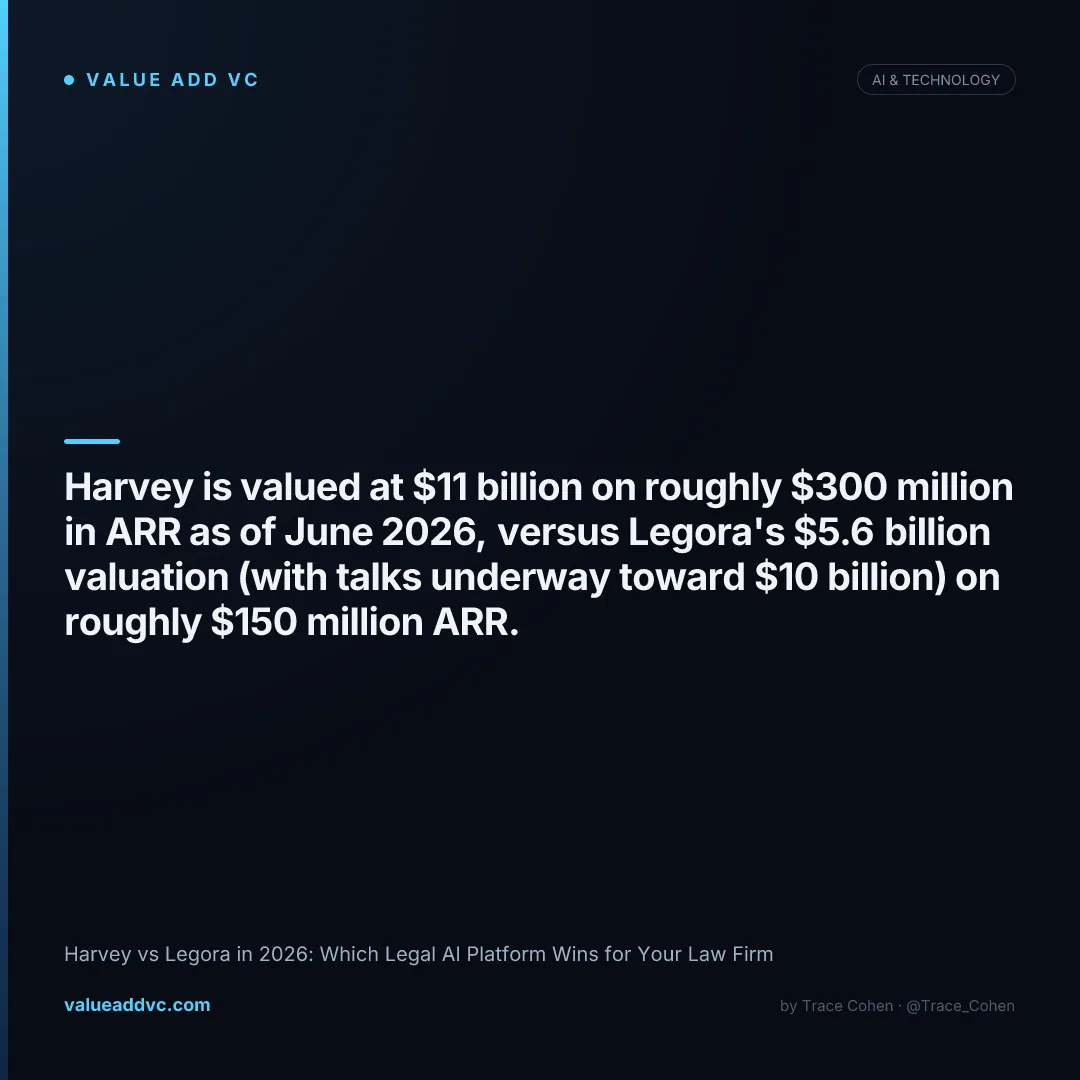
Harvey is worth $15.5 billion on more than $400 million in annualized revenue after a $550 million round that closed September 9, 2026; Legora is worth $5.6 billion — with talks underway to nearly double that to $10 billion — on roughly $150 million in ARR. That's the short answer. The longer answer is more interesting: these two companies aren't really building the same product.
Legal AI is now a two-horse race between a San Francisco company that wants agents to run a matter end-to-end and a Stockholm company that wants to make a shared workspace smarter. Both have raised nine-figure rounds in the last five months. Both are being adopted inside Big Law at a pace that would have been unthinkable in 2023. Picking between them for your firm depends far less on which one has the bigger number next to its name and far more on how your lawyers actually work.
Some links on this page may point to third-party pricing pages; this comparison is not sponsored and rankings are based only on the data below. See /editorial-standards.
Sources: Harvey's own announcement, CNBC, Sacra, TechCrunch, and TechFundingNews on Legora's August 2026 talks, checked October 2026.
Harvey vs Legora: The Core Difference in 2026
Harvey vs Legora comes down to architecture, not size: Harvey is an agentic platform that runs diligence, drafting, and research end-to-end for large firms, while Legora is a collaborative AI workspace built on top of Microsoft 365 for teams reviewing documents together. Harvey leads on enterprise scale and US litigation depth; Legora leads on cross-border collaboration and price.
Harvey was founded in 2022 in San Francisco by Winston Weinberg and Gabriel Pereyra, and it grew up inside large US law firms — its strongest coverage is litigation support, SEC filings, and the document conventions specific to American legal practice. Legora was founded in Stockholm in 2023, originally under the name Leya, by Max Junestrand, Sigge Labor, and August Erséus, and it grew up inside global and European firms doing high-volume, cross-border matter work. That founding context still shows up in the product: Harvey wants to be the agent that does the work; Legora wants to be the workspace where your team does the work together.
Harvey vs Legora by the Numbers
The table below pulls together valuation, funding, revenue, and pricing for both companies as of August 2026. Neither company publishes audited financials — both are private — so ARR and customer figures are third-party estimates and company disclosures rather than GAAP numbers.
| Metric | Harvey | Legora |
|---|---|---|
| Latest valuation | $15.5B (Sept 9, 2026) | $5.6B (April 2026), in talks near $10B (Aug 2026) |
| Latest round size | $550M, co-led by Diffusion and Lightspeed | $600M total ($550M Series D + $50M extension) |
| Total capital raised | ~$1.55B across 8 rounds | ~$680M+ across Seed through Series D |
| ARR (current) | $400M+ (Sept 2026) | ~$150M (Q2 2026) |
| ARR six months prior | ~$300M (Mar 2026) | ~$50M (Dec 2025) |
| Founded / HQ | 2022, San Francisco | 2023 (as Leya), Stockholm |
| Core architecture | Agentic platform, runs work end-to-end | Collaborative workspace layered on Microsoft 365 |
| Customer base | 3,000+ paying organizations, 80% of Am Law 100 | 1,000+ enterprise customers across 50+ markets |
| Entry-level pricing | ~$1,200–$2,000+/seat/month, 25-seat minimum (~$360K/yr floor) | ~$3,000/seat/year, 10-seat minimum (~$30K/yr floor) |
| Key investors | Sequoia, GIC, Kleiner Perkins, Diffusion, Lightspeed, Sapphire Ventures, a16z, Coatue | Accel, Benchmark, Bessemer, General Catalyst, ICONIQ, Y Combinator, Atlassian |
Figures are 2026 estimates blended from Harvey's own September 2026 funding announcement, CNBC, Sacra, TechCrunch, Bloomberg, and Legora's newsroom. Neither company has published audited financials; ARR and valuation figures are private-market estimates and are subject to revision.
Harvey vs Legora: Latest Private Valuation
Harvey's September 2026 funding announcement; CNBC and TechCrunch funding coverage, March–April 2026.
Harvey's September 2026 round widened the gap rather than closing it: Legora's $10 billion talk-stage valuation, if it closes, would still sit well below Harvey's new $15.5 billion mark.
Product: Agentic Diligence vs Collaborative Review
Harvey's product bet is that a lawyer's highest-leverage move is handing an agent a task and reviewing its output, not doing the first draft themselves. Its agents run legal research, contract analysis, and document drafting with minimal human routing in between, which is why it's landed the deepest penetration into large US litigation shops and Am Law 100 firms that need to move enormous document volumes through diligence. Legora's product bet is different: it assumes lawyers already work in shared documents and email threads across firms and clients, so it builds a tabular review layer and a shared AI workspace directly into that existing workflow rather than trying to replace it.
That difference shows up in who buys each product. Harvey's customer base skews toward large, US-headquartered firms running high-stakes litigation and SEC-adjacent work — the kind of matter where an agent running end-to-end diligence saves associates hundreds of billable hours. Legora's strength is in global and European firms handling cross-border matters where multiple teams, sometimes at different firms, need to review the same set of documents together. Neither approach is objectively better; they're built for genuinely different workflows, which is part of why both companies have been able to raise at multi-billion-dollar valuations within months of each other without directly cannibalizing each other's customer base.
Harvey's September 9, 2026 round arrived alongside two product moves that reinforce the agentic bet: a post-trained open-weight model the company calls Tenet, and Harvey LAB (Legal Agent Benchmark), a new benchmark for evaluating how legal AI agents perform on real matter work, according to Harvey's own announcement. Shipping a proprietary benchmark is itself a signal about where Harvey thinks the competition is heading — toward measurable agent performance, not just interface polish.
What the valuation numbers miss
A $10 billion talk-stage valuation for Legora is still not a closed round as of October 2026, and headline ARR figures for both companies are third-party estimates or company-stated figures rather than audited revenue — neither company has filed for an IPO. Harvey's own September 2026 announcement puts ARR at "more than $400 million," up from CEO Winston Weinberg's description of revenue as "significantly north of $200 million" as of March 2026 — both looser than a precise GAAP figure. Both companies are also burning meaningfully to fund the sales and infrastructure buildout behind that growth, and neither has disclosed a path to profitability. A roughly 39x ARR multiple for Harvey at its new $15.5B mark and roughly 37x for Legora (at its $5.6B mark) only make sense if growth rates like the ones above hold for several more years — a bet, not a certainty.
Which Legal AI Platform Should Your Firm Actually Choose?
Choose Harvey if: you're a large US firm running high-volume litigation, M&A diligence, or SEC-adjacent work, and you want agents handling first-pass drafting and research with minimal manual routing. Harvey now counts 80% of the Am Law 100 and more than 3,000 paying organizations as of September 2026. The 25-seat minimum and roughly $360,000/year entry point only make sense at real scale — this is not a tool for a 15-person boutique.
Choose Legora if: your firm works across borders, collaborates with co-counsel or clients directly inside shared documents, or is already standardized on Microsoft 365. Its 10-seat minimum and roughly $30,000/year floor make it accessible to mid-size firms that would never clear Harvey's contract minimums, and its European roots mean stronger coverage of non-US regulatory and cross-border matter conventions.
Choose neither yet if: your firm's document volume doesn't justify a five- or six-figure annual contract — smaller point solutions inside our full legal AI tools ranking cover that segment better than either platform here.
The bottom line:
Harvey wins on scale and US enterprise depth at $15.5B and $400M+ ARR; Legora wins on price and cross-border collaboration at $5.6B while it works toward a possible $10B round.
Track how private AI company valuations are moving across the market on our AI Valuations dashboard, and see the full breakdown of Harvey's business model in how Harvey actually makes money at Value Add VC. Originally published in the Trace Cohen newsletter.
Latest from the Pulse
Get VC data most people never see
— free to subscribe
Trace's notes on venture, AI and startups, a few times a week. Join 5,000+ subscribers. No spam.