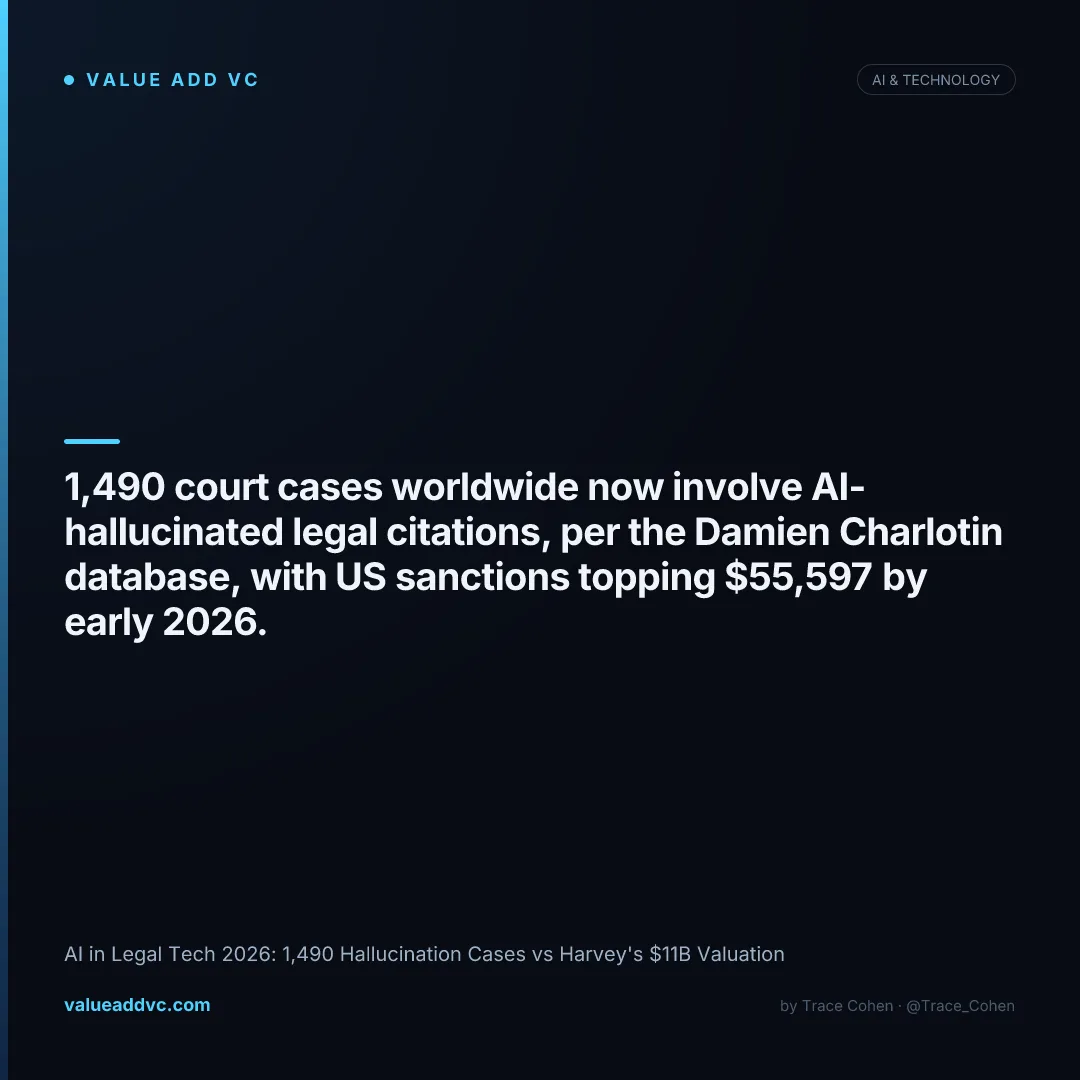
1,490 court cases worldwide now involve AI-hallucinated legal citations, per the Damien Charlotin database, and US sanctions for it have crossed $55,597 cumulatively as of early 2026. At the same time, Harvey AI just hit $300M in ARR at an $11B valuation. Both numbers are true because they describe two completely different ways of using AI in law.
Legal AI in 2026 has split cleanly into two camps: general-purpose chatbots used carelessly for citation research, and purpose-built legal AI platforms grounded in verified case-law databases. The first camp is generating a steady stream of sanctions and embarrassing court filings. The second camp is generating some of the fastest-growing enterprise software revenue in the industry. Confusing the two is where firms get into trouble.
How Are Law Firms Using AI in Legal Tech in 2026?
Law firms in 2026 are using AI for contract review, document drafting, e-discovery, and legal research, split between general-purpose LLMs (ChatGPT, Claude used directly) and domain-specific platforms like Harvey, Legora, and Westlaw's AI-Assisted Research that ground outputs in verified legal databases. RSGI's 2026 survey of 57 law firms and 25 in-house legal teams found 68% already deploying Harvey-based AI agents in production, with 21% running more than 50 agents. Power users report saving 11 hours per week on average, up from 8.5 hours six months earlier — a sign the productivity gains are compounding, not plateauing.
The Misuse Side: How AI Hallucinations Are Landing Lawyers in Court Trouble
The Damien Charlotin database, the most-cited public tracker of this problem, logs 1,490 court decisions worldwide as of mid-2026 — more than 1,000 of them in the US — where a court commented on a party's reliance on AI-hallucinated material. Sanctions have escalated in a clear progression: warnings, then $1,000-5,000 fines, then $10,000+, then an $86,000 penalty, and now calls for disbarment in repeat cases. The trend line is steeply upward, not flattening.
| Case / Incident | Year | Fake Citations | Outcome |
|---|---|---|---|
| Mata v. Avianca | 2023 | 6 | $5,000 sanction + public reprimand |
| Sullivan & Cromwell / Prince Global Holdings | 2026 | ~28 | Formal apology to Chief Judge Glenn |
| Various federal filings (Esquire tracker) | 2024-2025 | 1-15 each | Warnings escalating to fines |
| Repeat-offender attorney case | 2025 | 12 | $10,000+ sanction |
| Large-firm brief error | 2025 | 9 | $86,000 penalty |
| Global aggregate (Charlotin DB) | 2023-2026 | 1,490+ cases | $55,597+ cumulative US sanctions |
Figures are blended from the Damien Charlotin AI Hallucination Cases Database, GC AI's sanctions tracker, and Esquire Deposition Solutions reporting, 2023-2026. Cumulative sanction figures reflect documented US cases only and likely understate the true total given inconsistent court reporting.
The Adoption Side: Why Purpose-Built Legal AI Is Growing So Fast
The counterpoint to the sanctions data is that adoption of properly-grounded legal AI is accelerating, not slowing. Harvey AI raised $200M at an $11B valuation in March 2026 and reached $300M in ARR by May, up from $195M at the end of 2025 — roughly 54% ARR growth in five months, per Sacra's estimates. Competitor Legora has raised at a $5.5B valuation. RSGI's survey found 89% of law firms using Harvey say they can now take on more work because of it, which is the productivity claim every legal AI vendor makes but few can back with adoption data at this scale.
Which Practice Areas Are Adopting AI Fastest — and Which Are Getting Burned?
Adoption and misuse aren't evenly spread across practice areas. Litigation and bankruptcy filings show up disproportionately in the Charlotin hallucination database because they involve the highest volume of citation-heavy briefs under tight deadlines — the Sullivan & Cromwell bankruptcy filing and a large share of the 1,490 tracked cases fall into exactly this category. Contract review, due diligence, and e-discovery, by contrast, are where purpose-built legal AI is seeing the fastest and least controversial adoption, because those workflows involve summarizing and flagging existing documents rather than generating new citations from scratch — there's a source document to check the AI's output against, which removes most of the hallucination risk entirely.
Transactional practice groups — M&A, real estate, and fund formation — have been the quietest adopters and the least represented in sanctions data, largely because the AI is doing pattern-matching against a firm's own precedent documents rather than retrieving external case law. In-house legal teams, which made up 25 of the 82 respondents in RSGI's 2026 survey, report similar dynamics: contract redlining and NDA review are the highest-confidence AI use cases, while any output touching outside case law or regulatory citations still gets a human lawyer's sign-off before it leaves the building.
Why the Error Rates Are So Different Between Tool Types
ChatGPT and Claude, used directly, are trained on general internet text and have no built-in access to Westlaw, Lexis, or court filing databases — they generate plausible-sounding case names and citations through next-token prediction, not retrieval from a verified source. Stanford's RegLab documented 69-88% error rates for this category on legal queries. Westlaw's AI-Assisted Research (34%+ error rate) and Lexis+ AI (17%+) perform meaningfully better because they retrieve from the same licensed case-law corpora lawyers have used for decades and generate answers grounded in that retrieval, not from open-web pretraining alone.
I've made 65+ investments as an operator-turned-investor, and the legal AI category is one of the cleanest examples I've seen of why "AI wrapper" isn't automatically a knock on a startup — Harvey's moat isn't the underlying model, it's the verification layer and database integration on top of it. You can see how enterprise AI valuations compare across categories on the AI Valuations dashboard.
How the Legal AI Funding Landscape Is Shaping Up in 2026
Harvey's $11B valuation isn't happening in isolation — legal tech has become one of the more crowded vertical AI categories, with Legora raising at a $5.5B valuation and a growing set of smaller players targeting specific workflows like e-discovery, IP prosecution, and compliance monitoring. What separates the winners is the same pattern seen across enterprise AI generally: the startups winning large contracts are the ones that built or licensed a verification layer against authoritative source data, not the ones that shipped the thinnest possible wrapper around a foundation model's API. Harvey's growth from $195M to $300M ARR in five months tracks almost exactly with law firms citing trust and accuracy, not raw model capability, as the reason they signed.
That funding concentration also raises a real question for mid-market and boutique firms: the largest legal AI platforms are increasingly priced and packaged for AmLaw 100-scale deployments, which means smaller firms adopting AI in 2026 are more likely to be using general-purpose tools by default — the exact category with the 69-88% error rate on legal queries — simply because the verified alternative is priced out of reach. That pricing gap is arguably a bigger driver of the sanctions numbers than any individual lawyer's carelessness; a firm with a $50,000/year Westlaw AI budget behaves very differently than a two-partner shop pasting queries into ChatGPT for free.
What Law Firms Should Actually Do With AI Right Now
The practical rule emerging from the 2023-2026 sanctions data is simple: never cite a case name or quote generated by a general-purpose LLM without independently verifying it in Westlaw, Lexis, or the court's own docket system. That single verification step would have prevented nearly all 1,490 cases in the Charlotin database. Firms adopting domain-specific tools like Harvey, with built-in citation-checking and retrieval grounding, are seeing the 89% productivity-gain outcome instead of the sanctions outcome — the difference isn't caution versus speed, it's which tool is doing the retrieving.
For law firm leadership evaluating whether to adopt AI at all in 2026, the $11B Harvey valuation and the $55,597 in sanctions are really the same signal read two ways: the technology works well enough that billions of dollars of enterprise software revenue are being built on it, and it fails badly enough, when used without verification, that courts are now actively watching for it. Track how enterprise software valuations across categories compare on the SaaS Valuations dashboard.
The firms getting this right in 2026 tend to share three habits: they've picked one sanctioned or officially-approved AI tool per practice area rather than letting associates freelance with whatever chatbot is open in a browser tab, they've built a mandatory citation-verification step into their document review checklist regardless of which tool produced the draft, and they treat AI output on novel legal questions as a first draft for a senior associate to check, not a final answer for a partner to sign. None of that requires banning AI. It requires treating a $300M-ARR platform and a free chatbot as fundamentally different tools, because the data says they are.
1,490 court cases involve AI-hallucinated citations. Harvey AI is worth $11B and growing ARR 54% in five months.
Legal AI isn't one story in 2026 — it's two, and the gap between them is a single verification step.
Track enterprise AI valuations and adoption trends on the AI Valuations Dashboard at Value Add VC. Originally published in the Trace Cohen newsletter.
Latest from the Pulse
Get VC data most people never see
— free to subscribe
Trace's notes on venture, AI and startups, a few times a week. Join 5,000+ subscribers. No spam.