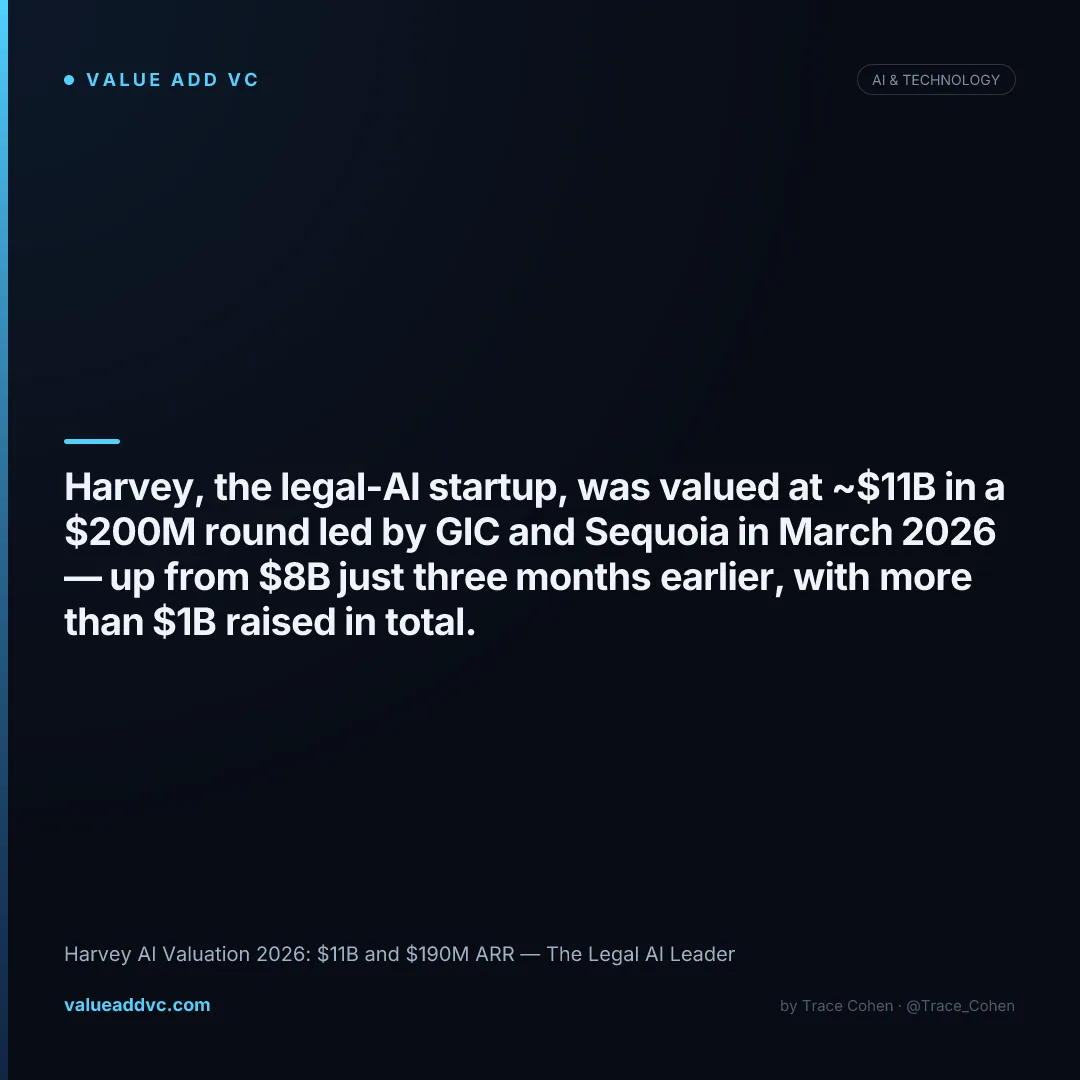
Harvey has become the clearest proof that vertical AI can command frontier-lab valuations. In March 2026 the legal-AI startup raised $200M at an ~$11 billion valuation, led by Singapore's GIC and Sequoia — up from $8B just three months earlier, and on more than $1B raised in total. The price is underwritten by one number that matters: roughly $190M in ARR as of January 2026, nearly double the $100M it reported in August 2025.
How we got here: $8B to $11B in three months
Founded in 2022, Harvey scaled faster than almost any enterprise software company on record. It closed an $8B valuation in December 2025, then watched that mark get re-priced upward within a single quarter — GIC and Sequoia led the $200M round at ~$11B in March 2026. Its cap table reads like a who's-who of AI capital: Sequoia, Kleiner Perkins, GV, the OpenAI Startup Fund, Coatue, and GIC, with more than $1B raised across rounds.
The pace tracks the revenue. Doubling ARR from $100M to $190M in roughly five months is the kind of curve that pulls valuations up faster than founders plan to raise — the same dynamic now visible across enterprise AI from Glean to Cohere.
How Harvey makes money
Harvey sells AI agents and assistants for legal and professional-services work — drafting documents, reviewing contracts, running due diligence, and completing multi-step workflows that used to consume associate hours. It monetizes through per-seat and enterprise contracts to three buyer types: law firms, in-house legal teams, and asset managers.
The distribution is the moat-in-progress. Harvey now reaches 100,000+ lawyers across 1,300 organizations — the majority of the AmLaw 100, more than 500 in-house legal teams, and 50 asset-management firms across 60 countries. In a market where trust, security, and workflow integration matter more than raw model quality, that installed base is hard to dislodge.
The bull case
Legal is a near-perfect AI market: enormous billable-hour budgets, document-heavy work, low tolerance for error, and buyers who will pay for tools that are demonstrably accurate and secure. Harvey's lead in the AmLaw 100, its shift from assistant to autonomous agents, and its embedded legal-engineering teams give it switching costs that a generic chatbot can't match. If agents start billing per completed task rather than per seat, the revenue ceiling rises sharply.
The bear case
At ~$11B on ~$190M ARR, Harvey trades near 58x revenue — pricing in years of flawless execution. The core risk is vertical-AI defensibility: Harvey doesn't own a frontier model, so as OpenAI and Anthropic ship cheaper, more capable models with longer context and better tool use, the gap between "Harvey" and "Claude with a legal prompt library" could narrow. Add well-funded competitors and pricing pressure, and the multiple leaves zero room for a stumble.
The competitive landscape
The fastest-rising vertical rival; a European-born legal-AI platform now expanding in the US.
Incumbent legal-research giant bundling AI into Westlaw and Practical Law.
Contract-focused legal AI with strong in-house and commercial traction.
The other legal-data incumbent racing to embed generative AI across its stack.
ChatGPT and Microsoft Copilot, used informally by lawyers for ad-hoc tasks — the commoditization threat.
Will Harvey IPO?
Not soon. At ~$190M ARR and growing fast, Harvey has every reason to stay private, keep compounding, and let the AmLaw flywheel run — much like the rest of the AI IPO pipeline, where the strongest names are in no hurry. The milestone to watch isn't a banker's roadshow; it's whether Harvey's agents move from "assist the associate" to "replace the task" — the moment that would justify the multiple and reset the legal-services market.
Harvey's $11B mark isn't a bet on legal AI being real — that's settled.
It's a bet that a vertical app keeps its lead while the models underneath it get cheaper and smarter every quarter.
Explore Related Dashboards
Interactive tools with live data on this topic
See the full Harvey company profile and track how the largest AI startups are priced on the AI Valuations dashboard at Value Add VC. Originally published in the Trace Cohen newsletter.
Latest from the Pulse
Get VC data most people never see
— 100% free
Weekly benchmarks, valuations, and fund data. Join 5,000+ investors. No spam.