
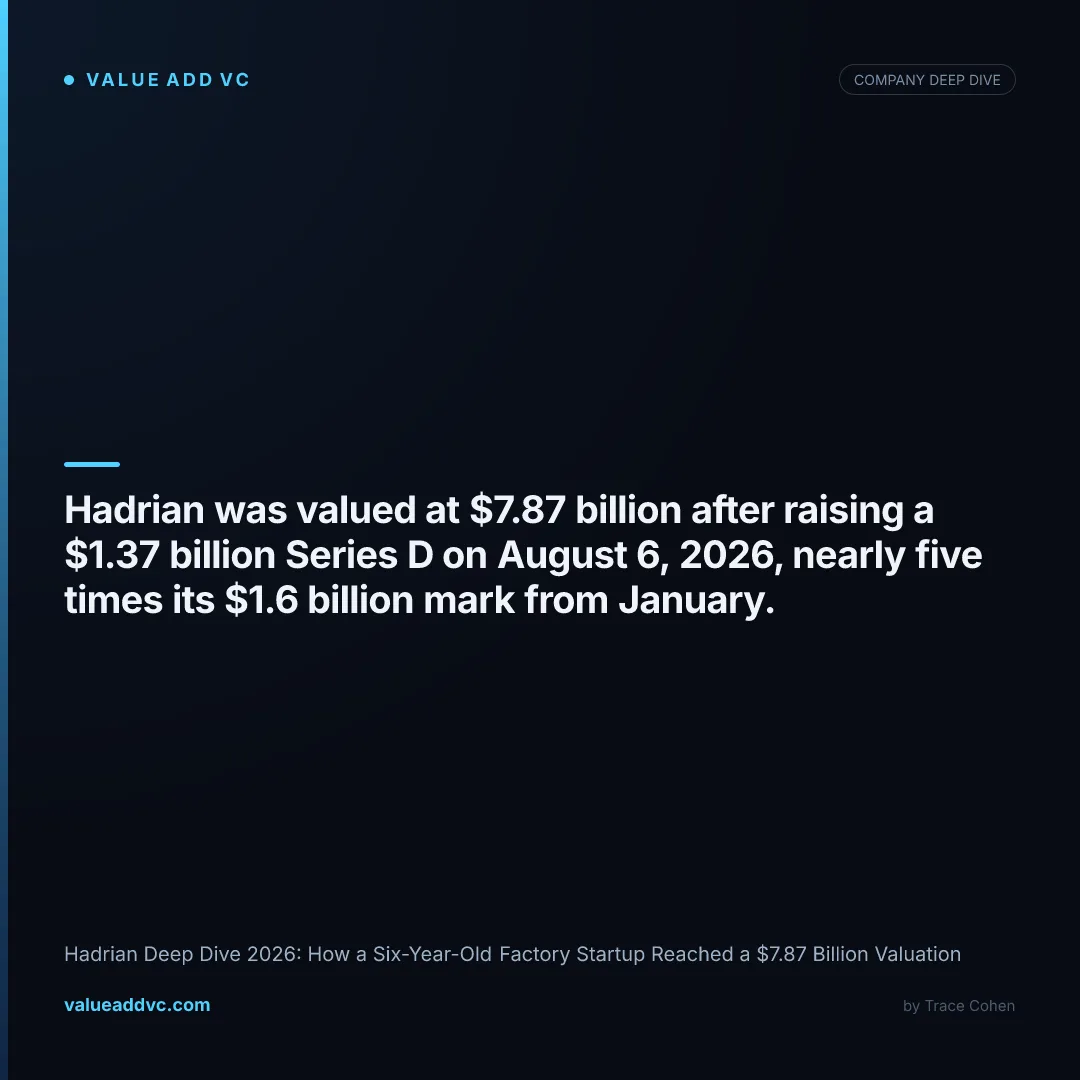
As of November 23, 2026, Hadrian is valued at $7.87 billion after a $1.37 billion Series D announced on August 6, 2026, nearly five times the $1.6 billion investors put on the automated-factory company in January.
Hadrian has gone from a 40-person machine shop in Hawthorne, California in 2022 to four factories covering just under 3 million square feet, a seven-year contract inside a Lockheed Martin missile plant, and a newly acquired steel foundry in Pennsylvania. We track Hadrian's rounds and news as they happen. This deep dive puts the funding history, factories, customers and open questions in one place, and links to our Series D breakdown for the round's full investor list.
Hadrian Company Deep Dive: Snapshot
Hadrian is a Torrance, California manufacturer founded in 2020 that builds and runs highly automated factories for aerospace and defense parts. Its last priced valuation is $7.87 billion, it has raised about $2 billion in equity, its footprint is just under 3 million square feet, and it does not disclose revenue.
Sources: TechCrunch (August 6, 2026), The Robot Report (January 25, 2026), defence-industry.eu (October 14, 2026).
What Does Hadrian Actually Do?
Hadrian machines precision metal components for vehicles and weapons the military and space companies already build: rocket and satellite structures, missile parts and submarine hardware. It does not design weapons. As TechCrunch put it in August 2026, Hadrian mass-produces parts for platforms already in service instead of building AI-powered weapons.
The problem Hadrian sells against is the U.S. machining supply base: thousands of small job shops running manual programming, small batches and an aging workforce. Hadrian's answer is a software layer, Opus, that plans, programs and monitors CNC machining so less-experienced technicians can run the machines. Hadrian claims Opus gets a new technician to productive output in 30 days or less, a company figure no outside party has tested.
How Does Hadrian Make Money?
Hadrian makes money by selling manufactured parts and dedicated production capacity to defense primes and government programs. TechCrunch described a "factories as a service" model in July 2025, in which customers that want committed capacity get a dedicated facility, and Hadrian has since extended that to building production cells inside a customer's own plant.
The named buyers are Lockheed Martin, RTX and Anduril, per The Next Web, while CNBC reported that the Army and Navy use Opus. Government money also funds capacity directly: the U.S. Army awarded Hadrian an initial $39.2 million, with a cumulative value of up to $80 million, to build an automated manufacturing facility at Red River Army Depot in Texarkana, Texas, according to TXK Today on March 25, 2026; work is due to finish by March 16, 2027.
How Much Has Hadrian Raised? Funding History
Hadrian has raised around $2 billion in equity since 2020, a PitchBook estimate cited by TechCrunch, across at least six financings. The disclosed amounts sum to about $1.85 billion by Value Add VC's arithmetic, before the undisclosed January 2026 extension. The early rounds were small: a $9.5 million seed, then a $90 million Series A in March 2022 co-led by Lux Capital and Andreessen Horowitz, when the company had 40 employees and three unnamed rocket and satellite customers, according to CNBC.
A $117 million Series B followed in February 2024, a mix of equity and debt that added RTX Ventures as a new investor, per TechCrunch. In July 2025, Founders Fund and Lux led a $260 million Series C that TechCrunch said took total funding to nearly $500 million. In January 2026, accounts advised by T. Rowe Price led a follow-on that valued Hadrian at $1.6 billion, according to The Robot Report; the amount was not disclosed.
The Series D on August 6, 2026 was co-led by WCM Investment Management, Washington Harbour Partners, Valor Equity Partners, 137 Ventures and Baillie Gifford, with JPMorgan Chase's Strategic Investment Group as anchor. Eleven days later Hadrian closed a $360 million revolving credit facility to buy machinery and factory hardware, according to a Kirkland & Ellis release dated August 17, 2026.
| Date | Round | Amount | Valuation | Lead investor(s) |
|---|---|---|---|---|
| Before 2022 | Seed | $9.5M | Not disclosed | Not disclosed |
| Mar 2022 | Series A | $90M | Not disclosed | Lux Capital, Andreessen Horowitz |
| Feb 2024 | Series B (equity and debt) | $117M | Not disclosed | Not disclosed |
| Jul 2025 | Series C | $260M | Not disclosed | Founders Fund, Lux Capital |
| Jan 2026 | Series C follow-on | Not disclosed | $1.6B | T. Rowe Price-advised accounts |
| Aug 6, 2026 | Series D | $1.37B | $7.87B | WCM, Washington Harbour, Valor, 137 Ventures, Baillie Gifford; JPMorgan SIG anchor |
| Aug 17, 2026 | Revolving credit facility (debt) | $360M | n/a | Morgan Stanley Senior Funding (lead arranger) |
How we counted: every Hadrian financing with a disclosed amount or valuation; founding to August 2026; 7 rows; as of November 23, 2026. Sources: CNBC (March 2022), TechCrunch (February 2024, July 2025, August 2026), The Robot Report (January 2026), Kirkland & Ellis and ABF Journal (August 2026).
Hadrian Equity Raised by Round, Seed to Series D ($M)
The Series D alone is about 2.9x the $476.5M Hadrian raised in its four earlier disclosed rounds combined (Value Add VC arithmetic).
CNBC (Mar 2022); TechCrunch (Feb 2024, Jul 2025, Aug 2026)
Data
| Item | Value |
|---|---|
| Seed | $9.5M |
| Series A (Mar 2022) | $90M |
| Series B (Feb 2024) | $117M |
| Series C (Jul 2025) | $260M |
| Series D (Aug 2026) | $1.37B |
Hadrian Product Portfolio
Hadrian's product line is factory capacity plus the software that runs it. The pieces disclosed as of November 2026:
- Opus: the factory software Hadrian calls its physical AI platform for factory autonomy. It runs Hadrian's own plants and, under the Lockheed deal, goes into a customer's facility.
- Precision CNC machining: the original business, started at Factory 1 in Hawthorne and Factory 2 in Torrance. TechCrunch reported in July 2025 that Factory 3 in Mesa, Arizona would have four times the machining throughput of Factory 2.
- Hadrian Additive: a 3D printing division for defense production launched in January 2026, with initial capacity expected during 2026, per The Robot Report.
- Castings: steel castings for Navy programs from the Kutztown, Pennsylvania foundry, Hadrian's Factory 6.
- Embedded cells: machining and inspection cells built inside a prime contractor's plant, starting with Lockheed Martin in Texas.
In July 2025 Hadrian also said it planned welding processes and separate maritime and munitions divisions. It has not published capacity or output figures for any line.
Inside the Customer's Plant: Hadrian's Lockheed, Navy and Foundry Bets
Hadrian's standout move in 2026 is taking its factories to where the demand sits instead of only shipping parts from California. In October 2026 Hadrian announced a seven-year agreement to install automated production inside Lockheed Martin's Missiles and Fire Control plant in Grand Prairie, Texas, according to defence-industry.eu. Commissioning starts in early 2027, and the cells will make parts for the PAC-3 MSE, THAAD, PrSM and GMLRS missile programs. The deal builds on a December 2025 memorandum of understanding; its value was not disclosed. "The warfighter can't wait on peacetime timelines," CEO Chris Power said.
The submarine work is bigger in capital terms. In March 2026 Hadrian opened its Cherokee, Alabama facility, a $2.4 billion project funded with $900 million from the U.S. Navy that makes hardware for the Columbia- and Virginia-class programs. On November 18, 2026, Manufacturing Dive reported that Hadrian had acquired the foundry of 160-year-old Kutztown Foundry & Machine in Pennsylvania, the first acquisition Hadrian has made, and will spend $300 million upgrading it. The purchase price was not disclosed.
One read on this: the in-plant model ties Hadrian to multiyear munitions budgets rather than one-off part orders, which is the kind of revenue a crossover investor wants to see. It also shifts execution risk onto Hadrian, which now has to run machines inside someone else's secure facility on someone else's schedule.
What Is Hadrian's Revenue? Key Metrics
Hadrian's revenue is not publicly disclosed as of November 2026, and neither are margins, backlog or burn. The last revenue datapoint is old: in February 2024, Power told TechCrunch the company was "well above $20 million in revenue" twelve months after it began serving customers, without naming the period.
The disclosed operating metrics are physical. Hadrian runs four facilities, two in Torrance plus Arizona and Alabama, and plans to nearly triple its workforce to about 2,000 people within a year, according to The Next Web's Series D report. Headcount had grown from six people to 40 in under a year by March 2022, CNBC reported then. Without revenue, there is no public basis for a revenue multiple on the $7.87 billion price.
Who Are Hadrian's Competitors?
Hadrian's main competition is the existing base of U.S. machine shops and the in-house manufacturing arms of the primes it sells to. Among venture-backed manufacturers, the closest comparison is Divergent Technologies, which uses 3D printers, robots and AI software to make components for the auto, aerospace and defense sectors.
Divergent raised a $290 million Series E led by Rochefort Asset Management at a $2.3 billion valuation in September 2025, of which $250 million was equity and $40 million debt, according to SiliconANGLE. Third-party data sites list a higher 2026 figure for Divergent, but no company announcement or news report confirms it, so the chart uses the September 2025 round.
Hadrian vs Divergent: Latest Confirmed Valuation and Raise
TechCrunch (Aug 2026), SiliconANGLE (Sep 2025)
Divergent's figures are almost a year older than Hadrian's, so the gap overstates the difference in today's prices.
Hadrian's customers also compete for the same investor dollars. CNBC's Series D story set Hadrian against Shield AI and Saronic as the defense-tech funding cycle's large rounds; see our Shield AI deep dive and the Q3 2026 defense and space rounds for that wider picture.
Hadrian Leadership Team
Hadrian is led by founder and CEO Chris Power, and its senior bench is mostly finance and defense-sales hires made as it scaled.
- Chris Power, founder and CEO: an Australian who moved to San Francisco in 2019 with $6,000 and one U.S. contact, per TechCrunch. He ran sales and marketing at an Australian enterprise software company and started ADSC, a fund that acquired aerospace and defense manufacturers, about a year before founding Hadrian.
- West Owens, CFO: appointed in October 2024, per Hadrian's announcement. He was previously CFO of TerraWatt Infrastructure and vice president of structured finance at SolarCity.
- Rear Admiral (ret.) Mike Manazir, vice president of federal sales: a retired Navy flag officer hired to sell to government buyers, per a Hadrian press release.
Power has said the Series D money will go toward "massive investments to scale our workforce," according to CNBC, and Hadrian has an equity program that gives factory technicians a stake in the company.
Hadrian Bull Case / Bear Case
The bull case
- Hadrian sells capacity to programs the Pentagon is already funding at scale, such as PAC-3 MSE and the Columbia-class submarine, so demand does not depend on a new weapon winning a competition.
- Customers that are also capital partners, the Navy at Cherokee and Lockheed at Grand Prairie, reduce how much of each factory Hadrian finances alone.
- A cap table that runs from Founders Fund to T. Rowe Price, Baillie Gifford and JPMorgan gives Hadrian access to venture, crossover and bank capital at once.
- The foundry purchase adds steel castings, a scarce process after the U.S. lost 1,600 foundries between 1984 and 2018, per a 2022 NDIA presentation cited by Manufacturing Dive.
What the headline misses: the bear case
- No current revenue, margin or backlog figure is public; the valuation rose nearly fivefold in seven months without one.
- Manufacturing is capital-heavy. Hadrian needed a $360 million credit line on top of $1.37 billion in equity, and each new plant ties up cash for years before it runs at full rate.
- Tripling headcount to about 2,000 in a year tests the Opus claim that new technicians are productive within 30 days.
- Revenue is concentrated in U.S. defense budgets; a shift in munitions or shipbuilding funding hits Hadrian directly.
- Primes such as Lockheed can bring automated machining in-house once the process is proven inside their own plants.
Will Hadrian IPO? IPO Outlook
Hadrian has not filed to go public as of November 23, 2026, and its CEO has pushed the timeline out: Chris Power does not plan to test public markets until 2029 at the earliest, according to The Next Web's August 2026 report. No bank mandate or listing venue has been reported.
The investor mix points the other way over a longer horizon. Long-only managers such as T. Rowe Price, Baillie Gifford and WCM usually buy in shortly before a listing, and Morgan Stanley arranged both Hadrian's 2025 factory loan and its 2026 revolver. Our read is that Hadrian has lined up IPO-ready shareholders but will want several years of audited revenue from Cherokee, Mesa and the Lockheed cells before filing, which fits Power's 2029 floor.
The Bottom Line
Hadrian has turned a machine-shop startup into a defense-industrial contractor with Navy-funded plants, an Army depot contract and a seven-year Lockheed deal, and investors have priced that at $7.87 billion. What it has not shown is the revenue and margin those factories produce. Until it does, the valuation is a bet that software can make American machining both cheaper and faster, and the Lockheed cells due to start commissioning in early 2027 are an early public test of that bet.
All figures are from company statements and credible reporting as of November 23, 2026. Track private defense-tech valuations and rounds with Value Add VC's funding tracker and our free Startup Funding Dataset.
Latest from the Pulse
Get VC data most people never see
— free to subscribe
Trace's notes on venture, AI and startups, a few times a week. Join 5,000+ subscribers. No spam.
No spam, unsubscribe anytime. Sent via Substack · Privacy · or subscribe on Substack ↗