Update (June 2026): Both lineups have moved on since this comparison. Google's current flagship is the latest Gemini 3.x Pro and OpenAI's is the latest GPT-5.x (its reasoning capability is now built into the flagship rather than a separate o-series model). The version names and benchmark figures below reflect the earlier Gemini Pro vs GPT-4-class generation; treat them as a directional baseline. The structural trade-off — context economics versus real-time multimodal and ecosystem breadth — still holds.
Gemini Pro and GPT-4 are genuinely different products built for different enterprise workloads — and the benchmark data makes the gaps clearer than most comparisons admit.
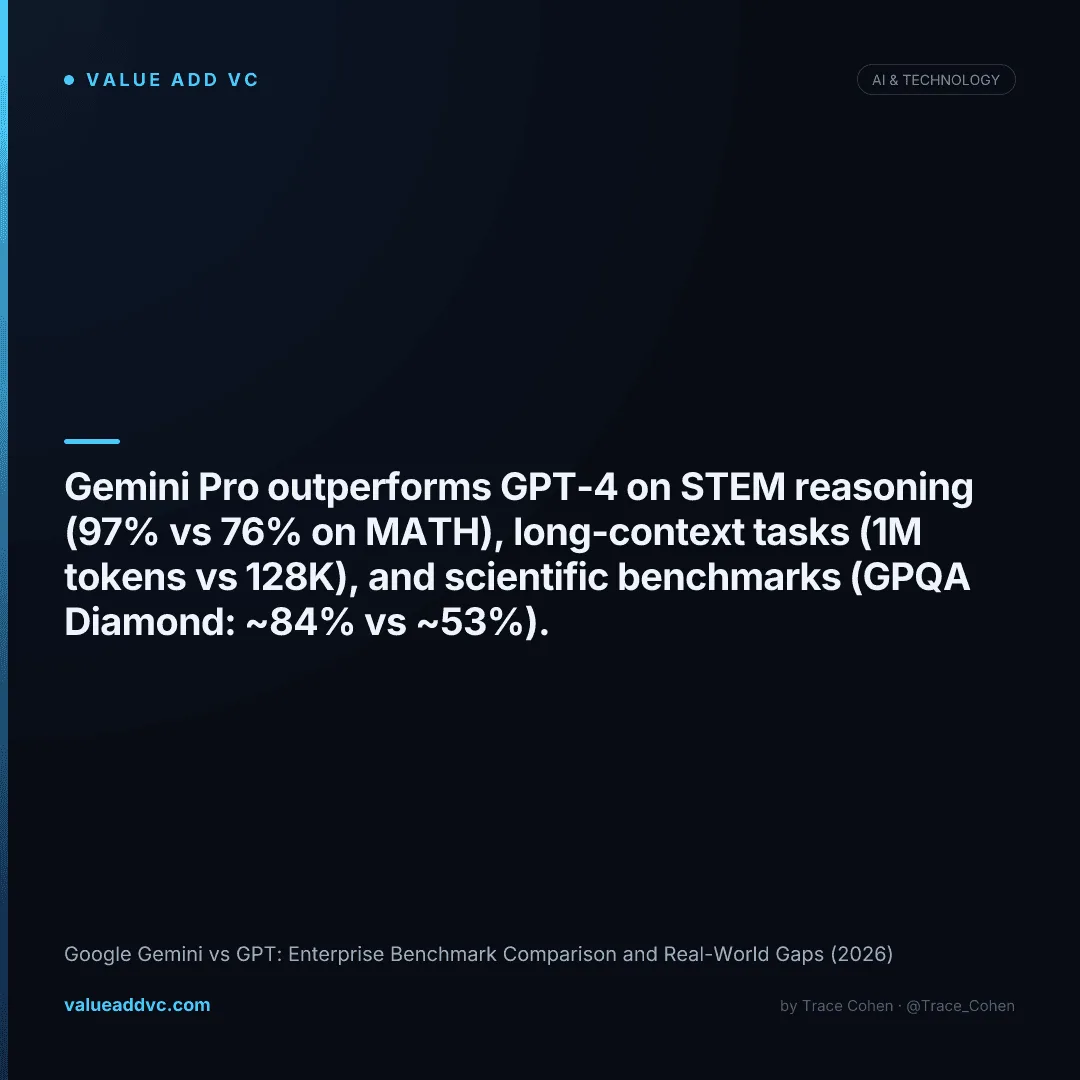
On raw reasoning benchmarks, Gemini Pro outperforms GPT-4 by a wide margin. On MATH, Gemini Pro scores ~97% versus GPT-4's ~76%. On GPQA Diamond (PhD-level science questions), the gap is even more pronounced: ~84% versus ~53%. These are not marginal differences — they represent a meaningful step up in scientific and technical reasoning capability.
But GPT-4 is not simply an older, worse model. It leads on real-time multimodal (live audio and video input), coding output quality (HumanEval ~90% vs ~84%), and the depth of ecosystem integration across OpenAI's platform. For enterprises choosing between the two, the right answer depends almost entirely on the use case.
Head-to-Head Benchmark Comparison
These are the most relevant benchmarks for enterprise buyers evaluating Gemini Pro vs GPT-4:
| Benchmark | Gemini Pro | GPT-4 | What It Measures |
|---|---|---|---|
| MATH | ~97% | ~76% | Advanced math problem solving |
| GPQA Diamond | ~84% | ~53% | PhD-level science (biology, chemistry, physics) |
| MMLU | ~90% | ~88% | General knowledge across 57 domains |
| HumanEval | ~84% | ~90% | Python coding problem completion |
| Context Window | 1M tokens | 128K tokens | Maximum input length per prompt |
| Real-Time Audio | Limited | Native | Live voice conversation capability |
| Input Pricing | $1.25–2.50/M | $2.50/M | Cost per million input tokens |
Sources: Google DeepMind, OpenAI technical reports. Scores represent best published results as of Q2 2026.
The Context Window Gap Changes the Architecture
The most consequential difference between Gemini Pro and GPT-4 for enterprise buyers is not a benchmark score — it is the 1 million token context window versus 128K. This is not a minor upgrade. One million tokens is approximately:
For GPT-4's 128K window, you need to chunk documents, build retrieval-augmented generation (RAG) pipelines, and manage context carefully. Gemini Pro lets you feed entire datasets in a single call. This architectural simplification reduces engineering overhead and eliminates chunking errors — a real operational advantage for legal, financial, and research workflows.
Where GPT-4 Still Wins
Despite Gemini's benchmark edge, GPT-4 retains real advantages in three areas:
The Thinking Mode Advantage
Gemini Pro includes an extended thinking mode — a chain-of-thought reasoning capability that enables the model to work through multi-step problems before delivering an answer. This is what drives its outsized performance on MATH and GPQA Diamond. For standard GPT-4 (non-o1/o3 reasoning variants), that internal reasoning step does not exist.
This matters for enterprise use cases involving complex financial modeling, scientific literature synthesis, legal analysis, and multi-hop reasoning across large documents. When accuracy on hard reasoning problems is the priority — not latency — Gemini Pro with thinking mode enabled is a material upgrade over GPT-4.
The trade-off: thinking mode adds latency. For real-time applications where response speed matters more than reasoning depth, GPT-4's faster inference often wins. Track how the AI model landscape is evolving on the AI Valuations dashboard at Value Add VC.
Which Model to Use: The Decision Framework
Use Gemini Pro when:
- ✓ You need to process full documents (>128K tokens)
- ✓ STEM, scientific, or complex math reasoning is required
- ✓ Long-context Q&A over codebases, reports, or contracts
- ✓ Cost efficiency on long-context workloads matters
- ✓ You want thinking mode for high-accuracy outputs
- ✓ Google Cloud / Vertex AI is your infrastructure stack
Use GPT-4 when:
- ✓ Real-time audio or video interaction is required
- ✓ Production code generation is the primary use case
- ✓ Azure OpenAI procurement path is already in place
- ✓ You need the broadest third-party integrations
- ✓ Latency matters more than reasoning depth
- ✓ Customer-facing voice or multimodal interfaces
Most enterprise AI buyer debates are about model identity, not model fit.
If you are doing long-document analysis or STEM reasoning, Gemini Pro is no longer a secondary choice — it is the default.
Track AI model valuations, frontier lab funding rounds, and enterprise AI adoption on the AI Valuations dashboard at Value Add VC. Originally published in the Trace Cohen newsletter.
Latest from the Pulse
Get VC data most people never see
— 100% free
Weekly benchmarks, valuations, and fund data. Join 5,000+ investors. No spam.