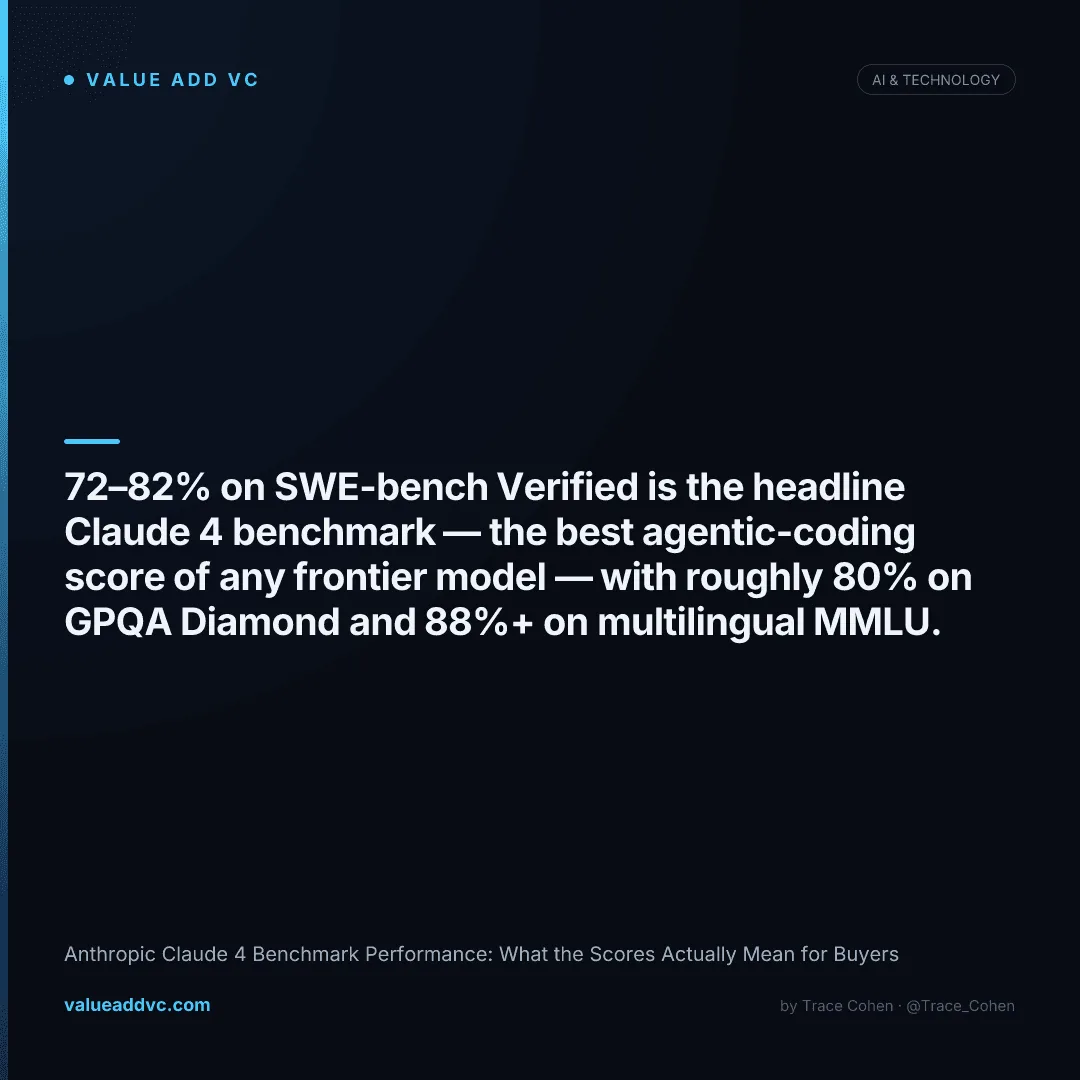
Claude 4 posts the best agentic-coding benchmark in the industry — 72% to 82% on SWE-bench Verified — while clearing roughly 80% on GPQA Diamond and 88%+ on multilingual reasoning. What those scores actually predict about production performance is the harder question.
Benchmark tables are how AI labs sell models, and they're half measurement, half marketing. The numbers are real, but they're run under ideal conditions — best prompt, extended thinking, sometimes parallel sampling — and the figure that ends up on the launch slide is usually the top of a range. If you're a buyer deciding where to route a workload or which model to wrap in a product, the scores matter less than what they predict about your task. Here's the full Claude 4 benchmark picture, by model and by price, and how to read it without getting sold.
Anthropic Claude 4 Benchmarks: The Numbers That Actually Matter
The Anthropic Claude 4 benchmarks that matter most cluster around three families: agentic coding (SWE-bench Verified, Terminal-Bench), reasoning and science (GPQA Diamond, AIME, MMMU), and knowledge and language (MMLU, multilingual MMLU). Claude 4's defining result is SWE-bench Verified at 72–82%, the strongest agentic-coding score of any frontier model. On the reasoning and knowledge tests it runs within a few points of GPT-5 and Gemini 2.5 Pro rather than dominating them.
That distribution is the whole story. Claude 4 is not uniformly the "smartest" model on every leaderboard — it's the model that turns intelligence into working code and completed multi-step tasks more reliably than anything else. For most buyers, that's the benchmark that pays. Here is how the family scores across the headline evals.
| Benchmark | What it measures | Claude 4 (Opus / Sonnet) | Read on it |
|---|---|---|---|
| SWE-bench Verified | Fixing 500 real GitHub issues | ~72–82% | Best-in-class; the headline |
| Terminal-Bench | Agentic command-line tasks | ~43–50% | Leading, but still hard for all models |
| GPQA Diamond | Graduate-level science Q&A | ~79–83% | Frontier-level, ties GPT-5 |
| AIME (math) | Competition math problems | ~75–90% | Strong with extended thinking on |
| MMMU | Multimodal college-level reasoning | ~76–80% | Competitive, not category-leading |
| MMLU (multilingual) | Knowledge across 14+ languages | ~88–90% | Near the top of the field |
| Tau-bench (tool use) | Agentic tool / function calling | ~70–82% | Best-in-class for real agents |
Figures are 2025–2026 ranges blended from Anthropic's published model cards, Artificial Analysis, and independent SWE-bench leaderboards. Ranges span the Claude 4 family (Opus and Sonnet variants) and reflect differences in extended thinking and parallel test-time compute; the high end usually requires settings most production deployments do not run.
How the Claude 4 Benchmarks Compare to GPT-5 and Gemini
The honest summary of the Claude 4 benchmarks versus the rest of the frontier: the gaps are small and the leadership is category-specific. Claude 4 wins agentic coding and tool use. GPT-5 and Claude 4 trade the lead on raw reasoning and math. Gemini 2.5 Pro wins on context length and multimodal breadth and stays within a few points everywhere else. No model sweeps the board, and the spread between the top three on most evals is now under 5 percentage points.
| Capability | Claude 4 | GPT-5 | Gemini 2.5 Pro |
|---|---|---|---|
| Agentic coding (SWE-bench) | Leader (~72–82%) | ~70–75% | ~64–70% |
| Tool use / agents | Leader | Strong | Strong |
| Math (AIME) | Strong | Leader | Strong |
| Science (GPQA) | ~79–83% | ~80–85% | ~82–84% |
| Context window | 1M standard (Opus 4.8+) | ~256K–400K | 1M+ (leader) |
| Multimodal breadth | Good | Strong | Leader |
| Top-tier price (per M out) | $25 (Opus 4.8) | ~$10–60 | ~$10–15 |
Comparison blended from vendor model cards, Artificial Analysis, and the LMSYS/Chatbot Arena leaderboard as of mid-2026. Scores shift with each point release; treat category leadership as more durable than any single percentage. Pricing reflects list rates before caching or batch discounts.
The practical takeaway: if your workload is code, agents, or anything that chains tool calls, the Claude 4 benchmarks justify the choice. If it's long-document analysis at a million tokens, Gemini's context window may matter more than a few SWE-bench points. For the full context on what shipped with this generation and how it stacks up against GPT-5 model for model, see this rundown of the Claude 4 launch. The valuations behind these labs reflect exactly that race — you can see where Anthropic and its peers sit on the AI Valuations dashboard.
Claude 4 Benchmark Scores by Model and Price
The Claude 4 benchmark numbers only mean something next to their price. Anthropic ships a tiered family — Opus, Sonnet, Haiku — where each step up buys a few points of capability at a multiple of the cost. The SWE-bench gap between Sonnet and Opus is often smaller than the price gap, which is why most production traffic runs on Sonnet, not the flagship.
| Model tier | SWE-bench Verified | Input $/M | Output $/M | Best for |
|---|---|---|---|---|
| Claude Opus 4 (now Opus 4.8) | ~72–80% | ~$5 | ~$25 | Hardest reasoning & agent runs |
| Claude Sonnet 4 / 4.5 | ~73–82% | ~$3 | ~$15 | Production coding & agents |
| Claude Haiku 4.5 | ~55–65% | ~$1 | ~$5 | High-volume, latency-sensitive |
| + Prompt caching | — | up to −90% | — | Repeated-context workloads |
| + Batch API | — | −50% | −50% | Async, non-urgent jobs |
| Extended thinking | +3–8 pts | more tokens | more tokens | Buys accuracy, costs latency |
Pricing and scores are 2026 list-rate estimates from Anthropic's pricing page and published model cards; exact figures vary by point release and region. Caching and batch discounts are Anthropic-documented program rates. SWE-bench ranges reflect with/without extended thinking and parallel sampling. As of September 2026, Claude Opus 4.8 lists at $5 input / $25 output per million tokens — down from the original Claude Opus 4 launch price of $15/$75 — per Anthropic's current pricing page.
Notice the pattern that doesn't show up in a launch headline: the price step from Sonnet to Opus has compressed from roughly 5x at Claude 4's original launch to under 2x now that Opus has settled at 4.8's $5/$25 rate, while the benchmark gap between the two tiers stayed only a few points wide the whole time. For most teams, Sonnet plus prompt caching is the rational default, with Opus reserved for the genuinely hard runs. That cost curve — capability getting cheaper per token every quarter — is the same dynamic reshaping software margins across the sector, which I've dug into on the SaaS Valuations dashboard.
What the Claude 4 Benchmarks Don't Tell You
Here's the part the table can't capture. A benchmark is a fixed test with a known answer key; your workload isn't. Three things consistently break the link between a high Claude 4 benchmark score and real-world performance, and buyers who ignore them get burned.
One: contamination and overfitting. Frontier models are trained on enormous slices of the public internet, and popular benchmarks leak into training data. A 90% on a well-known eval partly measures how much of that eval the model has effectively memorized. SWE-bench Verified is harder to game because it requires working code against hidden tests, which is exactly why it's the most trusted number in the table.
Two: the settings asterisk. The high end of every range — the 82% rather than the 72% — usually requires extended thinking, longer time budgets, or parallel sampling that you may not run in production because it multiplies latency and cost. The launch number and the number you actually get can differ by 5–10 points purely on configuration.
Three: the things no benchmark scores. Latency, refusal behavior, instruction-following on messy real prompts, output formatting reliability, and how the model degrades on your weird edge cases — none of that shows up on a leaderboard, and all of it determines whether a deployment works. This is why Claude's reputation in agentic coding tools outruns its raw scores: it tends to follow instructions and stay on task in ways the percentages don't express.
How Buyers Should Actually Use the Claude 4 Benchmarks
My rule after watching a dozen teams pick models: use vendor benchmarks to build a shortlist, never to make the final call. The Claude 4 benchmarks reliably tell you it belongs on the shortlist for any coding, agent, or tool-use workload — that's the durable signal across multiple independent trackers. They do not tell you it's right for your specific task.
So do the cheap thing that 90% of buyers skip: assemble 50–100 real examples from your own workflow, run them through Sonnet and Opus and one competitor, and score the outputs on the dimensions you care about — correctness, latency, format reliability, cost per task. That eval costs a few hundred dollars in tokens and a day of work, and it's worth more than every public leaderboard combined. The frontier models are close enough now that the right answer is almost always workload-specific.
And watch the trajectory, not just the snapshot. Anthropic ships point releases every few months, each nudging the benchmarks up and the effective price down. The Claude 4 score you see today is a floor, not a ceiling — which is exactly why the economics of building on these models keep improving even when the headline number barely moves.
Benchmarks build the shortlist. Your own eval makes the call.
Claude 4 leads agentic coding at 72–82% SWE-bench Verified and runs within 5 points of GPT-5 and Gemini everywhere else — but the only score that decides your deployment is the one you run on your own data.
Track AI model economics, frontier-lab valuations, and the companies building on them on the AI Valuations dashboard and the Unicorns tracker at Value Add VC. Originally published in the Trace Cohen newsletter.
Latest from the Pulse
Get VC data most people never see
— free to subscribe
Trace's notes on venture, AI and startups, a few times a week. Join 5,000+ subscribers. No spam.