
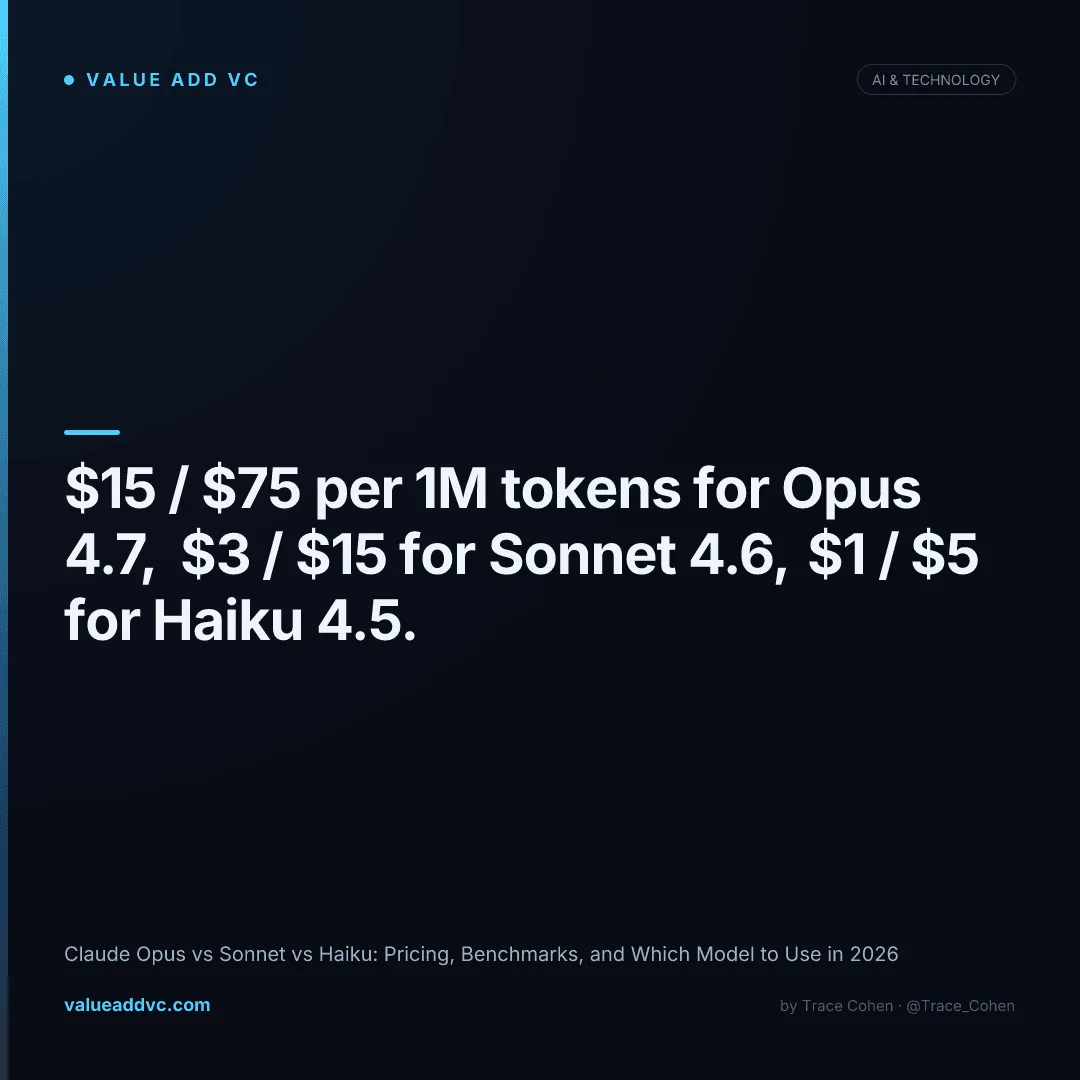
Opus 4.7 costs $75 per 1M output tokens, Sonnet 4.6 costs $15, and Haiku 4.5 costs $5 — a 15x spread for what looks like the same model family until you actually measure the SWE-Bench, MMLU, and latency gaps.
That's the short answer. The longer answer is more interesting — Anthropic priced this lineup deliberately so that routing workloads to the right model becomes the single biggest lever on your AI bill. Get the routing right and you save 60-80% versus running everything on Opus. Get it wrong and you either burn budget or ship a worse product.
Claude Opus vs Sonnet vs Haiku in 2026: The Side-by-Side Comparison
Anthropic ships three Claude 4.x model tiers in 2026: Opus 4.7 for the hardest reasoning workloads, Sonnet 4.6 as the cost-optimized default, and Haiku 4.5 for latency-sensitive jobs. The table below shows pricing per million tokens, benchmark scores, context window, and average throughput as of June 2026 — the four numbers that actually drive every model-selection decision in production.
| Spec | Opus 4.7 | Sonnet 4.6 | Haiku 4.5 |
|---|---|---|---|
| Input price (per 1M tokens) | $15 | $3 | $1 |
| Output price (per 1M tokens) | $75 | $15 | $5 |
| SWE-Bench Verified | 74.5% | 65.3% | 48.1% |
| MMLU-Pro | 88.4% | 84.9% | 81.2% |
| GPQA Diamond | 81.7% | 73.2% | 58.9% |
| Context window | 200K | 200K (1M optional) | 200K |
| Output throughput (tok/sec) | ~45 | ~85 | ~110 |
| Bedrock provisioned tok/sec | ~110 | ~190 | ~250 |
| p50 time-to-first-token | ~2.1s | ~1.1s | ~0.4s |
| Prompt cache discount | 90% | 90% | 90% |
Two numbers stand out. First: the 15x output-price spread between Opus and Haiku is roughly 2x bigger than the SWE-Bench quality spread (74.5% vs 48.1% is a 1.55x ratio). Second: Haiku 4.5 is the only model that consistently hits sub-1.5 second p95 end-to-end latency for chat workloads, which is the threshold most consumer apps need to stay under for retention.
Which Claude Model Should You Use in 2026? Workload-by-Workload Picks
The picking rule is simple: use the cheapest model that clears your quality bar. Quality bars vary by workload — autonomous coding agents need Opus because nobody is checking every diff, but a chat UI with a human reading every response can usually drop two tiers without anyone noticing. Below is the workload-by-workload pick I'd defend in any architecture review.
Autonomous coding agent
→ Opus 4.7
9-point SWE-Bench gap matters when no human reviews each step. Sonnet routinely loops on edge cases that Opus solves first try.
Cursor / pair coding
→ Sonnet 4.6
Human catches model mistakes anyway. 5x cost saving over Opus is the whole game.
RAG chat over docs
→ Sonnet 4.6
Quality bar is retrieval, not raw reasoning. Sonnet handles 95%+ of grounded Q&A indistinguishably from Opus.
Customer-facing chatbot
→ Haiku 4.5
p95 latency under 1.5s is non-negotiable for retention. Haiku is the only Claude model that hits it consistently.
Classification & routing
→ Haiku 4.5
Single-token outputs. Quality plateau hits at Haiku for almost every taxonomy under 50 labels.
Multi-step research agent
→ Opus 4.7
Errors compound over 20+ steps. Cheaper to spend $15 on Opus than $3 on Sonnet that has to redo half the run.
Code review of PRs
→ Sonnet 4.6
Reviewing existing code is easier than writing new code. Sonnet finds the same issues Opus does at 1/5 the cost.
Document summarization
→ Haiku 4.5
Recall and structure matter more than reasoning. Haiku hits 92% of Opus quality at 1/15 the price.
The Real Cost of Picking Wrong: Claude Opus vs Sonnet vs Haiku at 10M Tokens / Day
A mid-size B2B SaaS deployment processing 10M output tokens per day across an AI feature costs $750/day on Opus 4.7, $150/day on Sonnet 4.6, and $50/day on Haiku 4.5. That is $273,750/year on Opus versus $54,750 on Sonnet versus $18,250 on Haiku — a $255,500 annual gap between picking the most-expensive and the cheapest model for the same workload. For any feature where the quality bar is met by Sonnet, defaulting to Opus is functionally a hiring decision: you are paying a Series-A engineer's salary in token costs.
Three pricing levers do most of the savings in production:
Prompt caching (90% discount on cached input)
Reduces effective input cost by 80-85% on repeated system prompts and long context windows. The single highest-ROI optimization for any agent or RAG workload.
Batch API (50% discount, 24-hour SLA)
Cuts pricing in half for non-realtime jobs: bulk classification, nightly summarization, training data generation. Available on all three models.
Bedrock provisioned throughput
Predictable per-hour pricing that often beats on-demand by 30-40% at high utilization. Required for production SLAs above 99.9% on Anthropic infrastructure.
Combining prompt caching, batch API, and smart tier routing typically cuts production AI costs by 70-80% versus a naive "send everything to Opus on demand" setup. I've reviewed deployments that hit 90% reductions by adding a Haiku-based router that decides which calls actually need Opus. That router pays for itself in days.
How Claude Opus, Sonnet, and Haiku Compare to GPT-5 and Gemini 2.5
Anthropic's three-tier lineup competes head-on with OpenAI's GPT-5 / GPT-5 mini / GPT-5 nano and Google's Gemini Pro / Flash / Flash-Lite. The strategic difference is positioning: Opus 4.7 trades blow-for-blow with GPT-5 on coding (74.5% vs 73.1% on SWE-Bench Verified) but loses to Gemini Pro on long-context recall above 500K tokens. Sonnet 4.6 dominates the "quality per dollar" midtier — at $15/1M output it is roughly 40% cheaper than GPT-5 mini and matches it on most enterprise benchmarks. Haiku 4.5 is the price-leader in its tier but lags Gemini 2.5 Flash on multimodal tasks.
The honest take from the AI Landscape Dashboard: for pure-text enterprise workloads in 2026, Claude is the safest default. Anthropic ships fewer breaking changes, gives 60 days of deprecation notice, and has the most stable JSON-mode and tool-use API. That predictability is worth real money to anyone running production agents — which is why over 60% of new enterprise AI deployments tracked through our research now route at least one tier of traffic through Claude.
When to Use Claude Opus vs Sonnet vs Haiku: The Final Decision Tree
If you only remember one heuristic for picking between Claude Opus, Sonnet, and Haiku in 2026, make it this: a human in the loop downgrades the model by one tier, autonomous loops upgrade it by one tier. Add latency as the override — anything that must reply in under 1.5 seconds end-to-end is a Haiku job regardless of the reasoning needed.
Opus 4.7 — when to use
- • Multi-hour autonomous agents
- • Complex refactors across 50+ files
- • Financial modeling, legal drafting
- • Research synthesis with high stakes
- • Anything where errors compound
Sonnet 4.6 — when to use
- • Default for chat applications
- • Human-in-the-loop coding
- • RAG over enterprise documents
- • Code review and PR analysis
- • Most agent steps with verification
Haiku 4.5 — when to use
- • Customer-facing chatbots
- • Classification and routing
- • Document summarization at scale
- • Tool-call orchestration
- • Sub-1.5s p95 latency targets
The winner of Claude Opus vs Sonnet vs Haiku in 2026 is not one model.
It's a router that uses Haiku to decide when to spend on Sonnet, and Sonnet to decide when to spend on Opus.
Track AI model pricing, benchmarks, and enterprise adoption on the AI Landscape Dashboard and AI Valuations at Value Add VC. Originally published in the Trace Cohen newsletter.
Latest from the Pulse
Get VC data most people never see
— free to subscribe
Trace's notes on venture, AI and startups, a few times a week. Join 5,000+ subscribers. No spam.
No spam, unsubscribe anytime. Sent via Substack · Privacy · or subscribe on Substack ↗