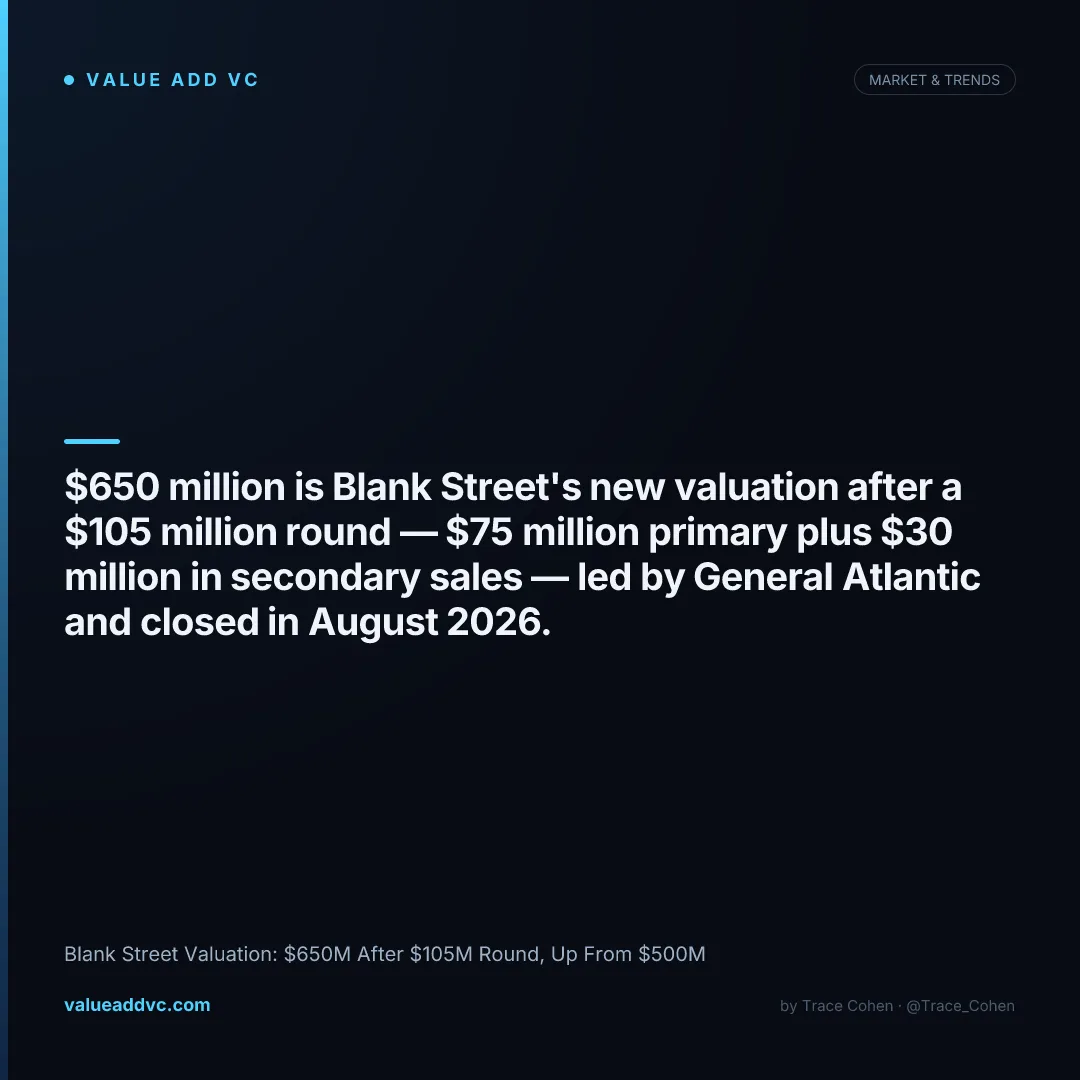
Blank Street raised $105 million in late August 2026 — $75 million primary plus $30 million in secondary sales — led by General Atlantic at a $650 million valuation, up roughly 30% from about $500 million a year earlier.
Existing investors Left Lane Capital, General Catalyst, and Tiger Global also participated in the round alongside General Atlantic. The coffee and matcha chain plans to use the money to push into affluent Los Angeles neighborhoods and open its first Philadelphia store, expanding a footprint built on a store format roughly a quarter the size of a typical café.
Blank Street Valuation 2026: Inside the $105 Million Round
Blank Street's $650 million valuation comes from a $105 million round led by General Atlantic, with Left Lane Capital, General Catalyst, and Tiger Global — all existing investors — also participating. Of that total, $75 million is primary capital going onto Blank Street's balance sheet, while $30 million is secondary: existing shareholders, likely early employees or seed-stage investors, selling shares rather than the company raising new funds. That split matters, because it means the headline $105 million overstates how much fresh growth capital Blank Street is actually deploying.
From a Brooklyn Coffee Cart to a $650 Million Chain
Blank Street was founded in 2020 in Williamsburg, Brooklyn, by Vinay Menda, Issam Freiha, and Ignacio Llado, and has since expanded to about 106 locations across New York, Boston, Washington D.C., Los Angeles, and six UK cities — London, Bristol, Birmingham, Manchester, Edinburgh, and Glasgow. The company has now raised approximately $214 million in primary funding across its history, including this round, according to figures reported alongside the raise.
| Milestone | Detail |
|---|---|
| Founded | 2020, Williamsburg, Brooklyn |
| Valuation, 2025 | ~$500M |
| Round size, Aug 2026 | $105M ($75M primary + $30M secondary) |
| Valuation, Aug 2026 | ~$650M |
| Lead investor | General Atlantic |
| Participating investors | Left Lane Capital, General Catalyst, Tiger Global |
Sources: Axios and Daily Coffee News on the round terms and expansion plans. Figures current as of September 3, 2026.
The 500-Square-Foot Bet: Why Blank Street's Unit Economics Are the Real Story
A typical Blank Street location occupies about 500 square feet, roughly a quarter the footprint of a full-size Starbucks café, and runs on one or two employees supported by Eversys automated espresso machines capable of producing 90 cups per hour. Monthly rent on a New York Blank Street location runs around $3,500, against $10,000 to $15,000 for a conventional independent café on the same block — a cost structure built specifically to make small, high-density urban footprints profitable at a fraction of the capital a full-format café requires.
That format is also the logic behind the new markets. Beverly Hills, West Hollywood, and Malibu are all dense, high-foot-traffic, high-rent neighborhoods where a 500-square-foot box with low staffing costs can plausibly work even against premium local rents — the same playbook Blank Street has already run in Manhattan and central London. The company is also opening its first Philadelphia location, adding a ninth US or UK metro to its map.
Blank Street vs. Dutch Bros vs. Starbucks: Small Box, Small Multiple
Blank Street's $650 million valuation is a rounding error next to the two publicly traded coffee chains it's implicitly compared to — but its store format is also a fraction of their size, which is the entire point of the model.
| Metric | Blank Street | Dutch Bros | Starbucks |
|---|---|---|---|
| Status | Private (Series C) | Public (NYSE: BROS) | Public (Nasdaq: SBUX) |
| Valuation / market cap | ~$650M | ~$9.8B–$12B | ~$121B |
| Founded | 2020 | 1992 | 1971 |
| Store count | ~106 | 1,136 | ~38,600 worldwide |
| Avg. store size | ~500 sq ft | ~900 sq ft | ~2,000 sq ft |
| New stores planned, 2026 | LA + Philadelphia (undisclosed count) | ~181 | Not disclosed by market |
Sources: Dutch Bros and Starbucks market cap data, August–September 2026; Dutch Bros 2025 store count and 2026 expansion plans per Chain Store Age and ABC15; Starbucks worldwide store count per company reporting, June 2026. Blank Street figures per Axios and Daily Coffee News.
Store Footprint: Blank Street vs. Dutch Bros vs. Starbucks
Company and press reporting on store size and count, 2026.
Blank Street's box is a quarter the size of Starbucks and roughly half of Dutch Bros — the entire model depends on that gap holding up as it enters pricier West Coast real estate.
What the headline misses
Nearly a third of this round — $30 million of $105 million — is secondary, meaning it funds existing shareholders exiting, not new stores. Only $75 million is actually available to open new locations, hire staff, and absorb the higher real estate costs of Beverly Hills, West Hollywood, and Malibu, markets where even a 500-square-foot box faces materially higher rent than the New York and UK cities where the format was proven out. A 30% valuation increase in a year is real growth, but it's also modest compared to the multiples some venture-backed consumer brands commanded during the 2021 funding peak — a sign investors are pricing Blank Street more like a scaling retail operator than a hypergrowth startup.
The bigger open question is whether the low-staff, automated-machine model that works in dense Manhattan and London blocks translates to Los Angeles, a market built around driving rather than walking past a storefront. Dutch Bros built its entire chain around a drive-thru-first format suited to car-dependent markets; Blank Street's walk-up box has no comparable track record west of Boston. Nothing in the company's own statements addresses that format mismatch directly.
The Bottom Line
Blank Street closes its latest round at a $650 million valuation, up roughly 30% in a year, with a proven 500-square-foot store format now headed toward Los Angeles and Philadelphia. What it doesn't have yet is any operating history in a car-dependent West Coast market, and nearly a third of its new capital went to existing shareholders rather than the business itself. The next number worth watching isn't the valuation — it's same-store sales once the first Beverly Hills and West Hollywood locations open and the format meets a market it hasn't tested before.
Track private company valuations on the Unicorn Tracker and see more consumer and AI valuation breakdowns at Value Add VC.
Latest from the Pulse
Get VC data most people never see
— free to subscribe
Trace's notes on venture, AI and startups, a few times a week. Join 5,000+ subscribers. No spam.
No spam, unsubscribe anytime. Sent via Substack · Privacy · or subscribe on Substack ↗