
67% of SaaS companies above $10M ARR now run a hybrid PLG-plus-sales-led model in 2026, not pure product-led growth — and hybrid companies hit their NRR targets 67% of the time versus 58% for PLG-only teams. That's the short answer. The longer answer is more interesting.
I've sat on both sides of this: as an operator building self-serve funnels and as an investor watching portfolio companies decide whether to hire their first AE at $500K ARR or $5M ARR. The PLG-versus-sales-led debate that dominated SaaS strategy decks from 2018 to 2023 is mostly over in 2026, and neither side won outright. What won was the hybrid model — and the companies still pretending it's a binary choice are the ones leaving growth on the table.
Product-Led Growth in 2026: Which Companies Are Still Using It and What Results Look Like
Product-led growth in 2026 still works, but almost no company at scale runs it in pure form anymore. Roughly 67% of SaaS companies above $10M ARR combine a self-serve PLG funnel with a sales team for enterprise expansion, and those hybrid companies grow faster and hit revenue-retention targets more reliably than either pure-PLG or pure-sales-led peers. The companies still cited as PLG wins — Figma, Notion, Calendly, HubSpot — all now run this hybrid version, not the pure free-to-paid self-serve model that defined PLG a few years ago.
The Numbers Behind Product-Led Growth Results in 2026
The headline PLG metrics have moved meaningfully since the 2021-2023 zero-rate era. Freemium products convert visitors to signups at a 6% median rate, while free-trial products convert 3-4% of visitors to a trial start. Once someone is in the funnel, free-trial products convert 17% of signups to paid, versus 5% for freemium — a gap that explains why more companies have shifted toward trial-first onboarding instead of open-ended free tiers. Opt-out trials that require a credit card upfront convert at 48.8%, nearly triple the 18.2% rate of opt-in trials with no card required, which is the single biggest lever most PLG teams still underuse.
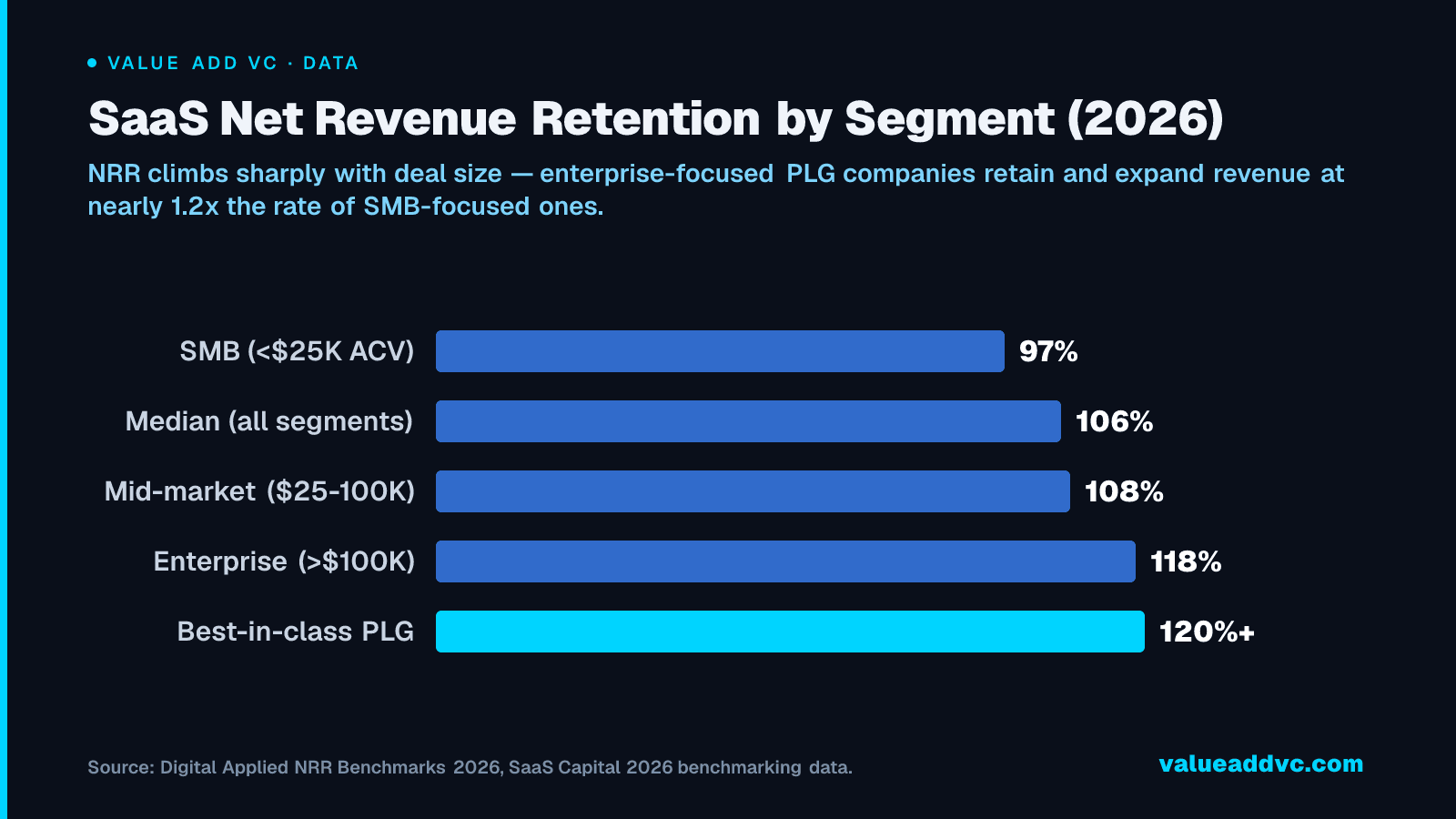
Activation — the point where a new user actually experiences the product's core value — has become the metric investors and operators watch most closely. A good activation rate in 2026 is 20-40%, and an excellent one is above 50%, both meaningfully higher bars than a few years ago as companies get better at AI-assisted onboarding that shortens time-to-value. Net revenue retention (NRR) is the other number that matters: the median venture-backed SaaS company sits at 106% NRR, enterprise-focused segments (over $100K ACV) run closer to 118%, mid-market ($25K-$100K ACV) sits around 108%, and SMB-focused segments (under $25K ACV) average 97% — meaning the smallest accounts are actually shrinking net of churn.
SaaS Net Revenue Retention by Segment (2026)
NRR climbs sharply with deal size — enterprise-focused PLG companies retain and expand revenue at nearly 1.2x the rate of SMB-focused ones.
Digital Applied NRR Benchmarks 2026, SaaS Capital 2026 benchmarking data.
Data
| Item | Value |
|---|---|
| SMB (<$25K ACV) | 97% |
| Median (all segments) | 106% |
| Mid-market ($25-100K) | 108% |
| Enterprise (>$100K) | 118% |
| Best-in-class PLG | 120%+ |
Figma, Notion, and Calendly: What Product-Led Growth Results Actually Look Like
Figma is still the clearest large-scale proof that product-led growth works when the monetization model matches the usage pattern. Figma went public on July 31, 2025 at $33 per share, valuing the company at $19.3B, and posted $1.056B in full-year revenue — up 41% year-over-year — with 132% net dollar retention. The critical detail most people miss: once Figma crossed $1B in ARR, the majority of that revenue came from team and enterprise plans, not individual free-to-paid upgrades. The free tier is the acquisition engine; team-based pricing is the monetization engine. That's a hybrid model wearing a PLG label.
Notion reached roughly $500M ARR on a valuation north of $10B by combining community-led growth (templates, creators, YouTube tutorials built by users, not Notion's marketing team) with product-led self-serve signup. Calendly is the leaner proof point: it hit $100M ARR with fewer than 250 employees, almost entirely through its viral scheduling-link loop — every meeting booked exposes the product to a new potential user with zero sales cost. That kind of capital efficiency is exactly why PLG economics still attract investors even as the pure-PLG label fades: fewer than 250 employees to $100M ARR would be a remarkable ratio under any go-to-market model.
PLG Proof Points: Figma vs Notion vs Calendly (2026)
Company S-1 filings, public statements, and 2026 press reporting.
Data
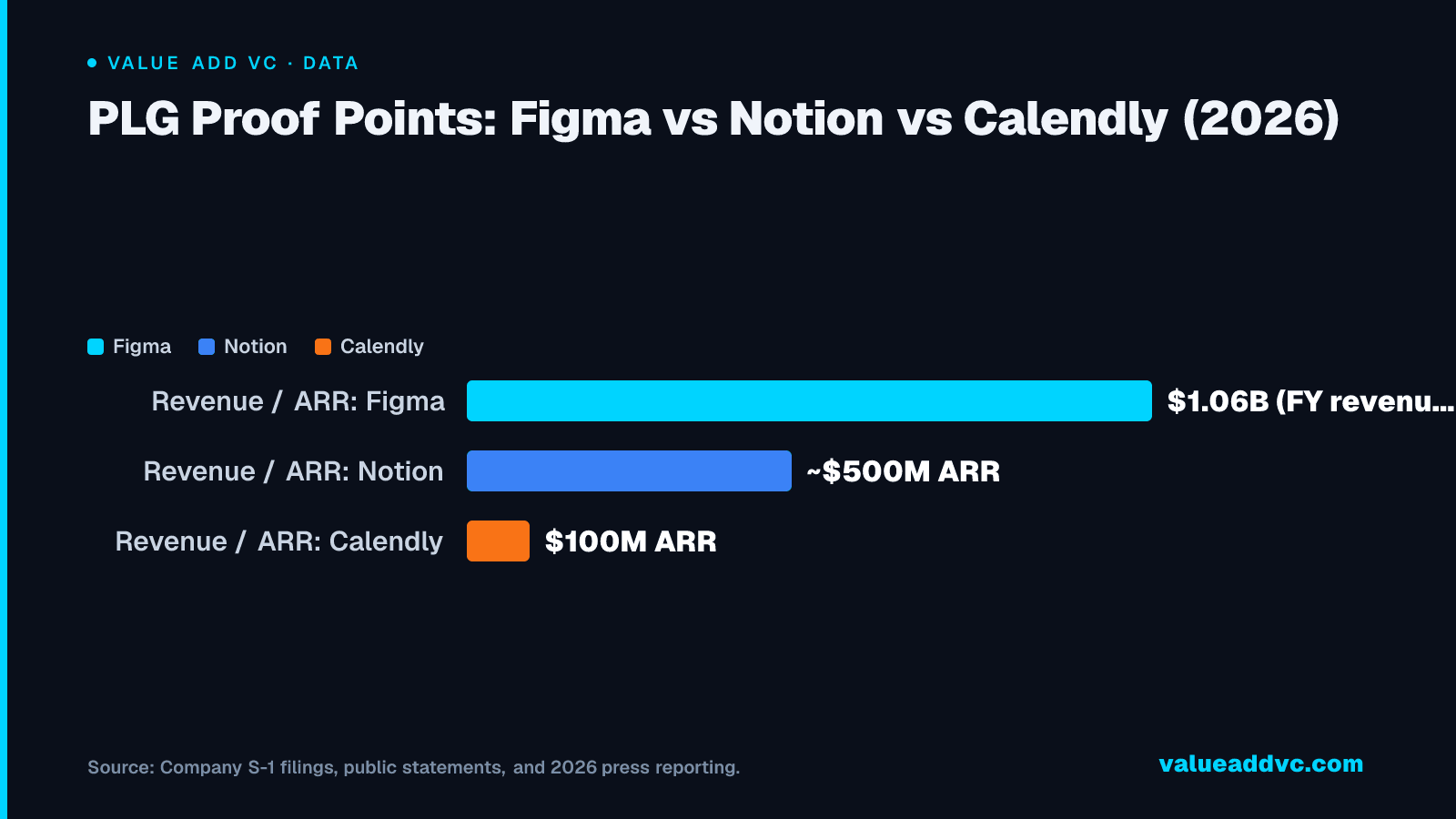
Figures are 2025-2026 reported figures blended from company S-1 disclosures, public statements, and 2026 press reporting (SaaS Mag, company investor materials). Figma's figure is trailing full-year revenue; Notion and Calendly figures are most-recently reported ARR.
Why Hybrid PLG+SLG Is Winning the Product-Led Growth Debate in 2026
The data on hybrid versus pure models is not close. Hybrid PLG-plus-sales-led companies hit their NRR targets 67% of the time, versus 58% for pure-PLG companies, and hybrid companies are twice as likely to post 100%+ year-over-year revenue growth compared to sales-led-only companies. The pattern that keeps showing up across HubSpot, DocuSign, Atlassian, Notion, and Figma is the same: product drives acquisition and initial qualification for SMB and mid-market users through a free trial or freemium plan, and a sales team handles high-ACV enterprise deals, complex multi-stakeholder purchases, and expansion once an account crosses a usage or seat threshold.
Pure sales-led growth hasn't disappeared — it's still the right model for genuinely complex, six-figure-ACV enterprise sales with multi-month implementation cycles, like security platforms or core infrastructure software where a single wrong deployment decision carries real risk. But that's now the smallest, slowest-growing slice of B2B SaaS, not the default. For founders deciding on a go-to-market motion, the more useful frame in 2026 isn't "PLG or sales-led" — it's "which accounts self-serve to value, and at what point does a human need to step in to close or expand the deal."
| Metric | Pure PLG | Hybrid PLG+SLG | Pure sales-led |
|---|---|---|---|
| Companies above $10M ARR using this model | ~15-20% | ~67% | ~15-18% |
| NRR target hit rate | 58% | 67% | ~55-60% |
| Likelihood of 100%+ YoY growth | Baseline | 2x sales-led-only | Baseline (lowest) |
| Typical CAC efficiency | Highest (self-serve) | Blended, still efficient | Lowest |
| Best fit | Low-ACV, high-volume SMB | Mid-market + enterprise expansion | 6-figure ACV, complex deployment |
| Example companies (2026) | Calendly, early-stage dev tools | Figma, Notion, HubSpot, Atlassian | Enterprise security, core infra |
| Typical activation benchmark | 20-40% (good) | 20-50%+ | N/A (sales-qualified) |
| Free trial → paid conversion | 5-17% | 10-20%+ (with sales assist on high-intent accounts) | N/A |
Figures are 2026 estimates blended from Shno.co PLG statistics, Userpilot, and Digital Applied benchmark reports. Company-model classifications reflect publicly described go-to-market motions as of 2026 and may include a sales-assisted layer not visible in headline messaging.
What This Means for Founders Building a PLG Motion in 2026
If you're a founder deciding on go-to-market strategy today, the data points to a specific sequence rather than a single choice. Start product-led if your ACV is low enough that self-serve signup and a 3-4% trial conversion rate (or 6% freemium signup rate) can carry the business past $1M-$5M ARR — Calendly's sub-250-employee path to $100M ARR is the proof this still works. Layer in a sales team once accounts cross a seat or usage threshold that signals real budget, rather than hiring AEs prematurely against a product that hasn't proven it can activate users on its own. That's the exact sequencing Figma and Notion both followed on the way to $500M-plus ARR.
The credit-card-upfront data point is worth calling out separately because it's the single easiest lever most early-stage teams still get wrong: requiring a card for a trial converts at 48.8% versus 18.2% for no-card trials. That's not a minor optimization — it's a 2.7x difference in the number of trial users who become paying customers, and it costs nothing to test. The question worth asking before almost any other PLG tactic: are you actually gating the trial in a way that filters for intent, or are you optimizing for vanity signup volume that never converts?
The other underrated shift in 2026 is where AI sits in the funnel. Activation benchmarks jumping to a 20-40% "good" range and 50%+ "excellent" range isn't happening by accident — AI-assisted onboarding (in-product copilots, auto-generated templates, usage-based nudges) is compressing the time between signup and first real value for a meaningfully larger share of users than manual onboarding flows ever did. That matters for the PLG-versus-hybrid decision because a higher activation rate directly raises the ceiling on how much revenue a self-serve motion can carry before a company needs to add sales headcount. Founders who treat AI onboarding as a nice-to-have rather than a core lever are leaving activation-rate gains, and therefore NRR gains, on the table.
For founders thinking about how retention and expansion metrics translate into valuation multiples down the line, see our breakdown of why net revenue retention drives SaaS multiples , and for a benchmarking view across the fundraising stack, our SaaS benchmarking dashboard tracks these metrics by ARR band in real time.
The Bottom Line
Product-led growth in 2026 is real, but it's rarely pure anymore — 67% of SaaS companies above $10M ARR blend it with a sales team, and that hybrid group out-executes both pure PLG and pure sales-led peers on NRR and growth rate. Figma's $1.06B revenue and 132% NDR, Notion's $500M ARR, and Calendly's $100M-ARR-on-250-employees are still the best evidence that self-serve product experience compounds — but every one of them now layers sales-assisted expansion on top rather than relying on the free tier alone. The strategic question for 2026 isn't PLG versus sales-led. It's knowing exactly which accounts should never talk to a human, and which ones are wasting your growth rate by not talking to one sooner.
Latest from the Pulse
Get VC data most people never see
— free to subscribe
Trace's notes on venture, AI and startups, a few times a week. Join 5,000+ subscribers. No spam.
No spam, unsubscribe anytime. Sent via Substack · Privacy · or subscribe on Substack ↗