SaaS companies lose an average of 5-7% of revenue annually to churn. For a startup at $5M ARR, that is $250,000-$350,000 walking out the door every year. Customer success platforms exist to stop that bleeding, but choosing the wrong one can waste months of implementation time and six figures in annual licensing fees.
We analyzed the 6 leading customer success platforms by features, pricing, total funding raised, and ideal customer profile. Whether you are a Series A startup looking for your first CS tool or a scaling company replacing spreadsheet workflows, this guide breaks down which platform fits your stage, budget, and go-to-market model.
What Are the Best Customer Success Platforms for Startups in 2026?
Customer success has evolved from a reactive support function into a strategic revenue driver. The best CS platforms now combine health scoring, automated playbooks, in-app communications, and revenue analytics into a single system of record for post-sale customer relationships.
The market has consolidated significantly. Totango merged with Catalyst in 2024, Vista Equity took Gainsight private, and newer entrants like Vitally have captured the modern B2B SaaS segment with faster time-to-value. Here are the 6 platforms that matter most for startups and scaling SaaS companies.
The 6 Best Customer Success Platforms, Ranked
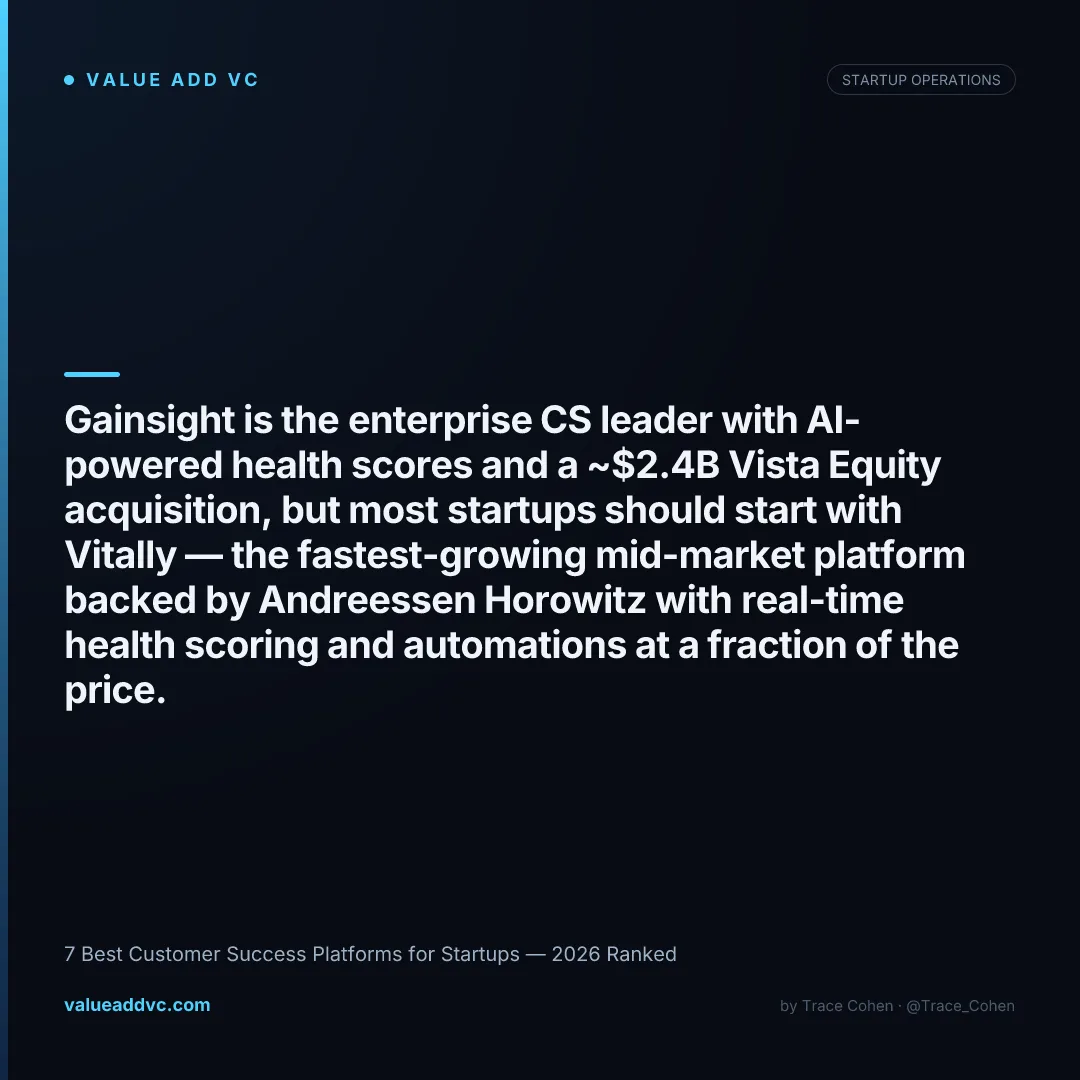
Gainsight is the undisputed market leader in customer success, serving 1,500+ enterprise clients including many of the largest SaaS companies in the world. Backed by $350M+ in funding from Vista Equity Partners and Insight Partners, Gainsight offers the most comprehensive CS suite available: health scores, playbooks, journey orchestration, product analytics (via Gainsight PX), and community management.
The tradeoff is complexity. Gainsight implementations typically take 3-6 months, require dedicated admin resources, and the pricing reflects its enterprise positioning. For startups below $10M ARR, it is often overkill. But for mid-market and enterprise SaaS companies with dedicated CS teams, nothing matches its depth.
Vitally has quickly become the go-to CS platform for modern B2B SaaS startups. Backed by $30M+ from Andreessen Horowitz, Vitally differentiates with real-time health scores, powerful automations, built-in project management, and 360-degree customer views that actually update in real time rather than on batch syncs.
What makes Vitally stand out for startups is time-to-value. Most teams are fully operational within 2-4 weeks compared to months for enterprise platforms. The interface is clean and modern, the automation builder is intuitive, and the pricing scales reasonably from small CS teams to larger organizations.
ChurnZero does exactly what the name promises: it is laser-focused on reducing churn. The platform combines real-time customer health monitoring with in-app communications, automated playbooks, and granular segmentation to help CS teams intervene before customers leave.
With approximately $30M in total funding, ChurnZero has built a particularly strong position with SaaS companies running hybrid self-serve and sales-assisted models. Its in-app engagement features — walkthroughs, surveys, and announcements — let CS teams reach users directly inside the product without relying on email alone.
Planhat is a Stockholm-based CS platform that has carved out a strong niche with European SaaS companies and teams that need highly customizable workflows. Backed by approximately $50M from Insight Partners, Planhat combines revenue management, health scores, and custom dashboards into a flexible platform that adapts to how your team actually works.
The platform excels at revenue analytics and renewal forecasting, making it a favorite among CS leaders who report into the CRO or CFO. Its data model is exceptionally flexible, which is both a strength (you can model any customer relationship) and a risk (it requires thoughtful configuration to avoid complexity creep).
Catalyst took a different approach to customer success by building a platform that feels like a CRM rather than a specialized CS tool. Backed by approximately $45M from Accel and True Ventures, Catalyst designed its interface to be immediately familiar to anyone who has used Salesforce or HubSpot, dramatically reducing the learning curve for CS teams.
In 2024, Catalyst merged with Totango, combining Catalyst's intuitive UX with Totango's composable playbook engine. The merged entity offers deeper functionality, though the integration is still evolving. For startups that want CS tooling without the overhead of learning a new paradigm, Catalyst's CRM-first approach remains compelling.
Totango pioneered the composable approach to customer success with its modular SuccessBLOCs: pre-built playbook templates for common CS workflows like onboarding, adoption, renewal, and expansion. With $200M+ in total funding and a 2024 merger with Catalyst, Totango offers one of the most feature-rich platforms in the category.
The standout differentiator is Totango's free tier, which is genuinely usable for small teams getting started with customer success. The SuccessBLOC templates dramatically reduce time-to-value by giving teams pre-configured journeys rather than building everything from scratch. The tradeoff: the modular architecture can feel fragmented compared to more unified platforms.
Total Funding Raised by Platform
Customer success platforms are sticky infrastructure — once a CS team builds their playbooks, health models, and workflows on a platform, switching costs are high. That makes funding a meaningful signal: the vendors with the deepest backing can invest in AI, integrations, and support quality over the long run without degrading the product to hit margins.
Customer Success Platforms Compared
| Platform | Core Strength | Starting Price | Total Funding | Best For |
|---|---|---|---|---|
| Gainsight | Full-suite CS + product analytics | Custom (enterprise) | $350M+ | Mid-market to enterprise SaaS |
| Vitally | Real-time health scores + speed | ~$200/mo | $30M+ | Series A-C startups |
| ChurnZero | In-app engagement + churn prevention | ~$250/mo | ~$30M | Hybrid self-serve + sales-assisted |
| Planhat | Flexible data model + revenue mgmt | Custom | ~$50M | European companies, custom workflows |
| Catalyst | CRM-like interface for CS teams | ~$200/mo | ~$45M | Startups wanting CRM-like CS |
| Totango | Composable playbooks + free tier | Free tier | $200M+ | Pre-built playbooks, free start |
Pricing from vendor pages and customer interviews as of August 2026. Most mid-market vendors price per CSM seat or per managed account with annual contracts.
How We Ranked These Customer Success Platforms
Our ranking methodology weighs five factors: core feature depth (health scoring, automation, playbooks), time-to-value for startup teams, pricing accessibility, total funding raised as a signal of market validation, and ecosystem integrations. We prioritize platforms that serve the startup and scaling SaaS segment, which is why Vitally ranks above platforms with more funding but slower implementation timelines.
All pricing and feature information was verified against public sources and vendor documentation as of August 2026. For our complete evaluation criteria, see our editorial standards.
The Customer Success Platform Market in 2026
The CS platform market has matured significantly over the past two years. The Totango-Catalyst merger in 2024 consolidated two mid-market players, Vista Equity's majority investment in Gainsight signaled peak enterprise value, and newer entrants like Vitally have proven that a modern, developer-friendly approach can win against incumbents with 10x the funding.
The biggest trend in 2026 is the convergence of customer success and revenue operations. Platforms are adding renewal forecasting, expansion pipeline management, and revenue attribution that historically lived in CRM or BI tools. Gainsight and Planhat are leading this convergence, while ChurnZero and Vitally are deepening their product-led growth integrations.
AI is reshaping every platform in the category. Gainsight launched AI-powered health score recommendations, Vitally added automated insight generation, and ChurnZero now offers AI-driven churn predictions. The platforms that integrate AI most effectively into existing workflows rather than bolting on chatbots will likely pull ahead over the next 12-18 months.
Which Customer Success Platform Should You Choose?
Pre-Seed to Seed (under $1M ARR)
Start with Totango's free tier or simple spreadsheet tracking. You do not need a dedicated CS platform yet. Focus your budget on product and finding product-market fit. Track your key SaaS metrics in a lightweight dashboard instead.
Series A-B ($1M-$10M ARR)
This is the sweet spot for Vitally or Catalyst. You have enough customers that churn hurts, but not so many that you need enterprise-grade orchestration. Prioritize fast implementation and health scoring. If you are running a hybrid self-serve model, ChurnZero's in-app features give you an edge. Check how your revenue intelligence stack integrates with your CS platform choice.
Series C+ ($10M+ ARR)
At this stage, Gainsight's depth justifies its complexity and cost. You likely have a dedicated CS team, need journey orchestration across segments, and want product analytics (Gainsight PX) alongside customer health. Planhat is a strong alternative if you need flexible revenue management or are headquartered in Europe.
The Bottom Line
For most startups, Vitally is the best customer success platform in 2026. It combines modern architecture, fast implementation, real-time health scoring, and reasonable pricing into a package that grows with you from Series A through Series C.
Gainsight remains the right choice for enterprise SaaS companies with dedicated CS operations, and Totango's free tier makes it the lowest-risk way to start building a CS practice from scratch. The worst decision is waiting too long to invest in customer success at all.
Track how customer success investments impact SaaS company valuations on the SaaS Valuations Dashboard at Value Add VC.
Latest from the Pulse
Get VC data most people never see
— free to subscribe
Trace's notes on venture, AI and startups, a few times a week. Join 5,000+ subscribers. No spam.