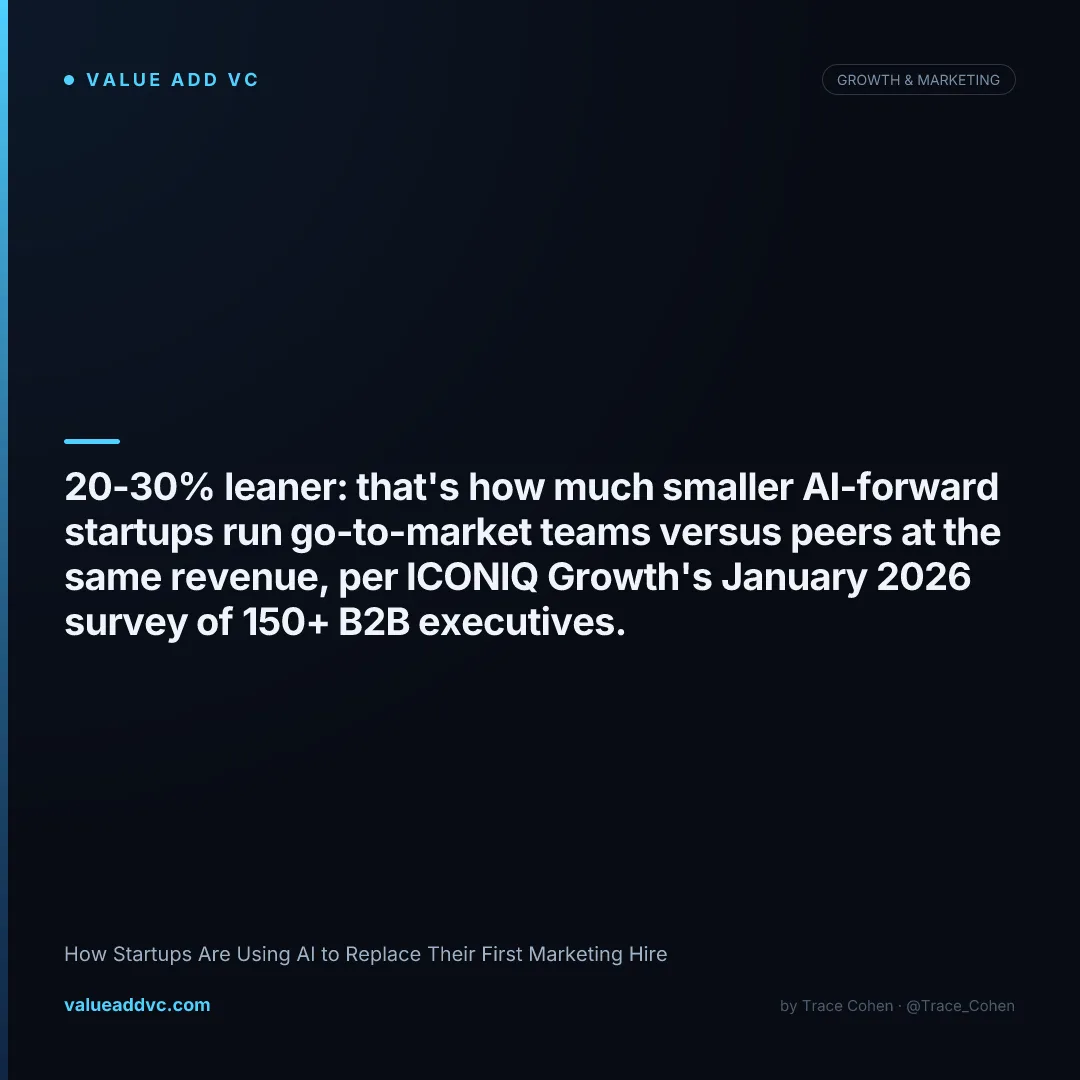
I don't think most startups need a dedicated marketing hire in year one anymore. AI-forward companies now run go-to-market teams 20-30% leaner than their peers at the same revenue stage, according to ICONIQ Growth's January 2026 survey of more than 150 B2B GTM executives, and they still generate roughly double the net-new revenue per person. The reason founders should delay that early marketing hire in 2026 isn't cash conservation, it's that a well-built AI stack now covers more of the actual job than most people assume.
How AI is replacing a startup's first marketing hire in 2026
AI-native go-to-market organizations run 20-30% leaner and roughly nine times flatter than traditional peers, while generating close to twice the net-new revenue per rep, according to ICONIQ Growth's State of Go-to-Market 2026 report, published in January 2026 from a survey of more than 150 B2B executives plus operating data across its own portfolio. Marketing is where that leverage shows up first, before sales or customer success.
I've watched this play out with founders I talk to directly: the generalist marketing hire that used to happen right after a startup's first few sales reps — someone to write the blog, run the email list, manage social, and build basic dashboards — keeps getting pushed later. It's not that founders don't value marketing. It's that a $50-700/month AI stack now does a credible version of that junior generalist's job, and the gap between "credible" and "good enough to ship" has closed faster than most hiring plans have caught up with.
Source: ICONIQ Growth, State of Go-to-Market 2026; HubSpot, 2026 State of Marketing Report.
What the leverage actually looks like at the ARR stage that matters
ICONIQ's data gets specific at the stage most seed and Series A founders care about: at $10M-$25M in annual recurring revenue, AI-forward companies run about 20 go-to-market full-time employees, versus 35 at lower-adoption peers doing comparable revenue — a 43% gap in headcount for the same output. That gap doesn't come from cutting marketing entirely; it comes from AI agents absorbing execution work (drafting, scheduling, first-pass analysis) so the humans on the team spend their time on ICP research, positioning, and partnerships instead.
SaaStr's coverage of the same ICONIQ data frames it as a structural shift in how go-to-market orgs are built, not a temporary cost-cutting move: companies with high AI adoption post roughly $640,000 in net-new ARR per go-to-market employee, against about $370,000 for low-adoption companies at the same stage. That's the part I think matters more than the headcount number itself — the AI-forward teams aren't just smaller, they're converting more revenue per person, which is a much harder thing to fake for a year or two before the math catches up with you.
This isn't isolated to marketing, and it isn't hypothetical
Forbes reported in June 2026 that AI-native startups operate at roughly 25% smaller headcount than non-AI peers in the same industry and cohort, citing Harvard Business School and INSEAD research, with flatter hierarchies and higher engineering density. And the labor-market effect isn't limited to startups: TechCrunch's running list of 2026 layoffs that name-checked AI includes Intuit's plan to cut about 3,000 jobs, roughly 17% of its workforce, as part of a restructuring toward AI-driven operations. None of this is about marketing specifically, but it's the same underlying force: work that used to require a headcount line now runs through a tool subscription instead.
On the marketing side specifically, HubSpot's own 2026 State of Marketing survey found 26.5% of marketers say AI has significantly increased their productivity, and another 66.2% say it's increased productivity slightly or moderately — putting the combined share above nine in ten. That's a company with an obvious incentive to talk up AI adoption among its own customer base, so I'd weight it a notch below the ICONIQ and Forbes data, but it's directionally consistent with everything else here.
Where I could be wrong
ICONIQ's own numbers contain the best counterargument to my own thesis. Marketing headcount isn't flat everywhere — at $10M-$25M in ARR it's still growing 23% year over year, and it's only at $250M-$500M in ARR and above that median marketing headcount growth flattens to roughly zero. Read plainly, that says the AI-replaces-the-first-hire pattern is really an early-stage phenomenon that fades once a company has found a repeatable motion worth scaling, not a permanent state where startups never need marketers. I'm generalizing from a below-$25M-ARR data point to a broader claim about "startups," and that's a real stretch.
There's also a selection-bias problem baked into this entire framing. Companies that show up as "AI-forward" in a survey like ICONIQ's are disproportionately the ones with founders technical enough to wire together an AI stack themselves, which likely correlates with other traits — stronger product instincts, tighter spending discipline — that would make them leaner and more capital-efficient with or without AI in the mix. Some of the leverage I'm crediting to AI tools is probably really about who chooses to run lean from the outset.
And the parts of the job that resist automation are exactly the parts that matter most once a startup has any real customer base: reading a confused prospect's tone on a call, deciding what NOT to say in a launch announcement, building the kind of relationship with a journalist or a design partner that turns into a reference customer. An AI stack can draft the email. It can't yet build the trust that makes someone open it.
Bottom line: the data backs the shift more than it backs a permanent verdict. AI-forward go-to-market teams really do run 20-30% leaner, put a smaller share of headcount into marketing (13% versus 17%), and generate close to double the revenue per person, per ICONIQ's January 2026 survey. But that same survey shows marketing headcount still climbing 23% at $10M-$25M in ARR, which tells me the honest thesis isn't "startups no longer need marketers," it's "startups can now delay that hire further into their growth than they used to, and should spend the extra runway proving the motion an eventual hire will scale."
Latest from the Pulse
Get VC data most people never see
— 100% free
Weekly benchmarks, valuations, and fund data. Join 5,000+ investors. No spam.